By Graham Fisher
Updated November 2026
Shopping for a 48V solar charge controller inverter means weighing battery chemistry, MPPT input capacity, inverter wattage and how well the unit handles a home load. This guide compares six integrated units from that angle. The selection criteria were built from published manufacturer specifications, brand reputation and the patterns owners commonly report: charge current, PV input voltage range, continuous inverter output, battery compatibility and built-in safety features. None of these units were bench-tested for this article.
Our top picks at a glance
- 1
 TOP CHOICEBest overallSolar Inverter 5000 Watt 48V to 120V, inbuilt 100A MPPT Solar ChargerView on Amazon
- 2
 TOP CHOICEBest for whole-home backupSUNGOLDPOWER 10000W 48V Solar Inverter Split Phase UL1741 SPH10048PView on Amazon
- 3
 TOP CHOICEBest for lithium and lead-acid mixed use5500W Hybrid Inverter 48V 110/120V Built-in 100A MPPT Home BackupView on Amazon
- 4
 Best for larger battery banksVEVOR Built-In 120A MPPT Hybrid Solar Inverter 6000W 48VView on Amazon
- 5
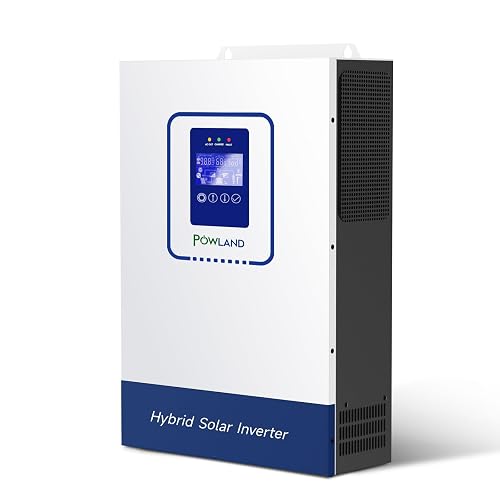 Best for RV and small home usePOWLAND 3600W Solar Inverter Pure Sine Wave 48V to 110V/120VView on Amazon
- 6
 Best budget pickY&H 6.2KW Hybrid Solar Inverter DC48V to AC220V Built-in 120A MPPTView on Amazon
Our Top Picks
| Product | Best for | Key feature |
|---|---|---|
| Solar Inverter 5000 Watt 48V to 120V | General off-grid use | Inbuilt 100A MPPT charger, up to 6 units in parallel |
| VEVOR 6000W Hybrid Solar Inverter | Larger battery banks | Built-in 120A MPPT with Wi-Fi |
| 5500W Hybrid Inverter 48V 110/120V | Mixed lithium and lead-acid batteries | Built-in 100A MPPT, LCD display |
| SUNGOLDPOWER 10000W 48V Solar Inverter | Whole-home backup | Two MPPTs, split-phase output |
| POWLAND 3600W Solar Inverter | RVs and small homes | Built-in 80A MPPT controller |
| Y&H 6.2KW Hybrid Solar Inverter | Budget-minded builds | Built-in 120A MPPT, dual AC output |
Solar Inverter 5000 Watt 48V to 120V, inbuilt 100A MPPT Solar Charger
Solar Inverter 5000 Watt 48V to 120V, inbuilt 100A MPPT Solar Charger, Max PV Input 5500W 500Vdc,Off Grid Pure Sine Wave Inverter Support up to 6 in Parallel for Lead Acid Lithium Battery
Best for: General off-grid use
This unit suits a DIY builder who wants a single box handling both battery charging from solar and 120V AC output for a modest household load.
Key specs
- 5000 W inverter output, 48V to 120V
- Inbuilt 100A MPPT solar charger
- Maximum PV input of 5500 W at 500 Vdc
- Pure sine wave output
- Supports up to 6 units in parallel
Pros
- High PV input headroom for array expansion
- Pure sine wave output suits sensitive electronics
- Parallel capability allows scaling later
Cons
- Owners often note that parallel setup requires careful configuration
- Limited detail on warranty terms in the listing
Bottom line: A strong general-purpose pick for someone building a moderate off-grid system who may grow the array later.
VEVOR Built-In 120A MPPT Hybrid Solar Inverter 6000W 48V
Built-In 120A MPPT Solar Charge Controller, with Wifi, Pure Sine Wave Inverter for Off-Grid System Lead Acid Lithium Battery VEVOR Hybrid Solar Inverter, 6000W 48V DC to Single Phase 220V / 230V AC
Best for: Larger battery banks
Best suited to a builder with a larger battery bank and a 220V/230V household load who wants Wi-Fi monitoring.
Key specs
- 6000 W, 48V DC to single-phase 220V/230V AC
- Built-in 120A MPPT solar charge controller
- Pure sine wave inverter
- Wi-Fi monitoring
Pros
- Higher charge current than most units in this list
- Wi-Fi allows remote monitoring
- Suits 230V households
Cons
- Owners sometimes report the app setup takes patience
- Heavier than smaller units, which affects mounting
Bottom line: Fits a 230V home with a substantial battery bank that needs fast recharge from solar.
5500W Hybrid Inverter 48V 110/120V Built-in 100A MPPT Home Backup
Supports LiFePO4 & Lead‑Acid Batteries. Multi‑Layer Safety Protection, LCD Display, Enables No‑Battery PV Direct Operation 5500W Hybrid Inverter 48V 110/120V AC Built‑in 100A MPPT Home Backup
Best for: Mixed lithium and lead-acid use
A good fit for someone who may switch battery chemistry or wants a unit that runs with or without a battery in PV direct mode.
Key specs
- 5500 W hybrid inverter, 48V, 110/120V AC output
- Built-in 100A MPPT controller
- Supports LiFePO4 and lead-acid batteries
- LCD display and multi-layer protection
Pros
- Works with both lithium and lead-acid chemistries
- Listing describes battery-free PV direct operation
- LCD display for quick status checks
Cons
- Battery-free operation is limited to daytime loads with solar available
- Wiring diagrams are not always clear to beginners
Bottom line: Suits a builder who wants flexibility on battery type and a clear status display.
SUNGOLDPOWER 10000W 48V Solar Inverter Split Phase UL1741 SPH10048P
SUNGOLDPOWER 10000W 48V Solar Inverter,Built-in 2 MPPTs, Max 200A Battery Charging, AC Input/Output 120V/240V(settable), Split Phase Pure Sine Wave Inverter(WiFi and BMS COMM) UL1741 SPH10048P
Best for: Whole-home backup
Designed for a larger home that needs split-phase 120V/240V output and a high-capacity battery charge rate.
Key specs
- 10000 W, 48V system
- Two built-in MPPT trackers
- Maximum battery charging of 200A
- Split-phase pure sine wave output, 120V/240V settable
- UL1741 listed per the model name
Pros
- Split-phase output suits typical US service panels
- Two MPPTs allow separate array strings
- High battery charge rate
Cons
- Installation complexity is higher than single-phase units
- Overkill for small cabins or RVs
Bottom line: The right choice for a full-size US home backup system with a proper battery bank and an electrician involved in the install.
POWLAND 3600W Solar Inverter Pure Sine Wave 48V to 110V/120V
POWLAND 3600W Solar Inverter, Pure sine Wave Inverter, 48V to 110V/120V, Built-in 80A MPPT Controller, Suitable for Homes, RVs, and can be Used with Lithium Lead-Acid Gel Battery Off-Grid Systems
Best for: RVs and small homes
A compact option for a cabin, shed or RV where wattage needs are moderate and space is tight.
Key specs
- 3600 W pure sine wave inverter
- 48V input, 110V/120V output
- Built-in 80A MPPT controller
- Compatible with lithium, lead-acid and gel batteries
Pros
- Smaller footprint than the 5000W+ units
- Battery chemistry flexibility
- Pure sine wave output
Cons
- 80A charge current limits fast recharge on large banks
- Lower wattage ceiling for power-hungry appliances
Bottom line: A sensible pick for a smaller off-grid space where a 3600W inverter covers the real load.
Y&H 6.2KW Hybrid Solar Inverter DC48V to AC220V Built-in 120A MPPT
Y&H 6.2KW Hybrid Solar Inverter DC48V to AC220V, Built-in 120A MPPT Controller,8000W 27A PV Input, Battery-Free Operatio, Dual AC Output, for 48V Lead/Li Battery,On/Off Grid Home Energy Storage System
Best for: Budget-minded builds
Suits a builder who wants a 120A MPPT controller and dual AC output without paying for premium brand features.
Key specs
- 6.2 kW hybrid inverter, DC 48V to AC 220V
- Built-in 120A MPPT controller
- 8000 W, 27A PV input rating
- Battery-free operation mode and dual AC output
Pros
- Strong charge current for the price tier
- Dual AC output adds flexibility
- Works with lead or lithium batteries
Cons
- Brand support and documentation are less established than larger names
- Owners sometimes report that settings require careful review before first use
Bottom line: A reasonable choice for a budget-conscious DIY system, provided the builder is comfortable checking settings carefully.
Buying Guide
Battery voltage and chemistry compatibility
All six units here are rated for 48V systems, but battery chemistry still matters. Lithium iron phosphate (LiFePO4) batteries require charge profiles that differ from flooded or AGM lead-acid. Confirm the unit lists your chemistry and that the charge voltage settings can be adjusted to match your battery manufacturer’s specifications.
Good picks for this: 5500W Hybrid Inverter 48V 110/120V; Solar Inverter 5000 Watt 48V to 120V
MPPT charge current rating
The MPPT rating (for example 80A, 100A or 120A) sets how fast the controller can push solar energy into the battery. A common planning rule is to check that the controller’s maximum charge current covers your battery bank’s recommended charge rate, and that the PV input voltage stays within the controller’s limit at your coldest expected temperature.
Good picks for this: VEVOR Hybrid Solar Inverter 6000W; SUNGOLDPOWER 10000W 48V Solar Inverter
Inverter continuous and surge wattage
Add up the continuous wattage of the loads you plan to run at the same time, then check that the inverter’s continuous rating exceeds that total with headroom. Motors and compressors draw a surge on startup, so confirm the surge rating too. Undersizing the inverter is one of the most common causes of shutdowns.
Good picks for this: POWLAND 3600W Solar Inverter; Y&H 6.2KW Hybrid Solar Inverter
Output waveform and voltage
Pure sine wave output is the safer choice for motors, medical equipment, variable-speed appliances and most electronics. Confirm the output voltage matches your appliances, whether 110V/120V or 220V/230V, and whether split-phase 120V/240V is needed for your service panel.
Good picks for this: SUNGOLDPOWER 10000W 48V Solar Inverter; VEVOR Hybrid Solar Inverter 6000W
Expansion and parallel operation
If you may add capacity later, check whether the unit supports parallel operation and how many units can be linked. Parallel setups require matching firmware and careful wiring, so plan the layout before buying the first unit.
Good picks for this: Solar Inverter 5000 Watt 48V to 120V; 5500W Hybrid Inverter 48V 110/120V
Protection features and monitoring
Look for overcurrent, short-circuit, over-temperature and battery low-voltage protection. LCD displays and Wi-Fi monitoring help you catch faults early. Built-in protections do not replace correctly sized fuses, breakers and grounding, which the system still requires.
Good picks for this: VEVOR Hybrid Solar Inverter 6000W; 5500W Hybrid Inverter 48V 110/120V
Installation environment and cooling
Inverters and MPPT controllers produce heat under load. Mount the unit on a non-combustible surface with clearance for airflow, and keep it out of direct sun and damp areas. Follow the manufacturer’s clearance specifications.
Good picks for this: POWLAND 3600W Solar Inverter; SUNGOLDPOWER 10000W 48V Solar Inverter
FAQ
Can one unit act as both a charge controller and an inverter?
Yes. Integrated or hybrid units combine an MPPT charge controller and a DC-to-AC inverter in one housing. They still need correctly sized DC and AC breakers, battery cables and grounding.
What size battery bank works with a 48V inverter?
There is no single answer. Size the bank from your daily energy use in watt-hours, your desired days of autonomy and the battery’s usable depth of discharge. Check the inverter’s maximum battery charge current to confirm the bank can absorb it.
Is a pure sine wave inverter necessary?
For most household electronics, yes. Modified sine wave output can cause motors to run hot and some electronics to behave unpredictably. All six units listed here are described as pure sine wave.
Can I use lithium and lead-acid batteries with the same unit?
Some units list support for both. You must still set the charge profile to match the battery type. Mixing chemistries on the same bank is not recommended.
Do I need an electrician to install one of these?
Many DIY builders install these systems, but a licensed electrician should review the design, especially for grid-tied or split-phase setups and for panel connections. Consult a qualified professional before connecting to your home wiring.
What is the difference between PV direct mode and battery mode?
In PV direct mode, solar power feeds loads during daylight without a battery in the loop, while battery mode stores energy for later use. Check the manual for how each mode behaves and how the unit transitions between them.
Conclusion
For a general off-grid build, the Solar Inverter 5000 Watt 48V to 120V offers a balanced feature set and room to grow. Builders who need larger charge current on a big bank should look at the VEVOR 6000W unit. For whole-home backup with split-phase output, the SUNGOLDPOWER 10000W is the strongest match on paper, though it requires more installation effort. The 5500W Hybrid Inverter suits anyone who wants chemistry flexibility, while the POWLAND 3600W fits smaller spaces. The Y&H 6.2KW is a reasonable budget-minded option if you are prepared to verify settings carefully. Always size the system from your actual loads and battery specifications, and have an electrician review the final wiring.
For related reading, see 5 Best Solar Charge Controller 48V for Off-Grid Systems (2026), 7 Best 48V Hybrid Solar Inverters for Off-Grid Homes (2026), 4 Best Solar Power Charge Controller Inverter Combos for Off-Grid Use (2026) and Solar Charge Controller DIY: Wire and Size One in 7 Steps.
Sources
- Background on solar energy systems, battery storage and off-grid planning (energy.gov)
- National Electrical Code guidance relevant to PV and battery wiring (nfpa.org)
- Safety certification standards such as UL 1741 for inverters (ul.com)
Before you buy: helpful guides
About Graham Fisher
Graham Fisher is part of our editorial team and reviews and edits our DIY solar power systems guides, checking product details against manufacturer specifications and owner feedback.