By Graham Fisher
Updated November 2026
A 60amp solar charge controller regulates current from your panels into your battery bank, and choosing the right one depends on battery chemistry, system voltage, and how much array you plan to connect. This list compares seven 60A units based on manufacturer specifications, brand reputation, and common owner feedback. Each pick is weighed against the selection criteria of MPPT operation, voltage support, input headroom, and monitoring options.
Our top picks at a glance
- 1
 TOP CHOICEBest overallPOWLAND 60A MPPT Solar Charge Controller,12V/24V/36V/48V Auto,Max InpuView on Amazon
- 2
 TOP CHOICEBest for lithium batteriesRenogy 60A MPPT Solar Charge Controller 12V/24V/36V/48V Auto, 150V MaxView on Amazon
- 3
 TOP CHOICEBest for Bluetooth monitoringBluetooth Charge Controllers for Solar Panels, Certified to UL1741 VicView on Amazon
- 4
 Best for timer control60A MPPT Solar Panel Charging Controller, 12V/24V Auto Solar Battery CView on Amazon
- 5
 Best for high-voltage arraysMPPT Solar Charge Controller 60AMP, for 12V/24V/36V/48V Auto, MAX 160VView on Amazon
- 6
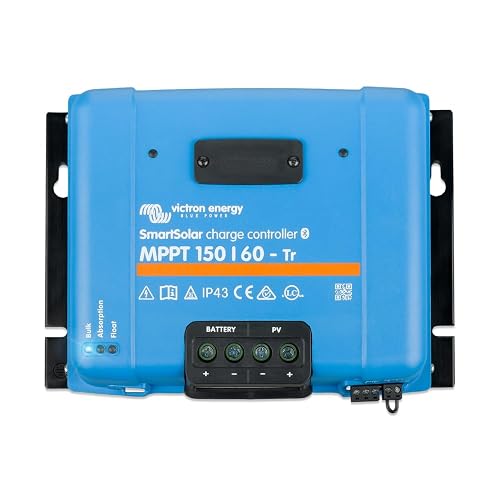 Best for Victron-style setupsBluetooth Solar Charge Controllers for Solar Panels, Certified to UL17View on Amazon
- 7
 Best for parallel expansionPowMr 60A MPPT Solar Charge Controller 12V/24V/48V, Solar Charge ContrView on Amazon
Our Top Picks
| Product | Best for | Key feature |
|---|---|---|
| POWLAND 60A MPPT | General DIY use | Auto 12V–48V detection |
| Renogy Rover Lite 60A | Lithium batteries | 150V maximum solar input |
| Victron SmartSolar 100V 50A | Bluetooth monitoring | Bluetooth app telemetry |
| 60A Charging Controller (Grey) | Timed charging | Timer on/off settings |
| MPPT 60AMP 160V Parallel | High-voltage arrays | 160V max input |
| Victron SmartSolar 150V 60A | Larger arrays | 150V input, 60A output |
| PowMr 60A MPPT | Parallel expansion | Up to 12 units in parallel |
POWLAND 60A MPPT Solar Charge Controller,12V/24V/36V/48V Auto,Max Input 150V LCD Display Regulator Intelligent Charge Controller for Sealed Gel AGM Flooded Lithium Battery
POWLAND 60A MPPT Solar Charge Controller,12V/24V/36V/48V Auto,Max Input 150V LCD Display Regulator Intelligent Charge Controller for Sealed Gel AGM Flooded Lithium Battery
Best for: General DIY use across common battery types
This unit suits builders who want automatic system voltage detection and an LCD readout without extra setup steps.
Pros
- Auto-detects 12V through 48V systems
- LCD display shows charging status
Cons
- Monitoring is limited to the onboard display
Renogy 60A MPPT Solar Charge Controller 12V/24V/36V/48V Auto, 150V Maximum Solar Input, for Gel Sealed Flooded and Lithium Battery, Rover Lite 60A
Renogy 60A MPPT Solar Charge Controller 12V/24V/36V/48V Auto, 150V Maximum Solar Input, for Gel Sealed Flooded and Lithium Battery, Rover Lite 60A
Best for: Lithium battery banks
Builders running LiFePO4 packs who want a charge profile designed for lithium chemistry will find this model a practical match.
Pros
- Supports sealed, flooded, and lithium battery types
- 150V maximum solar input for longer string lengths
Cons
- Owners often report the app and remote features need a separate accessory
Bluetooth Charge Controllers for Solar Panels, Certified to UL1741 Victron Energy SmartSolar MPPT Solar Charge Controller 100V, 50A, 12/24V
Bluetooth Charge Controllers for Solar Panels, Certified to UL1741 Victron Energy SmartSolar MPPT Solar Charge Controller 100V, 50A, 12/24V
Best for: Bluetooth monitoring and data logging
This Victron model fits builders who want to watch charge curves and battery voltage from a phone.
Pros
- Bluetooth app shows live charging data
- Listed to UL1741 for grid-interactive use
Cons
- 50A rating is below the 60A output of the other picks
60A MPPT Solar Panel Charging Controller, 12V/24V Auto Solar Battery Charger Controller with LCD Display, Dual USB Port and Timer Setting ON/Off Hours (Grey)
60A MPPT Solar Panel Charging Controller, 12V/24V Auto Solar Battery Charger Controller with LCD Display, Dual USB Port and Timer Setting ON/Off Hours (Grey)
Best for: Timed charging and USB device output
Smaller 12V and 24V builds that need scheduled on and off periods or USB charging ports will find this layout convenient.
Pros
- Timer setting for on and off hours
- Dual USB ports for small loads
Cons
- Listed for 12V and 24V only, not 48V
MPPT Solar Charge Controller 60AMP, for 12V/24V/36V/48V Auto, MAX 160V 2800W Input, 150V w/LCD Display, for Lead-Acid Lithium Battery — Parallel Version
MPPT Solar Charge Controller 60AMP, for 12V/24V/36V/48V Auto, MAX 160V 2800W Input, 150V w/LCD Display, for Lead-Acid Lithium Battery — Parallel Version
Best for: High-voltage array strings
Builders running longer panel strings who want headroom on input voltage and a parallel-capable design should consider this model.
Pros
- 160V maximum input with 2800W stated capacity
- Parallel version for multi-unit setups
Cons
- Owners sometimes report that the manual is brief on parallel wiring
Buying Guide
Battery Chemistry and Charge Profile
Make sure the controller supports your battery type, whether that is sealed gel, AGM, flooded lead-acid, or lithium. Each chemistry needs its own charge voltages, and a controller that lacks the right profile can shorten battery life. Lithium batteries in particular need a controller with a lithium setting or programmable voltage thresholds.
System Voltage and Auto-Detection
Check whether the unit supports the nominal voltage of your battery bank, such as 12V, 24V, 36V, or 48V. Controllers that auto-detect system voltage reduce setup errors, but it is still wise to confirm the detected voltage matches your wiring before connecting the array.
Maximum Solar Input Voltage and Array Headroom
The maximum input voltage limits how many panels you can wire in series. Leave a safety margin below the rated maximum, especially in cold climates where open-circuit voltage rises. Compare the wattage ratings at your system voltage to confirm the controller can handle your planned array size.
Monitoring, Displays, and Connectivity
An LCD display is useful for checking charge status on site, while Bluetooth or app-based monitoring makes it easier to track performance remotely. Choose the level of monitoring that fits how often you plan to check your system. Simpler units with basic displays can be enough for small, straightforward builds.
FAQ
Can a 60A controller handle a 48V battery bank?
Several models in this list support 48V operation with auto-detection, so a 60A unit can work with a 48V battery bank when the model lists that voltage. Always confirm the specific model supports your system voltage before buying. Also verify the maximum input voltage fits your panel configuration.
Is an MPPT controller better than a PWM controller for a 60A system?
MPPT controllers generally extract more energy from panels, especially when the panel voltage is higher than the battery voltage. For a system of this size, MPPT is usually the better choice when the array is large enough to benefit from the extra conversion efficiency. PWM units are simpler but tend to waste more energy in most DIY setups.
Do I need Bluetooth monitoring for a DIY solar system?
Bluetooth monitoring is not required, but it can help you spot charging problems and track battery health without going to the equipment. Many users find it valuable for larger or remote systems. A basic LCD display may be enough for a simple setup you check regularly in person.
Can I connect multiple 60A controllers in parallel?
Some models are designed for parallel operation, which can increase total charging capacity beyond a single unit’s rating. Check the manufacturer’s instructions for supported configurations and wiring requirements. Parallel setups should use the same model and matched wiring to avoid imbalance between units.
Conclusion
For most DIY builders with lead-acid or AGM batteries who want a straightforward, feature-rich controller, the POWLAND model is a practical starting point. Those running lithium batteries or who value a well-known brand and app-based control should look closely at the Renogy Rover Lite and the Victron SmartSolar options.
Builders who need parallel capacity or a larger array should focus on the models that explicitly support multiple units and higher input voltages. Match the controller’s battery profile, voltage support, and input headroom to your own system, and the right choice will follow.
Related reading
- Top 6 Wanderer Solar Charge Controllers Compared for DIY Systems
- Top 6 Solar 12V Charge Controller Options Compared for DIY Systems
- Top 6 MPPT Solar Charge Controllers for Lithium Batteries Compared
- Top 5 Solar Charge Controller Lithium Ion Battery Picks Compared (2026)
- Top 5 Rich Solar Charge Controllers Compared for DIY Systems
About Graham Fisher
Graham Fisher is part of our editorial team and reviews and edits our DIY solar power systems guides, checking product details against manufacturer specifications and owner feedback.