 By Claire Whitaker
Updated November 2026
Choosing an inverter for solar pump systems comes down to matching wattage, surge capacity and waveform to the motor you plan to run. The six models below were compared using manufacturer specifications, brand reputation and common owner feedback patterns, with an emphasis on pure sine wave output, surge rating, input voltage and built-in charging or control features.
Our top picks at a glance
- 1
 TOP CHOICEBest overallLCD Display, Dual AC and 20A Outlets, 2000W Pure Sine Wave InverterView on Amazon
- 2
 TOP CHOICEBest for higher surge loadsSurge 8000W Power Inverters with 4 AC OutletsView on Amazon
- 3
 TOP CHOICEBest for off-grid hybrid setupsSUMRY Hybrid Solar Inverter 4000W, 140A MPPT ControllerView on Amazon
- 4
 Best for mid-size pumps with remote controlLCD Display, 23 ft Wired Remote, 3000W Pure Sine Wave InverterView on Amazon
- 5
 Best for USB-charging extrasPower Inverters for Truck, Vehicles, Solar, Off-Grid 3000WView on Amazon
- 6
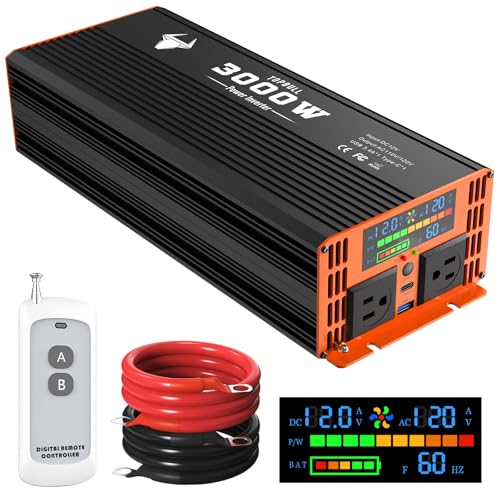 Best for light-duty and small pumpsSurge 6000W Power Inverter with 2 AC OutletsView on Amazon
Our Top Picks
| Product | Best for | Key feature |
|---|---|---|
| LCD Display 2000W Pure Sine Wave Inverter | Overall balance | Dual outlets, LCD display |
| Surge 8000W Power Inverter | High surge loads | 4 AC outlets, 8000W surge |
| SUMRY Hybrid Solar Inverter 4000W | Off-grid hybrid systems | Built-in 140A MPPT controller |
| LCD Display 3000W Pure Sine Wave Inverter | Mid-size pumps | 23 ft wired remote |
| Power Inverters for Truck, Solar, Off-Grid 3000W | Mixed device charging | 30W USB-C port |
| Surge 6000W Power Inverter | Light-duty pumps | 2 AC outlets, USB-A port |
LCD Display, Dual AC and 20A Outlets, 2000W Pure Sine Wave Inverter
LCD Display, Dual AC and 20A Outlets, 23ft Remote, Hardwire Port, USB, Power Inverter for Solar, RV Truck, 93% Max Efficiency 2000W Pure Sine Wave Inverter 12V DC to 120V AC, 4000W Surge
Best for: Overall balance of output and controls
This suits shallow-well or small irrigation pumps on a 12V battery bank where you want a readable status display and two AC outlets.
Pros
- Pure sine wave output suits most motor-driven pumps
- LCD display shows input voltage and load
Cons
- Continuous rating may be tight for larger submersible pumps
Surge 8000W Power Inverters with 4 AC Outlets
Surge 8000W Power Inverters with 4 AC Outlets, Hardwire Port, 30W Type-C, 5V/3.1A USB, Remote Control for Solar, RV, Truck 4000 Watt Inverter Pure Sine Wave 12V DC to 110/120V AC for Home
Best for: High surge loads
A fit for systems where pump startup surge is the main sizing concern and you want four outlets on one unit.
Pros
- Large surge rating helps pumps with high starting current
- Four AC outlets and remote control
Cons
- Large footprint and heavy cabling needs
SUMRY Hybrid Solar Inverter 4000W, 140A MPPT Controller
Glass Top Cover with LCD Display, 140A MPPT Charge Controller, Supports Battery-less or AGM Lithium Battery, Off Grid SUMRY Hybrid Solar Inverter, 4000W DC24V to AC120V Pure Sine Wave Power
Best for: Off-grid hybrid systems
Designed for builders who want a single unit handling charge control and AC output for a 24V off-grid pump system.
Pros
- Integrated 140A MPPT charge controller
- Supports lithium or AGM batteries per listing
Cons
- Requires a 24V battery bank, which limits swaps
LCD Display, 23 ft Wired Remote, 3000W Pure Sine Wave Inverter
LCD Display, 23 ft Wired Remote, Dual AC and 20A Outlets, Hardwire Port, USB, Power Inverter for Solar, Off-Grid, RV, Truck 3000W Pure Sine Wave Inverter 12V DC to 120V AC, 6000W Peak
Best for: Mid-size pumps with remote control
Suited to pumps that need to be started from a distance, such as a barn or garden well away from the battery bank.
Pros
- 23 ft wired remote for placement flexibility
- Hardwire port for permanent installs
Cons
- Wired remote limits how far you can mount it
Power Inverters for Truck, Vehicles, Solar, Off-Grid 3000W
LANDERPOW 3000W Pure Sine Wave Inverter 12V DC to 120V AC 6000W Peak for RV | Power Inverters for Truck, Vehicles, Solar, Off-Grid with 3 AC Outlets, 30W USB-C, 5V/3.1A USB, Hardwire Port, Remote Cont
Best for: Mixed device charging
Useful when the pump shares the system with phones, lights or tools that need USB charging.
Pros
- 30W USB-C plus 5V/3.1A USB outputs
- Three AC outlets and remote control
Cons
- Peak rating needs checking against pump startup current
Surge 6000W Power Inverter with 2 AC Outlets
3000 Watt Power Inverter 12V DC to 120V/110V AC for Vehicles Car Converter | RV, Truck, Solar, Home, Off-Grid Surge 6000W with 2 AC Outlet, USB-A Port, LCD Display, Remote Control and Cable Included
Best for: Light-duty and small pumps
A reasonable fit for small garden or stock-tank pumps on a modest 12V system.
Pros
- Compact, with USB-A and two AC outlets
- Remote control and cable included
Cons
- Lower continuous rating than the larger units above
Buying Guide
Match continuous wattage to pump nameplate
Add the pump’s running watts and leave headroom of at least 20 percent. Undersized inverters overheat or shut down under load.
FAQ
Can any inverter run a solar pump?
Not every inverter is suited to pump motors. Pumps often need a pure sine wave output and enough surge capacity to get the motor started, so check the inverter’s rated continuous wattage and surge rating against the pump nameplate before buying.
Why does a pump need more power at startup?
Motors draw a short burst of current when they start, often several times their running load. An inverter with a higher surge rating can handle that startup spike without shutting down, which is why surge capacity matters as much as continuous wattage.
Is a pure sine wave inverter necessary for a water pump?
For most submersible and AC pumps, pure sine wave output is strongly recommended because it runs motors more smoothly and with less heat than modified sine wave output. Some simple motors may tolerate modified sine wave, but pure sine wave is the safer choice for longevity.
What is the difference between a standard inverter and a hybrid solar inverter?
A standard inverter converts DC battery power to AC power only. A hybrid solar inverter adds a built-in charge controller so it can manage solar panels and batteries together, which simplifies off-grid setups that need both conversion and charging in one unit.
Should I size the inverter to exactly match the pump wattage?
It is better to leave some margin above the pump’s running wattage, along with enough surge headroom for startup. Running an inverter close to its maximum rating can reduce efficiency and lifespan, so a little extra capacity is generally a good idea.
Do I need a battery bank with these inverters?
Most of these inverters run off a 12V or 24V DC battery source, so a battery bank is typically part of the system. The battery size should be chosen based on how long you need to run the pump and the total energy it draws, not just the inverter rating.
Conclusion
For most off-grid pump setups with moderate loads, the 2000W or 3000W pure sine wave models offer a practical balance of capacity and price. If your pump has a high startup surge or you plan to run additional equipment, the 8000W surge model or the 4000W hybrid unit with built-in MPPT charging will better suit larger, more demanding systems.
Buyers with smaller pumps or tight budgets can start with the 2000W or 6000W surge options, while those building a complete solar-powered off-grid system should consider the hybrid SUMRY unit to simplify charging and conversion. Always confirm the pump’s continuous and startup wattage before making a final choice.
Related reading
- Top 6 Solar Inverters for Power Outage Picks for Home Backup
- Top 6 Solar Inverter Off Grid Options Compared for Homes
- Top 6 3 Phase Solar Power Inverters Compared for Commercial and Off-Grid Use
- Top 5 String Inverters for Solar Systems Compared for Homes (2026)
- Top 5 Solar Inverter Without Batteries Compared for Off-Grid Use (2026)
About Claire Whitaker
Claire Whitaker is part of our editorial team and reviews and edits our DIY solar power systems guides, checking product details against manufacturer specifications and owner feedback.


