 By Ethan Brooks
Updated November 2026
A residential off grid solar system has to match your household’s daily energy use, your battery reserve and the inverter voltage your appliances need. This list compares seven complete kits on those criteria: total panel wattage, battery capacity in kWh, split-phase or single-phase output, and how well each package covers a whole house versus a partial load. Product details come from manufacturer listings and common owner feedback, not from our own testing.
Our top picks at a glance
- 1
 TOP CHOICEBest overallECO-WORTHY 10KW Output Off Grid Solar System Complete KitView on Amazon
- 2
 TOP CHOICEBest for whole-house backupECO-WORTHY Whole House System 10KW Split PhaseView on Amazon
- 3
 TOP CHOICEBest for small homesSUNGOLDPOWER 5000W 48V Off Grid System Complete Solar KitView on Amazon
- 4
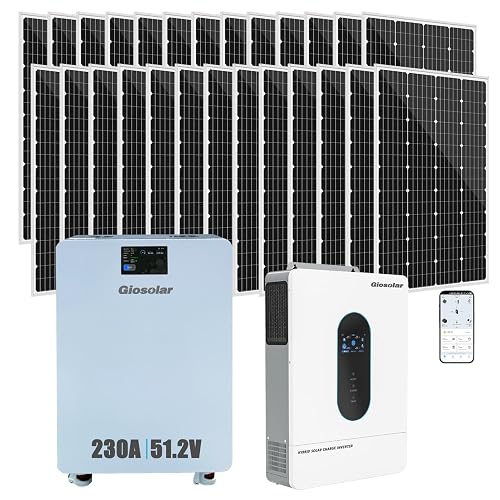 Best for high-demand homes12000W Solar Power System Kit with Hybrid InverterView on Amazon
- 5
 Best for mid-size loadsECO-WORTHY 10KW Solar Panel KitView on Amazon
- 6
 Best for a 5 kW budget buildOff Grid Solar Panle Kit with Battery & Inverter:12x195W Panels, 48V 5View on Amazon
- 7
 Best for learning the designThe DIY Off Grid Solar Power Bible: [10 in 1] The Most Complete and UpView on Amazon
Our Top Picks
Quick Comparison
| Product | Best for | Key feature |
|---|---|---|
| ECO-WORTHY 10KW Output Off Grid Solar System Complete Kit | Whole-home loads | 20.48kWh battery storage |
| ECO-WORTHY Whole House System 10KW Split Phase | Whole-house backup | 16kWh battery, split phase |
| SUNGOLDPOWER 5000W 48V Off Grid System Complete Solar Kit | Small homes | 5000W inverter, 100Ah battery |
| 12000W Solar Power System Kit | High-demand homes | 12kW hybrid inverter |
| ECO-WORTHY 10KW Solar Panel Kit | Mid-size loads | 2340W panels, 10.24kWh |
| ECO-WORTHY 5KW Off Grid Solar System Complete Kit | Budget 5 kW builds | Compact 5 kW package |
| The DIY Off Grid Solar Power Bible | Learning the design | Sizing and wiring guide |
ECO-WORTHY 10KW Output Off Grid Solar System Complete Kit
ECO-WORTHY 10KW Output Off Grid Solar System Complete Kit:10KW 120V/240V Output Split Phase Inverter| 4Pcs 48V 100Ah 20.48kWh High Capacity Energy Storage| 5310 Watts Solar Panel PV
Best for: Whole-home loads with large daily consumption.
This kit suits households that run electric heat pumps, electric ranges or multiple large appliances and want a 120V/240V split-phase setup.
Pros
- Pairs a 10 kW split-phase inverter with 20.48 kWh of battery storage.
- Panel array of about 5.3 kW gives generous daily production.
Cons
- Large footprint and wiring effort may exceed a first-time DIY builder’s comfort.
ECO-WORTHY Whole House System 10KW Split Phase
Whole House System:10KW 120V/240V Split Phase Solar Inverter| 48V 314Ah 16kWh High Capacity Energy Storage| 2950W Solar Panel ECO WORTHY 10000W Output Complete Off-Grid Solar Panel Kit for Home
Best for: Whole-house backup during outages.
Homeowners who want the system to carry the whole panel rather than a few circuits will find this layout practical.
Pros
- Split-phase 120V/240V output suits standard US service panels.
- Single 16 kWh battery bank keeps the wiring simpler.
Cons
- Panel wattage of about 2.95 kW is modest for full-time off-grid use in cloudy regions.
SUNGOLDPOWER 5000W 48V Off Grid System Complete Solar Kit
SUNGOLDPOWER 5000W 48V Off Grid System Complete Solar Kit,1 * 5000W 120Vac Solar Inverter UL1741+6 * 200W Mono Solar Panels +1 * 100Ah 51.2V Lifepo4 Battery UL1973, for House Storage (SGM-5K5E)
Best for: Small homes and cabins with moderate loads.
A good fit for a cabin or small house that runs lighting, a refrigerator, a well pump and some electronics.
Pros
- Single 5000W 120V inverter keeps setup straightforward.
- LiFePO4 battery is a stable chemistry for daily cycling.
Cons
- One 100Ah battery limits overnight runtime for larger loads.
12000W Solar Power System Kit with Hybrid Inverter
12000W Solar Power System Kit: 12KW 48V Split Phase Hybrid Solar Inverter with Dual 200A MPPT & WiFi, 12KWh 51.2V 230Ah Battery, 26pcs 120W Rigid Solar Panels for Home Off-Grid/Backup Power
Best for: High-demand homes that need large surge capacity.
Suited to homes with electric vehicle charging or multiple heat pumps that draw heavily during peak hours.
Pros
- 12 kW split-phase hybrid inverter with dual MPPT charge controllers.
- Large 12 kWh battery and 26-panel array handle substantial daily loads.
Cons
- Requires careful sizing and professional-level wiring; a licensed electrician should review the install.
ECO-WORTHY 10KW Solar Panel Kit
Solar Panel Kit:12PCS 195W Solar Panels(2340W)+2PCS 48V 100AH Cubix Lithium Battery(10.24kWh)+10KW Solar Inverter 120V/240V ECO-WORTHY 10KW Output 9.36KWH Off Grid Solar System Complete Kit for Home
Best for: Mid-size loads and a balanced panel-to-battery ratio.
A sensible middle option for households that want more storage than a 5 kW kit provides without the scale of a 12 kW system.
Pros
- Twelve 195W panels total 2340W with 10.24 kWh of battery.
- Split-phase 10 kW inverter matches standard US service.
Cons
- Panel array is on the smaller side for winter production in northern latitudes.
Buying Guide
Match Panel Wattage to Your Daily Energy Use
Start with your average daily kilowatt-hour use, which you can find on a utility bill. Solar panel kits are sized in total watts, and your array needs to produce enough energy across a typical day, including some margin for cloudy weather and seasonal drops in sunlight.
Check Battery Capacity and Chemistry
Battery capacity in kWh determines how long your home can run overnight or during a outage. Lithium iron phosphate (LiFePO4) batteries are common in these kits because they tolerate many charge cycles and are generally safer than some older chemistries. Compare the listed capacity against the energy you need to store, not just the peak power rating.
Confirm Inverter Output and Voltage
Look at whether the inverter provides split-phase 120V/240V output or single-phase 120V output. Split-phase systems are better suited to whole-house use, including large appliances like electric dryers, well pumps and central air conditioning. Make sure the inverter’s continuous and surge ratings can handle your heaviest loads.
Decide Between a Whole-House and Partial-Load System
A whole-house kit can power most of your home, but it usually costs more and needs more installation work. A smaller partial-load kit can cover essentials like lights, refrigeration, internet and a few outlets, which may be enough for a cabin, workshop or backup setup. Be honest about which loads you truly need to keep running.
Plan for Installation and Local Requirements
Residential off grid systems often require mounting hardware, wiring, grounding and sometimes a permit or inspection, depending on where you live. Consider whether you have the skills to install the kit yourself or whether you will need a licensed electrician or solar installer. Check the included cables, mounting components and warranty terms before you buy.
FAQ
How much solar power do I need for a home off grid system?
The right size depends on your household’s daily kilowatt-hour use and how many sunny hours your location gets. Add up your essential loads, then size the panel array and battery bank to cover them with some extra capacity for cloudy days. A licensed installer or a sizing calculator can help you refine the numbers.
Can an off grid kit power an entire house?
Some larger kits with split-phase inverters and higher battery capacity are designed to support whole-house loads. Heavy appliances such as electric heat, large air conditioners and well pumps may require careful load management. Review the inverter’s ratings and your actual appliance list before assuming full coverage.
How long will the battery last?
Battery lifespan depends on the chemistry, depth of discharge, temperature and how many charge cycles you run each year. LiFePO4 batteries are typically rated for thousands of cycles under moderate use. Check the manufacturer’s warranty and cycle rating for the specific battery in your kit.
Do I need a professional to install a residential off grid system?
Many homeowners with electrical experience install smaller kits themselves, but larger systems with split-phase output and battery banks often benefit from professional help. Local codes may require permits, inspections or licensed electrical work. When in doubt, consult a licensed electrician or solar installer before connecting the system to your home wiring.
Is an off grid system worth it compared to a grid-tied system?
An off grid system makes sense if you want independence from the utility, live in a remote area without grid access, or need reliable backup during outages. A grid-tied system with battery backup may be more cost-effective if your utility service is reliable. Weigh your goals, budget and local net-metering rules before choosing.
Conclusion
For most homeowners wanting a complete, expandable setup, the ECO-WORTHY 10KW Output Off Grid Solar System Complete Kit and the ECO-WORTHY Whole House System are the strongest options, with the Whole House System better suited to full-home coverage. If you need a more modest system for a cabin, workshop or essential loads, the SUNGOLDPOWER 5000W kit or the ECO-WORTHY 5KW kit is a practical starting point.
Choose the 12000W hybrid kit or the 10KW panel kit if you need higher output and larger battery reserves, and treat the DIY guide as a helpful companion for planning and maintenance rather than a system on its own. Match the kit to your real daily energy use, and confirm local installation requirements before you buy.
Related reading
- Wiring Diagram for Off-Grid Solar System: A Step-by-Step Guide
- Wind Solar Hybrid Off Grid System: How to Size and Wire One
- Whole House Off-Grid Solar System: Sizing Steps and Parts for Your Home
- What Is Needed for Off-Grid Solar System: A Step-by-Step Parts Checklist
About Ethan Brooks
Ethan Brooks is part of our editorial team and reviews and edits our DIY solar power systems guides, checking product details against manufacturer specifications and owner feedback.

