 By Graham Fisher
Updated November 2026
Choosing a bougerv mppt solar charge controller 40a comes down to three things: whether it matches your battery chemistry and system voltage, whether its 40-amp rating leaves enough headroom for your array, and whether the features you actually need, such as Bluetooth monitoring or a clear display, are included. The picks below were chosen by reviewing manufacturer specifications, overall brand reputation in the off-grid community, and the patterns that owners commonly report in their feedback. None of them were bench-tested for this article.
Our top picks at a glance
- 1
 TOP CHOICEBest overallRenogy Rover MPPT Solar Charge Controller with Bluetooth 40A 12V/24VView on Amazon
- 2
 Best for lithium-focused buildsRenogy Charge Controller-Rover 40A MPPT 12V/24V Auto-Detect LCD DisplayView on Amazon
- 3
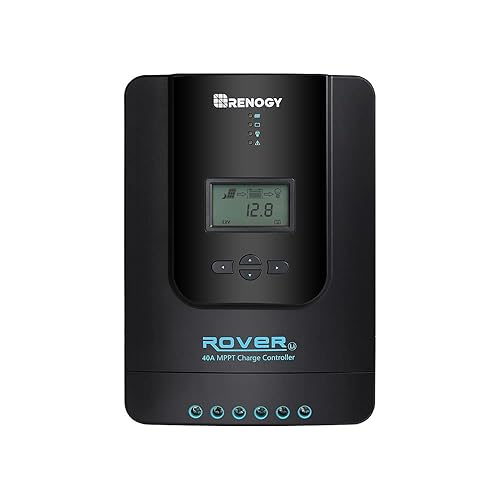 Best budget pickRenogy Solar Charge Controller Rover 40A 12V24V Auto Parameter DC Input MPPTView on Amazon
- 4
 Best for mixed battery typesACOPOWER Midas 40A MPPT Solar Charge ControllerView on Amazon
Our Top Picks
The table below gives a quick overview. Each product gets a fuller write-up beneath it.
| Product | Best for | Key feature |
|---|---|---|
| Renogy Rover MPPT Solar Charge Controller with Bluetooth 40A 12V/24V | Overall use with app monitoring | Bluetooth monitoring |
| Renogy Charge Controller-Rover 40A MPPT 12V/24V Auto-Detect LCD Display | Lithium-focused builds | Dual-peak tracking and Modbus support |
| Renogy Solar Charge Controller Rover 40A 12V24V Auto Parameter DC Input MPPT | Budget-conscious builders | Adjustable LCD and auto parameter detection |
| ACOPOWER Midas 40A MPPT Solar Charge Controller | Mixed battery types | Compatible with AGM, lithium and LiFePO4 |
Renogy Rover MPPT Solar Charge Controller with Bluetooth 40A 12V/24V
Renogy100V PV input,AGM/Gel/Flooded (auto), Li (manual), MPPT 99%,overcharge/short protection, negative ground,Bluetooth monitoring Rover MPPT Solar Charge Controller with Bluetooth 40A 12V/24V If you want more background, see How Solar Generators Work: Battery, Inverter and Charge Controller Explained.
Best for: Overall use with app monitoring
This suits DIYers who want to watch battery voltage, charge current and array output from a phone instead of walking out to a wall-mounted display. It is a strong all-round choice for a 12V or 24V system in the 40-amp class.
Key specs:
- Rated 40A output at 12V or 24V nominal system voltage
- MPPT tracking with a stated efficiency of around 99%
- Supports AGM, gel, flooded and lithium batteries (lithium set manually)
- Bluetooth monitoring
- Negative ground configuration
Pros:
- Bluetooth lets you check system status remotely from your phone
- Automatic battery-type detection for lead-acid chemistries
- Overcharge and short-circuit protection are included
Cons:
- Lithium battery setting has to be configured manually
- Bluetooth range is limited, so remote monitoring is best kept to nearby locations
Bottom line: A good first pick for a 12V or 24V system that benefits from app-based monitoring and a standard lead-acid or lithium setup.
Renogy Charge Controller-Rover 40A MPPT 12V/24V Auto-Detect LCD Display
Renogy Charge Controller-Rover 40A MPPT 12V/24V Auto-Detect LCD Display | 99.9% Efficiency for Gel/Flooded/Lithium Batteries | Dual-Peak Tracking & Modbus Support
Best for: Lithium-focused builds
This model is aimed at builders running gel, flooded or lithium batteries who want an on-unit LCD and support for dual-peak tracking. It fits well in systems where partial shading or changing sun angles make tracking performance matter.
Key specs:
- 40A rated output, 12V/24V auto-detect
- LCD display on the unit
- Dual-peak tracking
- Modbus support for integration with monitoring systems
- Listed for gel, flooded and lithium batteries
Pros:
- Dual-peak tracking helps when the array sees uneven light
- Modbus support is useful for logging data into a larger monitoring setup
- On-unit LCD gives status without needing a phone
Cons:
- Advanced features add setup steps that may be more than a simple system needs
- Owners sometimes mention that the menus take time to learn
Bottom line: The right choice for lithium or mixed-chemistry builds where you want on-unit readouts and advanced tracking options.
Renogy Solar Charge Controller Rover 40A 12V24V Auto Parameter DC Input MPPT
Renogy Solar Charge Controller Rover 40A 12V24V Auto Parameter DC Input MPPT Charge Controllers for Solar Panels Adjustable LCD for Gel Sealed Flooded Lithium Battery
Best for: Budget-conscious builders
This is a straightforward Rover-series unit for DIYers who want a dependable 40-amp MPPT controller without extra connectivity features. It works well for a small cabin, RV or shed system with a conventional lead-acid battery bank.
Key specs:
- 40A rated output, 12V/24V
- DC input with auto parameter detection
- Adjustable LCD
- Gel, sealed, flooded and lithium battery compatibility
Pros:
- Simple setup for standard lead-acid batteries
- Adjustable LCD gives a clear view of charge state
- Well-known product family with plenty of wiring examples online
Cons:
- No Bluetooth, so monitoring means being near the unit
- Lithium configuration requires manual adjustment of charge parameters
Bottom line: A practical pick for builders who want a proven 40A MPPT controller with a clear display and no need for wireless features.
ACOPOWER Midas 40A MPPT Solar Charge Controller
ACOPOWER Midas 40A MPPT Solar Charge Controller – Charge Controllers for Solar Panels – 100V, 40 Amp, 12/24V, Negative Ground, Compatible with AGM, Lithium, and LiFePO4 Batteries
Best for: Mixed battery types
The Midas is a good fit for systems that may change battery chemistry over time, or for users who want a single controller that lists AGM, lithium and LiFePO4 compatibility on the same unit.
Key specs:
- 40A rated output
- 100V maximum PV input
- 12V/24V system voltage
- Negative ground
- Compatible with AGM, lithium and LiFePO4 batteries
Pros:
- Lists several battery chemistries on one controller
- 100V input rating gives room for higher-voltage strings
- Negative ground setup matches common DIY wiring
Cons:
- Owners sometimes report that documentation is less detailed than larger brands
- Fewer built-in monitoring options than Bluetooth-equipped models
Bottom line: Best for builders who want one controller that covers several battery types and can accept a wider PV input range.
Buying Guide
System voltage and battery chemistry
Confirm whether your battery bank is 12V or 24V before buying. Most 40-amp MPPT controllers in this class support both, but auto-detection and manual lithium settings differ between models. Lithium batteries generally need a charge profile that matches the manufacturer’s voltage limits, so check that the controller offers a lithium setting or lets you set custom voltages.
Good picks for this: Renogy Charge Controller-Rover 40A MPPT 12V/24V Auto-Detect LCD Display, ACOPOWER Midas 40A MPPT Solar Charge Controller
Output current and array headroom
A 40A rating is the maximum charge current the controller can deliver to the battery, not the size of array it can handle. To estimate the array you can use, multiply the panel wattage by the number of panels, divide by the nominal battery voltage, and then compare the result against 40A with a margin. Keeping the charge current comfortably below the rating leaves room for temperature derating and future expansion.
Good picks for this: Renogy Rover MPPT Solar Charge Controller with Bluetooth 40A 12V/24V, Renogy Solar Charge Controller Rover 40A 12V24V Auto Parameter DC Input MPPT
PV input voltage limit
Check the maximum PV open-circuit voltage the controller accepts. Series-connected panels add their voltages together, and a cold morning can push open-circuit voltage above the nominal rating. Staying under the controller’s input limit with a margin for cold temperatures prevents damage. Manufacturers typically specify this limit clearly, so confirm it against your planned string layout.
Good picks for this: ACOPOWER Midas 40A MPPT Solar Charge Controller, Renogy Charge Controller-Rover 40A MPPT 12V/24V Auto-Detect LCD Display
Monitoring and display
Decide how you want to check system status. An on-unit LCD works well for a controller mounted near the batteries. Bluetooth or other wireless monitoring is useful when the controller sits in a closed enclosure or a hard-to-reach location. Some builders also want data logging or integration with a larger monitoring system, so look for protocol support if that matters to you.
Good picks for this: Renogy Rover MPPT Solar Charge Controller with Bluetooth 40A 12V/24V, Renogy Charge Controller-Rover 40A MPPT 12V/24V Auto-Detect LCD Display
Protection features
Look for overcharge protection, short-circuit protection, reverse-current protection and temperature compensation. These features protect the battery and the wiring if something goes wrong. Confirm that the controller lists the protections you need rather than assuming them.
Good picks for this: Renogy Rover MPPT Solar Charge Controller with Bluetooth 40A 12V/24V, Renogy Solar Charge Controller Rover 40A 12V24V Auto Parameter DC Input MPPT
Wiring and grounding
Check the grounding configuration before wiring. Most of these controllers are listed for negative ground systems, which matches common RV and off-grid DC setups. Mixing grounding schemes causes problems, so verify your inverter and other components use the same convention. Size the battery and array cables for the actual current, and fuse each battery and PV conductor close to its source.
Good picks for this: ACOPOWER Midas 40A MPPT Solar Charge Controller, Renogy Solar Charge Controller Rover 40A 12V24V Auto Parameter DC Input MPPT
Mounting, ventilation and care
MPPT controllers produce heat under load, so mount them on a vertical surface with clear airflow above and below. Keep them away from batteries that vent gas, and avoid enclosing them in sealed boxes without ventilation. Periodically check terminals for tightness and look for signs of corrosion, especially in humid or marine environments. Consult a qualified electrician or solar installer if your system connects to a home electrical panel.
Good picks for this: Renogy Rover MPPT Solar Charge Controller with Bluetooth 40A 12V/24V, Renogy Charge Controller-Rover 40A MPPT 12V/24V Auto-Detect LCD Display
FAQ
Is a 40A MPPT controller enough for a 12V system?
It depends on the array. Divide the total panel wattage by the battery voltage and compare the result against 40A, leaving a margin. A 40A controller on a 12V system can handle roughly 500 to 550 watts of panels at full output, which is a useful starting estimate rather than a hard limit.
Can I use this controller with lithium batteries?
Several of these models list lithium compatibility. Some require manual configuration of charge voltages, so set the values according to the battery manufacturer’s specifications before connecting the battery.
What is the difference between MPPT and PWM?
MPPT controllers track the array’s maximum power point and convert excess voltage into additional charge current, which usually gives more energy harvest than PWM, especially when the panel voltage is well above battery voltage. PWM is simpler and sometimes cheaper, but it typically wastes more of the array’s output.
Do I need Bluetooth on my charge controller?
No, but it helps if the controller is mounted in a location you do not visit often. An on-unit display gives the same information when you are standing next to it.
Can the controller handle two battery voltages?
The auto-detect models can identify 12V or 24V systems, but the system voltage still has to match your battery bank. Do not connect a 12V battery to a system configured for 24V.
How do I wire the controller safely?
Connect the battery first so the controller powers up and detects system voltage, then connect the PV array. Disconnect in reverse order. Fuse the battery and PV conductors, and follow the manufacturer’s wiring diagram. Have a qualified electrician review the installation if you are unsure.
Will a 40A controller work with a 60A or larger system?
No. A 40A controller limits current to 40A, so a larger array will not charge faster than the rating allows. For larger systems, choose a controller rated for the higher current or use multiple controllers.
Conclusion
For most builders, the Renogy Rover MPPT Solar Charge Controller with Bluetooth 40A 12V/24V is the most versatile starting point, thanks to its app monitoring and general-purpose setup. Builders focused on lithium batteries or who want on-unit tracking detail should look at the Renogy Charge Controller-Rover 40A MPPT 12V/24V Auto-Detect LCD Display. The Renogy Solar Charge Controller Rover 40A 12V24V Auto Parameter DC Input MPPT suits budget-minded lead-acid systems, and the ACOPOWER Midas 40A MPPT Solar Charge Controller fits mixed battery setups with a wider PV input range. Check your system voltage, array size and battery chemistry first, then match the features to those numbers.
Sources
- Federal guidance on solar energy systems, including basic system components and how they work together (energy.gov)
- National Fire Protection Association standards relevant to electrical installations and wiring safety (nfpa.org)
- Product safety certification information and how listed electrical equipment is evaluated (ul.com)
Before you buy: helpful guides
- Solar Charge Controller DIY: Wire and Size One in 7 Steps
- Solar Charge Controller Lithium Ion: How to Choose and Wire One (Step-by-Step)
- Solar Charge Controller 100 Amp: How to Size and Wire One Safely
- Solar Charge Controller Repair: A Step-by-Step Guide for DIY Builders
- Solar Charge Controller 20 Ampere: How to Size and Wire One (2026)
Related reading
About Graham Fisher
Graham Fisher is part of our editorial team and reviews and edits our DIY solar power systems guides, checking product details against manufacturer specifications and owner feedback.


