 By Graham Fisher
Updated November 2026
Choosing an mppt solar charge controller 48v 100a is less about finding the biggest number on the box and more about matching the controller’s input voltage, charge current and battery chemistry to your array and battery bank. This list focuses on units that auto-detect a 48V system, handle up to 100 amps of charge current, and offer a readable display, multiple battery profiles and enough PV input headroom for a typical off-grid array. Each pick is judged on published specifications, brand reputation and common owner feedback patterns.
Our top picks at a glance
- 1
 TOP CHOICEBest overallUpgraded 100A MPPT Solar Charge Controller 12V 24V 36V 48V (Best overall)View on Amazon
- 2
 TOP CHOICEBest for parallel battery banksPowMr 100A MPPT Solar Controller, 12V/24V/36V/48V AutoView on Amazon
- 3
 TOP CHOICEBest for lithium-focused setupsUpgraded 100A MPPT Solar Charge Controller 12V 24V 36V 48V LCD DisplayView on Amazon
- 4
 Best for app monitoring100A MPPT Solar Charge Controller, 250VDC Max PV Input, 99.9% EfficiencyView on Amazon
- 5
 Best budget pickSolar Charge Controller 100A 12V 24V 36V 48V Intelligent Recognition (SA100A)View on Amazon
- 6
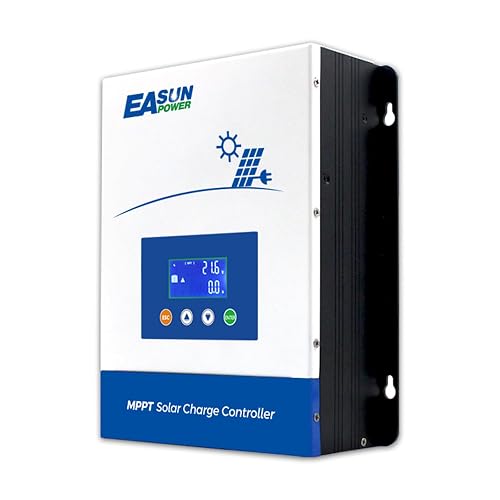 Best for high-voltage arraysPOWLAND 100A MPPT Solar Charge Controller, 12V/24V/36V/48V AutoView on Amazon
Our Top Picks
Before the individual reviews, here is how the six compare on the features that matter most for a 48V, 100A build.
| Product | Best for | Key feature |
|---|---|---|
| Upgraded 100A MPPT Solar Charge Controller (B0HBPNN8R6) | General-purpose 48V systems | Four battery type settings and overcharge protection |
| PowMr 100A MPPT Solar Controller (B0CYPWSLFV) | Expandable battery banks | Up to 12 units in parallel |
| Upgraded 100A MPPT Solar Charge Controller LCD (B0DK4RFMMW) | Lithium battery owners | LCD display with dual USB output |
| 100A MPPT Solar Charge Controller 250VDC (B0GFDDW9GF) | Remote monitoring | 250VDC maximum PV input and app monitoring |
| Solar Charge Controller 100A SA100A (B0FFSJ7Y88) | Budget-conscious builds | Automatic voltage recognition with LCD |
| POWLAND 100A MPPT Solar Charge Controller (B0CDC9M1HJ) | Higher-voltage string arrays | 150V maximum input |
Upgraded 100A MPPT Solar Charge Controller 12V 24V 36V 48V (Best overall)
Handle 4 different battery types. Dual USB. Overcharge protection. Easy to read display 2026 Upgraded 100A MPPT Solar Charge Controller 12V, 24V, 36V, 48V
Best for: General-purpose 48V systems that may switch between battery chemistries. A related read: Solar Water Heater Pumps and Controllers: How Active Systems Run.
This controller suits DIYers who want one unit that can run lead-acid or lithium banks without rewiring, and who value a clear display and built-in protections.
Key specs
- Rated for 100A charge current
- Auto-detects 12V, 24V, 36V and 48V systems
- Maximum 100V PV open-circuit input
- LCD display and dual USB outputs
Pros
- Supports multiple battery types from one unit
- Overcharge protection listed as a standard feature
- Display is straightforward to read at a glance
Cons
- Limited published detail on monitoring options
- Owners often recommend confirming battery profile settings manually
Bottom line: A sensible first pick for a 48V build that may change battery chemistry later.
PowMr 100A MPPT Solar Controller, 12V/24V/36V/48V Auto
PowMr 100A MPPT Solar Controller, 12V/24V/36V/48V Auto, MPPT Charge Controller 100 Amp w/ LCD Display, Up to 12(Max) Solar Regulator Connections in Parallel, Work with Lead-Acid and Lithium Batteries
Best for: Expandable battery banks that may grow over time.
Builders planning to add parallel controllers as the array grows will find the parallel capability here the main draw.
Key specs
- 100A MPPT charge current rating
- Auto-switching 12V through 48V operation
- Up to 12 units can be connected in parallel (per listing)
- LCD display
Pros
- Parallel expansion path for larger arrays
- Works with both lead-acid and lithium batteries
- Automatic voltage detection reduces setup steps
Cons
- Parallel wiring requires careful current balancing and documentation
- Owners often note the display menu takes time to learn
Bottom line: Best for builders who expect to scale their system and want a path to parallel units.
Upgraded 100A MPPT Solar Charge Controller 12V 24V 36V 48V LCD Display
Upgraded 100A MPPT Solar Charge Controller 12V 24V 36V 48V LCD Display Battery Intelligent Regulator Max 100V Input Dual USB for Lead-Acid/Lithium
Best for: Lithium battery owners who want a clear status display.
This unit fits lithium-focused builds where the display and USB outputs are used for monitoring phones, lights or small accessories.
Key specs
- 100A rated charge current
- 12V, 24V, 36V and 48V auto-recognition
- Maximum 100V input
- Dual USB output and LCD display
Pros
- Supports lead-acid and lithium chemistries
- Dual USB output for small loads
- Intelligent regulator logic simplifies setup
Cons
- Maximum 100V input limits series string length
- No remote monitoring listed in the product name
Bottom line: A solid fit for lithium 48V banks where local display and USB charging matter.
100A MPPT Solar Charge Controller, 250VDC Max PV Input, 99.9% Efficiency
100A MPPT Solar Charge Controller,250VDC Max PV Input,99.9% Efficiency,12V 24V 36V 48V Auto,APP Monitoring,LCD Display,100 Amp Solar Panel Regulator for Lead-Acid/Lithium Battery,RV Off-Grid
Best for: Users who want app-based monitoring and a higher PV input ceiling.
Systems with longer series strings or a remote monitoring requirement, such as off-grid cabins or RV installations, will find the higher input rating and app support useful.
Key specs
- 100A MPPT charge current
- 250VDC maximum PV input
- Listed efficiency of 99.9%
- 12V, 24V, 36V and 48V auto operation
- LCD display and app monitoring
Pros
- High PV input ceiling allows longer series strings
- App monitoring for remote status checks
- Suitable for lead-acid and lithium batteries
Cons
- Efficiency figures are manufacturer-stated and vary with conditions
- App setup depends on phone compatibility and Bluetooth range
Bottom line: Best for remote or RV builds that need app monitoring and a generous PV input range.
Solar Charge Controller 100A 12V 24V 36V 48V Intelligent Recognition (SA100A)
Solar Charge Controller 100A 12V 24V 36V 48V Intelligent Recognition LCD Display Battery Intelligent Regulator Maximum 100V Input Dual USB for Lead Acid/Lithium Battery (SA100A)
Best for: Budget-conscious 48V builds with a straightforward feature set.
Builders who need a 100A controller with automatic voltage recognition and do not require app features will find this model covers the basics.
Key specs
- 100A rated charge current
- Automatic 12V through 48V recognition
- Maximum 100V input
- LCD display and dual USB
Pros
- Intelligent voltage recognition reduces manual configuration
- Compatible with lead-acid and lithium batteries
- Dual USB outputs for small loads
Cons
- Fewer features listed than the higher-end options
- Owners often recommend verifying wiring gauge and fusing separately
Bottom line: A practical choice when budget is the main constraint and the feature list is adequate.
POWLAND 100A MPPT Solar Charge Controller, 12V/24V/36V/48V Auto
POWLAND 100A MPPT Solar Charge Controller,12V/24V/36V/48V Auto,Max Input 150V LCD Display Regulator Intelligent Regulator Charge Controller
Best for: Higher-voltage string arrays that need more PV input headroom.
Designers building arrays with longer strings of panels will benefit from the higher listed input limit, which gives more design flexibility.
Key specs
- 100A MPPT rating
- Maximum 150V PV input
- Auto-detects 12V, 24V, 36V and 48V systems
- LCD display
Pros
- 150V maximum input allows longer series strings
- Automatic system voltage detection
- LCD display for status information
Cons
- Series string voltage must still be calculated against the input limit with margin for cold temperatures
- Fewer connectivity options than app-enabled models
Bottom line: Good for designs that need a higher PV voltage ceiling without moving to app-based monitoring.
Buying Guide
Match the controller to your battery voltage and chemistry
A 48V controller is meant for a nominal 48V battery bank. Lithium iron phosphate (LiFePO4) banks typically sit near 51.2V nominal, while lead-acid banks have a different absorption and float profile. Check that the charge voltage presets match your battery manufacturer’s recommendations. For reference points, the LiFePO4 Battery Voltage Chart: State of Charge Reference for Solar Builders article covers typical voltage ranges by state of charge.
Good picks for this: Upgraded 100A MPPT Solar Charge Controller 12V 24V 36V 48V (Best overall) and Upgraded 100A MPPT Solar Charge Controller LCD Display.
Check the PV input voltage limit
The maximum PV input voltage is a hard limit. Panel open-circuit voltage rises in cold weather, so calculate the cold-temperature Voc of your series string and keep it below the controller’s rating with a safety margin. Designs that need longer strings may require a controller with a higher listed input ceiling. For how MPPT differs from simpler designs, see MPPT vs PWM Charge Controllers: How to Match One to Your System.
Good picks for this: 100A MPPT Solar Charge Controller 250VDC Max PV Input and POWLAND 100A MPPT Solar Charge Controller.
Size the charge current and wire gauge
A 100A rating is the maximum charge current, not a guarantee. Your actual array wattage determines the real charge current. At 48V nominal, a 100A controller delivers roughly 4,800W of charging power at full output. Use conductor sizing that matches your current and run length, and fuse both the PV and battery conductors. For a worked sizing example, read Solar Charge Controller 100 Amp: How to Size and Wire One Safely.
Good picks for this: PowMr 100A MPPT Solar Controller and Solar Charge Controller 100A SA100A.
Look for battery type and charge profile settings
Multiple battery type presets help if you may change chemistry later. Confirm you can set absorption, float and low-voltage disconnect thresholds manually, since preset values may not match your specific battery. Owners often report that lithium batteries with built-in battery management systems still benefit from a controller set to a matching profile.
Good picks for this: Handle 4 different battery types, Dual USB, Overcharge protection, Easy to read display 2026 Upgraded 100A MPPT Solar Charge Controller.
Plan for expansion and parallel operation
If your array may grow, check whether the controller supports parallel operation. Parallel wiring divides charge current across units but requires matching battery voltage, consistent cabling and a clear plan for combined current on the battery bus.
Good picks for this: PowMr 100A MPPT Solar Controller.
Consider monitoring and display needs
An LCD display shows real-time voltage, current and fault codes at the unit. App monitoring adds remote visibility but depends on your phone and wireless range. Choose based on whether you need to check status from inside the building or from across the property.
Good picks for this: 100A MPPT Solar Charge Controller 250VDC Max PV Input and Upgraded 100A MPPT Solar Charge Controller LCD Display.
Evaluate protection features and wiring hardware
Overcharge protection, reverse polarity protection and temperature compensation reduce the risk of damage. Controllers protect the charge circuit but do not replace fuses, breakers or a proper battery disconnect. Install overcurrent protection on both battery and PV conductors according to the controller and wire manufacturers’ specifications.
Good picks for this: Upgraded 100A MPPT Solar Charge Controller 12V 24V 36V 48V (Best overall) and Solar Charge Controller 100A SA100A.
FAQ
What does 48V mean for a solar charge controller?
The 48V rating refers to the nominal battery bank voltage the controller charges. The unit regulates charge voltage to match that bank, and most models in this class auto-detect 12V, 24V, 36V and 48V systems.
Can I use a 100A controller with a smaller battery bank?
Yes, but the controller’s current rating is a ceiling. Battery bank size and battery manufacturer charge-rate limits determine the safe charge current. Many lithium batteries specify a maximum charge rate in C-rate terms, so check those figures.
Is MPPT better than PWM for a 48V system?
MPPT controllers generally harvest more energy from higher-voltage arrays because they convert excess panel voltage into charge current. PWM is simpler and less expensive to build around, but it wastes more energy when panel voltage is well above battery voltage. The MPPT vs PWM Charge Controllers: How to Match One to Your System article explains the trade-offs.
Can I connect two controllers in parallel?
Some models, including the PowMr unit listed above, are designed for parallel operation. Confirm the manufacturer’s parallel specifications, use matched cabling, and check that the battery bus can handle the combined current.
What battery types work with these controllers?
Most listed units support lead-acid (flooded, AGM, gel) and lithium chemistries, including LiFePO4. Always set the battery type or voltage profile to match your battery manufacturer’s recommendations.
Do I need a separate fuse or breaker?
Yes. Controllers do not replace overcurrent protection. Install fuses or breakers on the battery and PV conductors rated for the wire gauge and expected current, following the National Electrical Code or your local equivalent.
How do I check the PV voltage limit safely?
Multiply the panel open-circuit voltage by the number of panels in series, then adjust for the lowest expected ambient temperature using the panel’s temperature coefficient. Keep the result below the controller’s maximum input rating. Consult a licensed electrician if you are unsure.
Conclusion
For most general 48V builds, the Upgraded 100A MPPT Solar Charge Controller with four battery type settings is a balanced starting point. Builders planning to expand should look at the PowMr unit for parallel capability. Lithium-focused users may prefer the LCD model with dual USB, while remote or RV installations may benefit from the 250VDC app-enabled controller. Long-string designs point toward the POWLAND unit, and budget-driven projects can consider the SA100A. Match the controller to your array voltage, battery chemistry and monitoring needs before you buy.
Sources
- Off-grid solar system design basics and battery system guidance (energy.gov)
- Research on photovoltaic system performance and charge controller technology (nrel.gov)
- National Electrical Code information on overcurrent protection and conductor sizing (nfpa.org)
Before you buy: helpful guides
About Graham Fisher
Graham Fisher is part of our editorial team and reviews and edits our DIY solar power systems guides, checking product details against manufacturer specifications and owner feedback.


