By Ethan Brooks
Updated November 2026
A diy whole house solar system has to power the full home, not just a few circuits, so the selection criteria here are inverter output, battery capacity, panel wattage and how complete the kit is out of the box. Each pick below is judged on how well its listed specifications match whole-home loads, and on patterns owners commonly report about setup and support.
Best overall: SUNGOLDPOWER 10000W Off Grid System – View on Amazon
Best for large homes: ECO-WORTHY 10KW Off Grid Kit – View on Amazon
Best for hybrid backup: 12000W Solar Power System Kit – View on Amazon
Best for storage capacity: Whole House System 10KW – View on Amazon
Best for a mid-size home: Solar Panel Kit 10KW with 10.24kWh battery – View on Amazon
Best for moderate loads: SUNGOLDPOWER 5000W Off Grid Kit – View on Amazon
Best budget-minded 5kW option: Off Grid Solar Panel Kit 5KW – View on Amazon
Our Top Picks
Quick Comparison
| Product | Best for | Key feature |
|---|---|---|
| SUNGOLDPOWER 10000W Off Grid System | Overall whole-home coverage | 10kW split-phase inverter |
| ECO-WORTHY 10KW Off Grid Kit | Large homes | 20.48kWh battery bank |
| 12000W Solar Power System Kit | Hybrid grid backup | 12kW dual-MPPT inverter |
| Whole House System 10KW | Storage capacity | 16kWh battery storage |
| Solar Panel Kit 10KW | Mid-size homes | 10.24kWh lithium storage |
| SUNGOLDPOWER 5000W Off Grid Kit | Moderate loads | 5kW inverter, UL1741 |
| Off Grid Solar Panel Kit 5KW | Smaller budgets | 5kW inverter and battery |
SUNGOLDPOWER 10000W Off Grid System Complete Kit

SUNGOLDPOWER 10000W Off Grid Solar system Complete Kit, 1*10KW 120V/240Vac Solar inverter (UL1741) + 12*550W solar panel ( 6.6KW) +5 *100Ah 51.2V Lifepo4 Battery (UL1973),For House storage(SGR-10K25S)
Best for: Overall whole-home coverage
Suited to homeowners who want a single 10kW split-phase inverter paired with five 100Ah lithium batteries and roughly 6.6kW of panels.
Pros:
- Split-phase 120V/240V output matches standard US service panels.
- Lithium battery bank is listed with UL1973 certification.
Cons:
- Twelve 550W panels need a substantial roof or ground-mount area.
ECO-WORTHY 10KW Off Grid Solar System Complete Kit

ECO-WORTHY 10KW Output Off Grid Solar System Complete Kit:10KW 120V/240V Output Split Phase Inverter| 4Pcs 48V 100Ah 20.48kWh High Capacity Energy Storage| 5310 Watts Solar Panel PV
Best for: Large homes
Fits households with high evening loads, such as electric HVAC or well pumps, thanks to four batteries totaling about 20kWh.
Pros:
- Large battery capacity supports extended overnight use.
- Split-phase inverter output is well matched to whole-house wiring.
Cons:
- Heavy battery set requires careful placement and lifting help.
12000W Solar Power System Kit: 12KW 48V Split Phase Hybrid
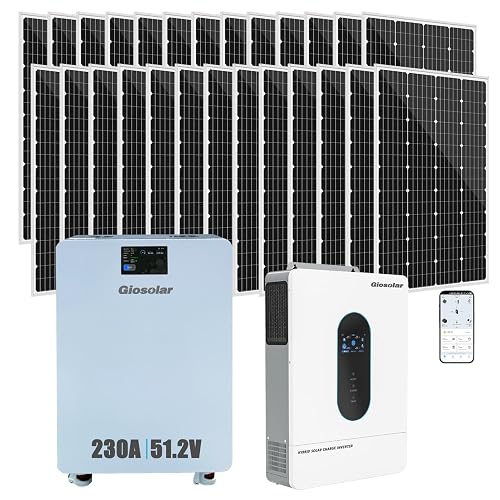
12000W Solar Power System Kit: 12KW 48V Split Phase Hybrid Solar Inverter with Dual 200A MPPT & WiFi, 12KWh 51.2V 230Ah Battery, 26pcs 120W Rigid Solar Panels for Home Off-Grid/Backup Power
Best for: Hybrid grid backup
Designed for homeowners who want grid-tied savings with battery backup, using a hybrid inverter with WiFi monitoring.
Pros:
- Dual 200A MPPT inputs handle a large array efficiently.
- WiFi monitoring is included for tracking production.
Cons:
- Twenty-six panels make this one of the larger roof footprints on the list.
Whole House System: 10KW 120V/240V Split Phase Solar Inverter

Whole House System:10KW 120V/240V Split Phase Solar Inverter| 48V 314Ah 16kWh High Capacity Energy Storage| 2950W Solar Panel ECO WORTHY 10000W Output Complete Off-Grid Solar Panel Kit for Home
Best for: Storage capacity
A good match for owners who prioritize a 16kWh battery bank for longer outages.
Pros:
- 16kWh storage is well above typical small-system kits.
- Split-phase 10kW inverter suits whole-home loads.
Cons:
- Listing mixes multiple component details, so confirm exact contents before ordering.
Solar Panel Kit 10KW Off Grid with 10.24kWh Battery

Solar Panel Kit:12PCS 195W Solar Panels(2340W)+2PCS 48V 100AH Cubix Lithium Battery(10.24kWh)+10KW Solar Inverter 120V/240V ECO-WORTHY 10KW Output 9.36KWH Off Grid Solar System Complete Kit for Home
Best for: Mid-size homes
Works for households that want a balanced mix of 10kW output and about 10kWh of storage without oversizing.
Pros:
- Balanced panel-to-battery ratio for moderate homes.
- Includes a 10kW split-phase inverter.
Cons:
- Storage may run short during multi-day cloudy periods.
SUNGOLDPOWER 5000W Off Grid System Complete Solar Kit

SUNGOLDPOWER 5000W 48V Off Grid System Complete Solar Kit,1 * 5000W 120Vac Solar Inverter UL1741+6 * 200W Mono Solar Panels +1 * 100Ah 51.2V Lifepo4 Battery UL1973, for House Storage (SGM-5K5E)
Best for: Moderate loads
Suited to smaller homes or cabins where a 5kW inverter covers typical daily use.
Pros:
- UL1741-listed inverter and UL1973 battery.
- Lower output keeps installation simpler.
Cons:
- Likely undersized for homes with electric heating or large appliances.
Buying Guide
Inverter Output and Voltage Match
The inverter determines how much power your system can deliver at once. For a whole-home setup, look for a split-phase 120V/240V inverter so you can run major appliances like HVAC, water heaters, and electric ranges, not just lights and outlets. Check that the continuous rating covers your home’s typical peak demand.
Battery Capacity and Chemistry
Battery capacity controls how long your home can run overnight or during an outage. Lithium iron phosphate (LiFePO4) batteries are the common choice for home storage because they tolerate many charge cycles and handle deep discharge well. Compare the total kilowatt-hour rating across the kit to estimate how many hours of essential loads it can support.
Panel Wattage and Total Array Size
Total panel wattage sets how quickly your batteries recharge and how much daytime power your home can use directly. Make sure the array is large enough to cover your daily consumption after accounting for sunlight hours in your area. Matching panel voltage to the inverter’s input range is also important for safe, efficient operation.
Kit Completeness and Included Components
A complete kit that includes panels, mounting hardware, inverter, batteries, and charge controller saves time and avoids compatibility guesswork. Review exactly what is listed, since some kits include only panels and an inverter while others add storage and wiring. Confirm that certifications such as UL listings are noted for the inverter and batteries.
Expandability and Installation Requirements
Consider whether you may want to add batteries or panels later, and whether the inverter supports that expansion. Also think about the electrical work involved, since a whole-house system typically requires permits, a licensed electrician for the main panel connection, and proper grounding. Planning for these steps up front helps keep the project on budget and up to code.
FAQ
Can a DIY whole house solar system really power an entire home?
Yes, a properly sized system with a split-phase inverter and adequate battery storage can cover most household loads. The key is matching the total kilowatt-hours and inverter output to your actual usage. Many homeowners still keep a grid connection or backup generator for extended cloudy periods.
Do I need a permit to install a whole house solar system?
Most areas require electrical permits for solar installations, especially when connecting to your main electrical panel. Local rules vary, so check with your building department before starting. Inspections help confirm the work is safe and meets code.
Is a licensed electrician required for the installation?
Connecting a system to your home’s main panel is usually work that requires a licensed electrician, and some jurisdictions mandate it. Even if you handle mounting and panel placement yourself, having a professional review the wiring is a good safety step. This also helps with insurance and inspection requirements.
How long will the battery storage last overnight?
Overnight runtime depends on how much energy your home uses after sunset and how much storage the kit provides. Calculate your evening and nighttime kilowatt-hour use, then compare it to the usable battery capacity. Running only essential loads will stretch the stored energy considerably.
What maintenance does a home solar system need?
Solar panels need occasional cleaning and a visual check for damage, debris, or loose mounting hardware. Batteries and the inverter should be kept in a cool, ventilated location and checked periodically according to the manufacturer’s guidance. Monitoring the system’s performance regularly helps catch problems early.
Conclusion
Homeowners who want the largest, most complete whole-house setup with strong overall capacity should look at the 10000W and 10KW off-grid kits. Those with bigger homes or higher daily loads will benefit most from the higher output options, while buyers who want backup power alongside grid connection may prefer the hybrid 12000W kit.
For smaller homes or a more budget-conscious first step, the 5000W kit offers a practical entry point that can cover essential loads. Match your choice to your actual energy use, and confirm permit and electrician requirements before you buy.
Related reading
- Whole House Off-Grid Solar System: Sizing Steps and Parts for Your Home
- Top 7 DIY Off Grid Solar System Kits Compared for Homes (2026)
- Solar Panel Specifications for DIY Systems: What Each Number Means
About Ethan Brooks
Ethan Brooks is part of our editorial team and reviews and edits our DIY solar power systems guides, checking product details against manufacturer specifications and owner feedback.