By Mason Hollis
Updated November 2026
An off grid solar system for small cabin use has to do a lot with a little: run a refrigerator, charge phones and laptops, power LED lights and maybe a well pump or small space heater fan, all without a utility connection. The right kit depends on daily energy use, how much sun the site gets, and how much battery storage you need to get through cloudy stretches. This guide compares five complete kits sold on Amazon US, ordered by how well each one fits a typical small cabin load. Selection was research-based: we looked at published specifications, manufacturer documentation, brand track record and patterns in owner feedback. Nothing here was tested in a lab or installed by us.
Our top picks at a glance
- 1
 TOP CHOICEBest overall3000W 24V Solar Power System Complete Kit with 1440W (12×120W) Solar PView on Amazon
- 2
 TOP CHOICEBest for weekend cabins480W Solar Panel Kit with 100Ah LiFePO4 Battery and 1000W Inverter, 12View on Amazon
- 3
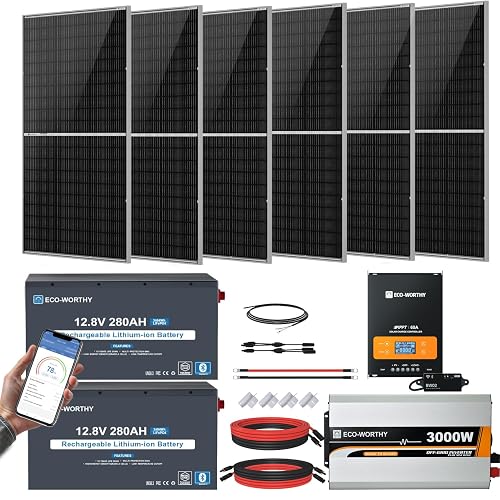 TOP CHOICEBest budget pick6pcs 195W Solar Panels+2Pcs 12.8V 280Ah Lithium Battery+60A MPPT ChargView on Amazon
- 4
 Best for year-round cabinsSolar Panel Kit:12PCS 195W Solar Panels(2340W)+2PCS 48V 100AH Cubix LiView on Amazon
- 5
 Best for larger off-grid homesWhole House System:10KW 120V/240V Split Phase Solar Inverter| 48V 314AView on Amazon
Our Top Picks
Quick Comparison
| Product | Best for | Key feature |
|---|---|---|
| 3000W 24V Complete Kit with 1440W panels | Cabins with mixed loads and occasional heavy appliances | 3kW inverter with 5.12kWh battery |
| 480W Kit with 100Ah LiFePO4 Battery | Weekend and seasonal cabins | Compact 12V system with 1000W inverter |
| 1200W 24V Lithium Solar System (195W panels) | Budget-minded cabin builds | 4.68kWh lithium storage with 60A MPPT controller |
| 12x195W Kit with 10.24kWh Cubix battery | Year-round cabins with higher winter loads | 9.36kWh storage and 10kW inverter output |
| 10kW Whole House Split Phase System | Larger off-grid homes and guest houses | 120V/240V split phase output |
3000W 24V Solar Power System Complete Kit with 1440W Solar Panel 3KW Peak 6KW Pure Sine Wave Inverter, 5.12KWH Battery, PV Combiner Box, MPPT Solar Controller, Off-Grid Home RV Backup
3000W 24V Solar Power System Complete Kit with 1440W (12×120W) Solar Panel 3KW Peak 6KW Pure Sine Wave Inverter, 5.12KWH Battery,PV Combiner Box,MPPT Solar Controller,Off-Grid Home RV Backup
Best for: Overall balance of capacity, inverter headroom and panel output for a small cabin.
This kit suits a cabin with a refrigerator, lighting, a laptop setup and a few intermittent loads such as a microwave or power tools. Its 3kW continuous inverter rating with 6kW surge handles motor starts better than the smallest kits. For another angle, check out Solar Panel for Small Cabin: 9 Best Picks for Off-Grid Use (2026).
Key specs
- 1440W total solar array (12 × 120W panels)
- 3kW continuous / 6kW peak pure sine wave inverter
- 5.12kWh battery storage
- 24V system voltage with MPPT charge controller
- Includes PV combiner box
Pros
- Good inverter headroom for motor loads
- Solid storage for a small cabin’s nightly use
- Complete component set reduces sourcing work
Cons
- Panel array needs a reasonably sized roof or ground mount
- Wiring and mounting still require basic electrical competence
Bottom line: The most balanced choice if your cabin runs a fridge plus regular power tools or a small pump.
480W Solar Panel Kit with 100Ah LiFePO4 Battery and 1000W Inverter, 12V Complete Off-Grid Solar Power System
480W Solar Panel Kit with 100Ah LiFePO4 Battery and 1000W Inverter, 12V Complete Off-Grid Solar Power System: 4×120W Solar Panels + 40A MPPT Controller + Pure Sine Wave Inverter for RV Cabin Shed
Best for: Weekend and seasonal cabins with modest daily loads.
A 12V system at this scale fits a cabin used a few days a week, with lights, phone and laptop charging, a small fan and perhaps a compact fridge. Installation is simpler than higher-voltage kits.
Key specs
- 480W solar array (4 × 120W panels)
- 100Ah LiFePO4 battery
- 1000W pure sine wave inverter
- 40A MPPT charge controller
Pros
- Lower-voltage setup is approachable for DIY wiring
- LiFePO4 chemistry tolerates deep cycling well
- Compact footprint for small roofs
Cons
- Limited capacity for full-time living or large appliances
- 1000W inverter cannot start heavy motors reliably
Bottom line: Pick this if the cabin is a getaway rather than a full-time residence.
6pcs 195W Solar Panels + 2Pcs 12.8V 280Ah Lithium Battery + 60A MPPT Charge Controller + 3000W Pure Sine Wave Inverter ECO-WORTHY 1200W 24V 4.68KWH Lithium Battery Solar System Off Grid
6pcs 195W Solar Panels+2Pcs 12.8V 280Ah Lithium Battery+60A MPPT Charge Controller+3000W Pure Sine Wave Inverter [Ultra] ECO-WORTHY 1200W 24V 4.68KWH Lithium Battery Solar System Off Grid
Best for: Budget-minded cabin builds that still need real storage.
This kit pairs a 1170W panel array with about 4.7kWh of lithium storage, a reasonable match for a cabin that spends most of its load on lights, electronics and a refrigerator.
Key specs
- 6 × 195W solar panels (1170W total)
- 2 × 12.8V 280Ah lithium batteries (4.68kWh total)
- 60A MPPT charge controller
- 3000W pure sine wave inverter
Pros
- Good storage per dollar of component value, based on listing specs
- Two-battery layout allows future expansion
- Inverter capacity suits most cabin appliances
Cons
- Brand-level support depth is narrower than established solar makers
- Requires careful sizing of the 24V wiring and fusing
Bottom line: A sensible starting point when the budget is the main constraint and loads are moderate.
Solar Panel Kit: 12PCS 195W Solar Panels (2340W) + 2PCS 48V 100AH Cubix Lithium Battery (10.24kWh) + 10KW Solar Inverter 120V/240V ECO-WORTHY 10KW Output 9.36KWH Off Grid Solar System Complete Kit for Home
Solar Panel Kit:12PCS 195W Solar Panels(2340W)+2PCS 48V 100AH Cubix Lithium Battery(10.24kWh)+10KW Solar Inverter 120V/240V ECO-WORTHY 10KW Output 9.36KWH Off Grid Solar System Complete Kit for Home
Best for: Year-round cabins with higher winter loads.
The 2340W array and roughly 9.4kWh of usable-class storage give more margin for short winter days, heating-season fan and pump loads, and extended cloudy periods than the smaller kits.
Key specs
- 12 × 195W solar panels (2340W total)
- 2 × 48V 100Ah lithium batteries (10.24kWh nominal)
- 10kW solar inverter, 120V/240V output
Pros
- Higher 48V battery voltage reduces current and wire sizing
- Substantial array for winter production
- Split-phase output supports 240V appliances
Cons
- Larger footprint and heavier batteries need solid mounting
- May exceed what a very small cabin actually uses
Bottom line: The better pick for a cabin lived in through winter, provided the site has enough roof or ground space.
10KW 120V/240V Split Phase Solar Inverter 48V 314Ah 16kWh Energy Storage 2950W Solar Panel ECO WORTHY Complete Off-Grid Solar Panel Kit for Home
Whole House System:10KW 120V/240V Split Phase Solar Inverter| 48V 314Ah 16kWh High Capacity Energy Storage| 2950W Solar Panel ECO WORTHY 10000W Output Complete Off-Grid Solar Panel Kit for Home
Best for: Larger off-grid homes and guest houses that exceed typical small-cabin loads.
This is oversized for most small cabins but fits a larger rural structure with electric heat, a well pump and full kitchen use. Consider it only if your load audit supports it.
Key specs
- 10kW split phase inverter, 120V/240V
- 48V 314Ah battery bank (16kWh nominal)
- 2950W solar array
Pros
- Split-phase output handles whole-home appliances
- Large storage buffer for extended outages of sun
- Scalable for future expansion
Cons
- Overkill for most small cabins and adds significant installation complexity
- Higher-voltage split-phase wiring should be done or inspected by a licensed electrician
Bottom line: Only the right choice if the structure is genuinely a full home. Consult a licensed electrician before installing a split-phase system.
Buying Guide
Daily Energy Use (Watt-Hours per Day)
Add up the watts of every device you plan to run, multiply each by its hours of use per day, and total the watt-hours. A cabin with a 50W fridge running 10 hours (500Wh), LED lights totaling 100Wh and electronics at 150Wh needs about 750Wh per day. Size storage for at least two days of autonomy and the array to recharge that in your worst month of sun.
Good picks for this: 480W Solar Panel Kit with 100Ah LiFePO4 Battery; 6pcs 195W Solar Panels Kit
Inverter Size and Surge Capacity
The inverter must carry your highest simultaneous load plus motor start surges. A well pump or compressor can draw several times its running wattage at startup. A 3kW continuous rating with 6kW peak covers most small-cabin motor loads better than a 1kW unit.
Good picks for this: 3000W 24V Complete Kit; Whole House 10KW Split Phase System
Battery Chemistry and Voltage
Lithium iron phosphate (LiFePO4) batteries offer deeper usable depth of discharge and longer cycle life than lead-acid, and they weigh less. Higher system voltages such as 24V or 48V reduce current and allow thinner wire runs. Confirm the battery management system (BMS) is included and matched to the charge controller.
Good picks for this: 12x195W Kit with 10.24kWh Cubix battery; 480W Kit with 100Ah LiFePO4
Solar Array Size and Roof Space
Panel wattage is only useful if the roof or ground mount can hold it at a good tilt facing south in the Northern Hemisphere. Measure usable area first. Panels are typically around 1 square meter for 195–200W modules, so a 1440W array needs roughly 8 to 9 square meters of unshaded space.
Good picks for this: 3000W 24V Complete Kit; 6pcs 195W Solar Panels Kit
Charge Controller Type and Sizing
An MPPT controller extracts more energy from panels than PWM, especially when panel voltage is well above battery voltage or in cold weather. Confirm the controller’s maximum amperage and voltage input exceed your array’s specifications, with headroom for cold-weather voltage rise.
Good picks for this: 480W Kit with 40A MPPT; 6pcs 195W Kit with 60A MPPT
Expansion and Future Needs
If you plan to add an electric heater, a larger fridge or a second building later, choose a kit with a battery bank and inverter that can be expanded in parallel or upgraded. Two-battery layouts and higher-voltage inverters make growth easier than replacing the whole system.
Good picks for this: 6pcs 195W Kit with two batteries; Whole House 10KW Split Phase System
Installation Skill and Safety
Low-voltage DIY systems are within reach for handy homeowners, but DC wiring carries real fire risk without proper fusing and breakers. Follow the National Electrical Code and manufacturer instructions. Higher-voltage split-phase systems should be installed or inspected by a licensed electrician.
Good picks for this: 480W Solar Panel Kit; 3000W 24V Complete Kit
FAQ
How big of an off grid solar system does a small cabin need?
Most small cabins run comfortably on 500 to 1,500 watt-hours per day, which points to a 500 to 1,500W array and 2 to 5kWh of storage. Calculate your own daily load first, since usage varies widely.
Can a small off grid solar system run a refrigerator?
Yes. A modern efficient 12V or 24V DC fridge or a compact AC fridge on an inverter can run on a small system, but the compressor’s startup surge must be within the inverter rating. Check the fridge’s energy use per day on its label or spec sheet.
How long does a lithium battery last in a cabin system?
Manufacturers commonly specify LiFePO4 cycle life in the thousands of cycles at a defined depth of discharge. Actual lifespan depends on temperature, charge settings and how deeply the battery is cycled.
Do I need a backup generator with an off grid cabin system?
Many off-grid owners keep a small generator for extended cloudy periods or winter. Sizing storage for at least two days of autonomy reduces how often you rely on it.
Is 24V or 48V better for a small cabin?
Both work. 48V reduces current and wire size for the same power, which helps larger systems. 24V is a common middle ground for small-to-mid builds, and 12V suits very small, simple setups.
Do solar panels work in winter for a cabin?
They produce less energy because of shorter days and lower sun angles, but cold temperatures often increase panel voltage. Plan the array for your worst-month production, not the summer average.
Conclusion
For most small cabins, the 3000W 24V complete kit offers the most balanced mix of storage, inverter headroom and panel output. The 480W 12V kit suits weekend getaways, the 6-panel 24V kit is the budget-minded starting point, and the 12-panel 48V-battery kit serves year-round cabins with higher winter loads. The 10kW split-phase system is for larger homes only. Start with a daily watt-hour audit, then match the kit to that number, not the other way around.
Sources
- Guidance on sizing off-grid and standalone solar systems and understanding energy use (energy.gov)
- Research on photovoltaic performance, battery storage and off-grid system design (nrel.gov)
- National Electrical Code requirements for wiring and overcurrent protection (nfpa.org)
Related reading
- 6 Best Off-Grid Solar System Kits for Homes and Cabins (2026)
- 6 Best Off Grid Cabin Solar Power System Options for 2026
- 5 Best Off-Grid Cabin Solar Systems of 2026: Buyer's Picks
- Wind Solar Hybrid Off Grid System: How to Size and Wire One
- Top 5 Off Grid Solar Panel Systems for Home Options Compared in 2026
- Ongrid and Off Grid Solar System (2026): Which Is Better for Your Home?

About Mason Hollis
Mason puts together our diy solar power systems guides, digging through specifications, manufacturer details and owner reviews so you don't have to.