 By Graham Fisher
Updated November 2026
Choosing a renogy rover 40 amp mppt solar charge controller comes down to three things: battery voltage compatibility, whether you need Bluetooth monitoring, and how much array power you plan to add later. This list compares Renogy Rover 40A-class units and a few close alternatives, based on manufacturer specifications and common owner feedback patterns. We did not bench-test these units.
Our top picks at a glance
- 1
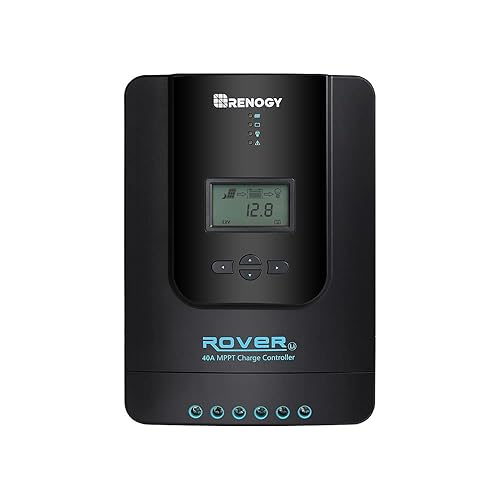 TOP CHOICEBest overallRenogy Solar Charge Controller Rover 40A 12V24V Auto Parameter DC Input MPPTView on Amazon
- 2
 TOP CHOICEBest for Bluetooth monitoringRenogy Rover MPPT Solar Charge Controller with Bluetooth 40A 12V/24VView on Amazon
- 3
 TOP CHOICEBest for lithium-focused buildsRenogy Charge Controller-Rover 40A MPPT 12V/24V Auto-Detect LCD DisplayView on Amazon
- 4
 Best budget pickRenogy Rover 30A 12V/24V Auto DC Input MPPT Solar Charge ControllerView on Amazon
- 5
 Best for larger arraysRenogy 60A MPPT Solar Charge Controller 12V/24V/36V/48V Rover LiteView on Amazon
- 6
 Best for app-based tuningBluetooth Charge Controllers for Solar Panels, Certified to UL1741 VicView on Amazon
- 7
 Best for small kitsRenogy95V PV input,AGM/Gel/Flooded (auto), Li (manual), MPPT 99%,overcView on Amazon
Our Top Picks
Quick Comparison
| Product | Best for | Key feature |
|---|---|---|
| Renogy Rover 40A (B01MSYGZGI) | General off-grid use | Auto 12V/24V detection |
| Renogy Rover 40A with Bluetooth (B079JRNFY6) | Remote monitoring | Bluetooth app monitoring |
| Renogy Rover 40A Auto-Detect (B0DYV4H82R) | Lithium batteries | Dual-peak tracking |
| Renogy Rover 30A (B07DNVW37B) | Tight budgets | LCD parameter adjustment |
| Renogy Rover Lite 60A (B0DJY4K25P) | Larger arrays | 150V maximum solar input |
| Victron SmartSolar 50A (B073ZJ43L1) | Bluetooth tuning | 100V PV input rating |
| Renogy Rover 20A with Bluetooth (B079JTMR95) | Small kits | Compact 20A output |
Renogy Solar Charge Controller Rover 40A 12V24V Auto Parameter DC Input MPPT
Renogy Solar Charge Controller Rover 40A 12V24V Auto Parameter DC Input MPPT Charge Controllers for Solar Panels Adjustable LCD for Gel Sealed Flooded Lithium Battery
Best for: General off-grid use with 12V or 24V battery banks.
This is a solid match for a first DIY system where you want the controller to sort out the battery voltage on its own and keep the setup simple.
Pros
- Auto-detects 12V or 24V systems
- Adjustable LCD for gel, flooded and lithium settings
Cons
- Monitoring requires a separate display or accessory
Renogy Rover MPPT Solar Charge Controller with Bluetooth 40A 12V/24V
Renogy100V PV input,AGM/Gel/Flooded (auto), Li (manual), MPPT 99%,overcharge/short protection, negative ground,Bluetooth monitoring Rover MPPT Solar Charge Controller with Bluetooth 40A 12V/24V
Best for: Remote monitoring of battery and array data.
Owners who check their system from a phone or who want logged charge data will find the built-in Bluetooth the main reason to choose this version.
Pros
- Bluetooth monitoring with a companion app
- Overcharge and short-circuit protection
Cons
- Phone pairing adds a step during setup
Renogy Charge Controller-Rover 40A MPPT 12V/24V Auto-Detect LCD Display
Renogy Charge Controller-Rover 40A MPPT 12V/24V Auto-Detect LCD Display | 99.9% Efficiency for Gel/Flooded/Lithium Batteries | Dual-Peak Tracking & Modbus Support
Best for: Lithium-focused builds that need precise charge profiles.
Builders running LiFePO4 banks will appreciate the dual-peak tracking and Modbus support for integration with other gear.
Pros
- Dual-peak tracking for partial shading
- Modbus support for system integration
Cons
- Modbus setup is more involved than plug-and-play
Renogy Rover 30A 12V/24V Auto DC Input MPPT Solar Charge Controller
Renogy Rover 30A 12V/24V Auto DC Input MPPT Solar Charge Controller Parameter Adjustable LCD Display Solar Panel Regulator fit for Gel Sealed Flooded and Lithium Battery, Rover 30A,Black
Best for: Tight budgets and modest array sizes.
A 30A rating suits smaller arrays, and it is a reasonable choice when you do not expect to grow the system past that point.
Pros
- Lower current rating matches small arrays well
- Adjustable LCD parameters
Cons
- Limited headroom if you add panels later
Renogy 60A MPPT Solar Charge Controller 12V/24V/36V/48V Rover Lite
Renogy 60A MPPT Solar Charge Controller 12V/24V/36V/48V Auto, 150V Maximum Solar Input, for Gel Sealed Flooded and Lithium Battery, Rover Lite 60A
Best for: Larger arrays and higher-voltage battery banks.
If you are planning an expansion or a 48V bank, the higher current rating and 150V solar input give more room than the 40A class.
Pros
- 60A output and 150V maximum solar input
- Supports 36V and 48V battery banks
Cons
- Overbuilt for small 12V systems
Buying Guide
Battery Chemistry and Voltage Compatibility
Confirm that the controller supports your battery type, whether that is sealed gel, flooded lead-acid, or lithium. Also check that the controller matches your system voltage, such as 12V or 24V, since mismatched settings can shorten battery life.
Array Power and Expansion Room
Size the controller to your solar array with some headroom for future panels. A 40-amp unit is a common fit for mid-sized off-grid or RV setups, but the maximum PV input voltage and wattage limits matter as much as the amp rating.
Monitoring Options
If you want to check charge levels and history from a phone, look for built-in Bluetooth or a compatible communication port. An LCD display alone is useful for quick checks but does not offer remote tracking.
Protection Features and Build Quality
Overcharge, short-circuit, and reverse-polarity protection help prevent costly damage to your batteries and wiring. Pay attention to the ground configuration your system requires, since some controllers are designed only for negative-ground installations.
FAQ
Can a Renogy Rover 40A controller handle both 12V and 24V systems?
Most Rover 40A models are designed to auto-detect 12V or 24V systems, so you usually do not need to set the voltage manually. Always confirm the specific model’s listed voltage range before you buy. Matching the controller to your battery bank is essential for correct charging.
Do I need Bluetooth monitoring for my solar setup?
Bluetooth is not strictly required, but it makes it much easier to check battery voltage, charge current, and daily harvest from your phone. It is most useful if your system is mounted somewhere hard to reach. A basic LCD may be enough for a simple, fixed installation.
What is the difference between MPPT and PWM controllers?
MPPT controllers track the maximum power point of the panels and convert the extra voltage into added charge current, which usually gives better efficiency. PWM controllers are simpler and cheaper but typically waste more power, especially when panel voltage is much higher than battery voltage. For most 40-amp applications, MPPT is the more common choice.
Can I use lithium batteries with these controllers?
Many of the listed units include a lithium charging profile, though some require you to set the battery type manually. Check that the lithium setting matches your battery manufacturer’s charge voltage recommendations. Incorrect settings can reduce battery lifespan or trigger protection shutdowns.
How do I choose the right amp rating for my panels?
Divide your total array wattage by your system voltage to estimate the charge current, then add a safety margin. Make sure the controller’s rated current and maximum PV input wattage both exceed your planned array. Leaving room for future expansion can save you from replacing the controller later.
Conclusion
For most users with a 12V or 24V battery bank and a moderate solar array, a Renogy Rover 40A model with Bluetooth or a clear LCD offers a solid balance of capability and value. Choose the variant whose battery chemistry settings and monitoring features match how you plan to use your system.
If you need higher current, a larger array, or higher voltage support, a unit like the 60A Rover Lite or the Victron alternative may be a better fit. Smaller systems with lighter loads can reasonably look at the 30A or 20A options instead.
Related reading
- 5 Best 30 Amp MPPT Solar Charge Controller Options Compared (2026)
- 3 Best Mppt Solar Charge Controller 60 Amps Compared for DIY Systems (2026)
- Top 6 MPPT Solar Charge Controllers for Lithium Batteries Compared
- Top 5 Mppt Solar Charge Controller 12v Options Compared for DIY Systems
- Top 5 40amp MPPT Solar Charge Controllers Compared for DIY Systems
About Graham Fisher
Graham Fisher is part of our editorial team and reviews and edits our DIY solar power systems guides, checking product details against manufacturer specifications and owner feedback.



