 By Graham Fisher
Updated November 2026
Choosing a solar power battery charge controller comes down to four things: battery chemistry compatibility, panel voltage and wattage headroom, the charging algorithm, and whether you need monitoring. The seven units below are ranked by how well their specifications fit common DIY setups, from small 12V kits to 48V banks. Specs and owner feedback patterns were the basis for this list, not bench testing.
Our top picks at a glance
- 1
 TOP CHOICEBest overallVictron Energy SmartSolar MPPT 100/50View on Amazon
- 2
 TOP CHOICEBest for high-voltage arraysUpgraded 100A MPPT Solar Charge Controller 12V 24V 36V 48VView on Amazon
- 3
 TOP CHOICEBest for lead-acid and lithium with LCDSolar Charge Controller 100A 12V 24V 36V 48V SA100AView on Amazon
- 4
 Best for small PWM setups30A PWM Solar Charge Controller 12V 24V Dual USBView on Amazon
- 5
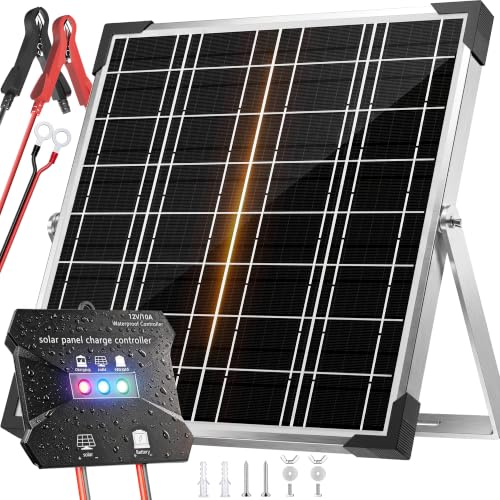 Best for vehicles and trickle maintenanceVoltset 20W 12V Solar Panel Battery Charger Trickle Maintainer Kit | SView on Amazon
- 6
 Best for small portable MPPT10Amp 12 Volt MPPT Solar Charge Controller, Bateria Power IntelligentView on Amazon
- 7
 Best budget PWM pickSOLPERK 10A Solar Charge Controller Waterproof Solar Panel ControllerView on Amazon
Our Top Picks
Quick Comparison
| Product | Best for | Key feature |
|---|---|---|
| Victron Energy SmartSolar MPPT 100/50 | Overall DIY builds | Bluetooth monitoring, MPPT tracking |
| Upgraded 100A MPPT Solar Charge Controller | High-voltage arrays | 12V to 48V auto-detection |
| Solar Charge Controller 100A SA100A | Lead-acid and lithium | Intelligent battery recognition |
| 30A PWM Solar Charge Controller | Small PWM setups | Timer and load control modes |
| Smart Charge Controller 20W Kit | Vehicles and maintenance | Waterproof, trickle charging |
| SunRock 10 MPPT Controller | Small portable systems | Compact MPPT, 150W max PV |
| SOLPERK 10A PWM Controller | Budget small systems | LED display, 12V/24V |
Victron Energy SmartSolar MPPT 100/50
Victron EnergyBluetooth Charge Controllers for Solar Panels, Certified to UL1741 SmartSolar MPPT Solar Charge Controller 100V, 50A, 12/24V
Best for: Overall DIY builds where monitoring matters.
This unit suits builders who want a mainstream MPPT controller with phone-based status and a 50A output rating at 12V or 24V.
Pros
- Bluetooth monitoring for battery and array data
- Wide, well-documented MPPT tracking range
Cons
- Higher cost than basic PWM units
Upgraded 100A MPPT Solar Charge Controller 12V 24V 36V 48V
Upgraded 100A MPPT Solar Charge Controller 12V 24V 36V 48V LCD Display Battery Intelligent Regulator Max 100V Input Dual USB for Lead-Acid/Lithium
Best for: High-voltage arrays and 48V battery banks.
A good fit for builders stringing longer panel strings who need automatic voltage detection across four system voltages.
Pros
- Supports 12V through 48V systems
- Dual USB outputs for small loads
Cons
- Display is basic compared with Bluetooth units
Solar Charge Controller 100A 12V 24V 36V 48V SA100A
Solar Charge Controller 100A 12V 24V 36V 48V Intelligent Recognition LCD Display Battery Intelligent Regulator Maximum 100V Input Dual USB for Lead Acid/Lithium Battery (SA100A)
Best for: Lead-acid and lithium battery banks with an LCD readout.
Builders switching between battery chemistries will appreciate the recognition settings and clear on-unit display.
Pros
- Intelligent recognition for lead-acid and lithium
- Maximum 100V input for larger panel strings
Cons
- Owners often report the manual is thin on wiring detail
30A PWM Solar Charge Controller 12V 24V Dual USB
30A PWM Solar Charge Controller, 12V 24V Dual USB Solar Panel Battery Intelligent Regulator with LCD Display, Auto Parameter Adjustable, Timer Setting, Multiple Load Control Modes
Best for: Small PWM setups with timed load control.
A practical choice for shed lighting or small off-grid loads where a timer and multiple load modes add real value.
Pros
- Timer and multiple load control modes
- Auto parameter adjustment with LCD readout
Cons
- PWM technology wastes more panel output than MPPT in cold or low-light conditions
Smart Charge Controller Waterproof 20W 12V Solar Panel Battery Charger Trickle Maintainer Kit
Voltset 20W 12V Solar Panel Battery Charger Trickle Maintainer Kit | Smart Charge Controller, Waterproof, Safety Protections, for Car Boat RV Marine Trailer Automotive Trailer Truck Motorcycle
Best for: Vehicles, boats and trickle maintenance.
This kit suits owners keeping a starter battery topped off on a boat, RV or trailer rather than powering a full off-grid bank.
Pros
- Waterproof design with built-in protections
- Trickle maintainer mode for long storage
Cons
- Output is too small for household-scale battery banks
Buying Guide
Battery Chemistry Compatibility
Confirm that the controller supports your battery type, such as sealed lead-acid, flooded lead-acid, gel, AGM, or lithium iron phosphate. Each chemistry needs its own charging voltages, and a controller that lacks the right profile can shorten battery life or leave the bank undercharged.
Panel Voltage and Wattage Headroom
Check the maximum open-circuit voltage and the maximum PV wattage the controller accepts, then compare them with your planned array. Leaving some headroom above your panel total helps the system handle cold weather, when panel voltage rises, and gives room to expand later.
Charging Algorithm: MPPT or PWM
MPPT controllers track the panel’s maximum power point and generally harvest more energy, especially when panel voltage is well above battery voltage. PWM controllers are simpler and less expensive, and they can be a reasonable fit for small systems where the panel and battery voltages are closely matched.
Monitoring, Display, and Load Control
An LCD or LED display, Bluetooth, or USB ports can make it easier to read charge state and adjust settings. If you plan to run lights, pumps, or other loads directly from the controller, look for built-in load outputs and the control modes they offer.
FAQ
Can I use one controller for both lead-acid and lithium batteries?
Some models offer selectable or automatic battery profiles that cover both chemistries, but you should confirm this in the product specifications. Set the profile to match your battery manufacturer’s recommended voltages before connecting the bank.
Do I need an MPPT controller for a small 12V system?
Not always. A PWM controller can work well for small, low-wattage systems where the panel voltage is close to the battery voltage. MPPT becomes more worthwhile as panel voltage rises or as the array grows.
How do I size a controller for my solar panels?
Add up the wattage of your panels and check that the total stays within the controller’s rated PV input at your system voltage. Also confirm that the panels’ open-circuit voltage stays below the controller’s maximum input voltage, including in cold temperatures.
Is a waterproof rating important?
It matters most when the controller will be mounted outdoors or in damp locations such as boats, RVs, or trailers. For indoor battery rooms or enclosed cabinets, the rating is less critical, though ventilation and proper wiring still matter.
Should I install a fuse or breaker with my controller?
Yes. Fusing the battery connection and the solar input is a standard safety practice that protects wiring and components from short circuits. Use fuses or breakers rated for your system’s current and voltage, and follow the manufacturer’s wiring instructions.
Conclusion
If you want the most efficient harvesting and a premium monitoring option, the Victron Energy SmartSolar MPPT 100/50 is the strongest fit. For higher-voltage arrays and lead-acid or lithium banks with a built-in display, the 100A MPPT models suit larger DIY systems, while the 30A PWM and 10A units are better matched to small, budget-conscious setups.
Choose based on your battery chemistry, panel voltage, and expected load. Smaller boats, RVs, and trickle-charging kits do well with the compact controllers, while off-grid cabins and larger battery banks benefit from the higher-capacity MPPT options.
Related reading
- Top 6 MPPT Solar Charge Controllers for Lithium Batteries Compared
- 6 Best LiFePO4 Battery Solar Charge Controllers Compared for DIY Systems
- 6 Best Dual Battery Solar Charge Controller Options for RVs and Boats (2026)
- 5 Best Solar Panel Battery Charge Controllers for DIY Systems (2026)
- 4 Best Solar Power Charge Controller Inverter Combos for Off-Grid Use (2026)
- Top 5 Rich Solar Charge Controllers Compared for DIY Systems
- Top 5 Mppt Solar Charge Controller 12v Options Compared for DIY Systems
- Top 5 40amp MPPT Solar Charge Controllers Compared for DIY Systems
About Graham Fisher
Graham Fisher is part of our editorial team and reviews and edits our DIY solar power systems guides, checking product details against manufacturer specifications and owner feedback.


