 By Claire Whitaker
Updated November 2026
A solar power inverter 5000W is the right size for many off-grid cabins, backup-ready homes and workshops that run well-chosen loads. This list compares six 5000W units by output voltage, MPPT charge controller rating, battery compatibility, parallel support and AC charger capacity. Each pick is based on manufacturer listings and common owner feedback patterns; none of these units were bench-tested for this article. If you want more background, see 6 Best Eco Worthy 5000W Solar Hybrid Inverter Options Compared (2026).
Our top picks at a glance
- 1
 TOP CHOICEBest overallSunGoldPowerCo 5000W DC 48V UL1741 Pure Sine Wave Solar InverterView on Amazon
- 2
 TOP CHOICEBest for parallel expansionSUNGOLDPOWER UL1741 5000W Solar InverterView on Amazon
- 3
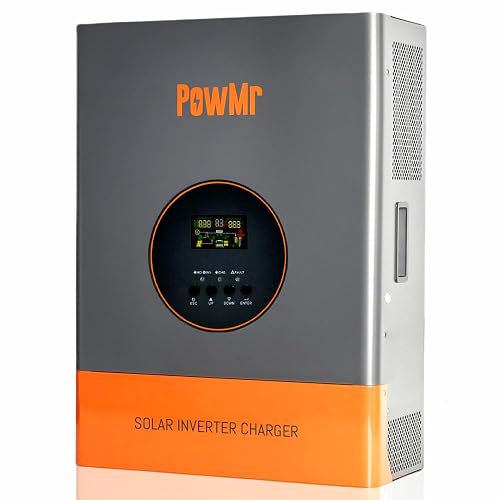 TOP CHOICEBest for lithium and lead-acid mixesPowMr 5000W Hybrid Solar Inverter 48VDC to 110/220VACView on Amazon
- 4Best for 120V-only systemsSUNGOLDPOWER 5000W DC 48V All in One Solar InverterView on Amazon
- 5
 Best for high PV inputECO-WORTHY 48V 5000W Solar Inverter Custom Home BackupView on Amazon
- 6
 Best for home backup budgetsECO-WORTHY UL1741 5000W 48V Solar Inverter ChargerView on Amazon
Our Top Picks
Quick Comparison
| Product | Best for | Key feature |
|---|---|---|
| SunGoldPowerCo 5000W DC 48V UL1741 | Overall balance | 100A MPPT, parallel support |
| SUNGOLDPOWER UL1741 5000W | Expansion-free setups | 80A MPPT, 40A AC charger |
| PowMr 5000W Hybrid | Mixed battery chemistries | 120A MPPT, 15000W peak |
| SUNGOLDPOWER 5000W All in One | 120V input and output | 80A MPPT, pure sine |
| ECO-WORTHY 48V 5000W | High PV array input | 5500W at 500V PV input |
| ECO-WORTHY UL1741 5000W | Home backup use | 100A MPPT, 40A AC charger |
SunGoldPowerCo 5000W DC 48V UL1741 Pure Sine Wave Solar Inverter
5000W DC 48V UL1741 Pure Sine Wave Solar Inverter,100A MPPT Solar Charger and 40A AC Battery Charger, 120V AC Output Solar Inverter Charger Manufactured by SunGoldPowerCo.,Ltd (Support Parallel)
Best for: Overall balance of charge capacity and parallel expansion
This unit suits DIYers who want a 100A MPPT controller and room to add a second inverter later.
Pros
- 100A MPPT charge controller
- Listed as parallel-capable
Cons
- Parallel setup adds wiring complexity
SUNGOLDPOWER UL1741 5000W Solar Inverter
SUNGOLDPOWER UL1741 5000W Solar Inverter,48V DC to 110V/120V AC,All in One,80A MPPT Solar Charger and 40A AC Battery Charger Pure Sine Wave for Off Grid System(NO Parallel)
Best for: Single-unit systems that will not expand
Owners building a fixed off-grid system with one inverter often pick this model for its 80A MPPT controller and all-in-one layout. For a deeper look, 6 Best Solar Power Inverter Grid Tie Options for Homes (2026) covers this in detail.
Pros
- All-in-one design with 40A AC charger
- Pure sine wave output
Cons
- Listed as not parallel-capable
PowMr 5000W Hybrid Solar Inverter 48VDC to 110/220VAC
PowMr 5000W Hybrid Solar Inverter 48VDC to 110/220VAC, 5kW Off-Grid w/Built-in 120A MPPT Charge Controller, Pure Sine Wave Inverter for 48V Lead-Acid and Lithium Battery, Peak Power:15000W
Best for: Mixed lead-acid and lithium battery banks
Builders with a battery bank in transition, or who want 110V or 220V output options, may find this model flexible.
Pros
- 120A MPPT controller
- Supports both lead-acid and lithium profiles
Cons
- Peak rating is high; real surge capacity depends on the load
SUNGOLDPOWER 5000W DC 48V All in One Solar Inverter
SUNGOLDPOWER 5000W DC 48V All in One Solar Inverter, 120Vac Input and Output, 80A MPPT Solar Charger and 40A AC Charger,Pure Sine Wave Inverter for Backup, Off-Grid System (Can't Parallel)
Best for: 120V input and output systems
This model fits DIYers whose grid or generator input is 120V and who want matching output for backup duty.
Pros
- 120Vac input and output
- 80A MPPT and 40A AC charger
Cons
- Listed as not parallel-capable
ECO-WORTHY 48V 5000W Solar Inverter Custom Home Backup
ECO-WORTHY 48V 5000W Solar Inverter | Custom Home Backup Power/Complete Systems | 48Vdc to120Vac, 5500W@500V PV Input
Best for: Arrays with higher PV voltage
Installers stringing more panels in series will appreciate the listed 500V PV input ceiling.
Pros
- 5500W PV input at 500V
- Positioned as a complete backup system
Cons
- Verify panel string voltage against the 500V limit before buying
ECO-WORTHY UL1741 5000W 48V Solar Inverter Charger
ECO-WORTHY UL1741 5000W 48V Solar Inverter Charger, 48V DC to 120V AC,Inversor Solar Built in 100A MPPT Solar Charge Controller,40A AC Charger,Work with Lead Acid/LiFePO4,Home Backup
Best for: Home backup with lead-acid or LiFePO4 batteries
Homeowners wanting a grid-backup charger alongside solar input often look at this unit’s 40A AC charger.
Pros
- 100A MPPT and 40A AC charger
- Works with lead-acid and LiFePO4
Cons
- Confirm UL1741 certification paperwork with the seller
Buying Guide
Battery Voltage Compatibility
Most of these 5000W units are built for 48V battery banks, which is the common choice for off-grid systems because it reduces current and wire size. Confirm that your battery bank matches the inverter’s DC input voltage before you buy. Some listed models also support specific battery chemistries, so check whether your batteries are lead-acid, LiFePO4, or both.
MPPT Charge Controller Rating
The MPPT charger rating determines how much solar power the unit can convert into battery charge. Higher amperage ratings generally allow more solar panels to be connected and faster recharging. Match the controller rating to your array size and the battery bank’s charge capacity rather than assuming more is always better.
Parallel Support and Future Expansion
If you may need more power later, look at whether the model supports parallel operation with additional inverters. Some units in this list explicitly allow parallel connection, while others do not, which limits how far you can expand the system. Choose a parallel-capable model if you expect your household loads to grow over time.
AC Output Type and Load Sensitivity
Pure sine wave output is generally the safer choice for sensitive electronics, medical devices, and motor-driven appliances. Modified sine wave units can work for simpler loads but may cause buzzing or reduced efficiency with some equipment. Check the output waveform and voltage (110V or 120V) against what your appliances require.
AC Charger Capacity and Generator Backup
Many of these inverters include a built-in AC battery charger that lets you top off batteries from a generator or grid power during low-sun periods. Review the charger amperage to see how quickly batteries can be recharged from an AC source. This feature is especially useful for cloudy winters or extended backup situations.
FAQ
Can a 5000W inverter run a whole off-grid home?
A 5000W inverter can power many household loads at once, but it depends on your total simultaneous demand and surge needs. Large appliances like well pumps, air conditioners, or electric ranges can strain a single unit. Calculate your peak wattage before deciding whether 5000W is sufficient for your home.
Do I need a 48V battery bank for these inverters?
Most of the models in this list are designed for 48V battery systems, which is a common standard for this power class. Confirm the DC input voltage in each product’s specifications before purchasing batteries. Mismatched voltage can damage the equipment or prevent it from operating.
What is the difference between MPPT and PWM charge controllers?
MPPT controllers track the optimal voltage of your solar array and typically harvest more energy, especially in cool or variable weather. PWM controllers are simpler and less efficient, so they are less common in units of this size. The MPPT units in this roundup are a better fit for most off-grid installations.
Is a pure sine wave inverter necessary for a home system?
A pure sine wave inverter is recommended for most home use because it delivers clean power that protects sensitive electronics and motors. Modified sine wave units can be adequate for basic lighting or simple resistive loads. Choose pure sine wave if you run computers, medical equipment, or modern appliances.
Can I connect multiple inverters together for more power?
Only some models in this list support parallel operation, so you should check each product’s listing before planning an expansion. Parallel setups must use compatible units and follow the manufacturer’s wiring guidelines. If you think you may need more capacity later, prioritize a parallel-capable model from the start.
Conclusion
For most off-grid homes that want room to grow, a 48V pure sine wave model with parallel support and a strong MPPT controller is the most flexible choice. Buyers who only need a simpler, non-expandable setup or who plan to use the inverter in a vehicle-style application may find a lower-capacity or modified sine wave option sufficient. Match the inverter to your battery voltage, peak load, and future plans to get the best fit.
Related reading
- Solar Power Inverter Size: How to Calculate the Right Rating (2026)
- Solar Power Inverter Manufacturer: How to Evaluate One Before You Buy
- Solar Power Inverter Installation: A Step-by-Step Guide for DIY Builders
- Solar Power Inverter Cost: What to Expect and How to Budget (Step-by-Step)
- Solar Power Inverter 3000w: How to Size, Wire and Use One Safely
- Solar Power Inverter 3000 Watt: How to Size and Wire One (2026)
About Claire Whitaker
Claire Whitaker is part of our editorial team and reviews and edits our DIY solar power systems guides, checking product details against manufacturer specifications and owner feedback.


