 By Claire Whitaker
Updated November 2026
Choosing a 48v 200ah lifepo4 battery comes down to usable capacity, the built-in battery management system, cycle life, and whether the unit includes a charger or monitoring. This list compares seven 48V 200Ah-class lithium iron phosphate options sold on Amazon US, grouped by the job each one fits best. Figures below come from manufacturer listings and common owner feedback patterns, not from our own testing.
Our top picks at a glance
- 1
 TOP CHOICEBest overallWall Mounted 48V 200Ah(205Ah) LiFePO4 Battery with 200A PACE BMSView on Amazon
- 2
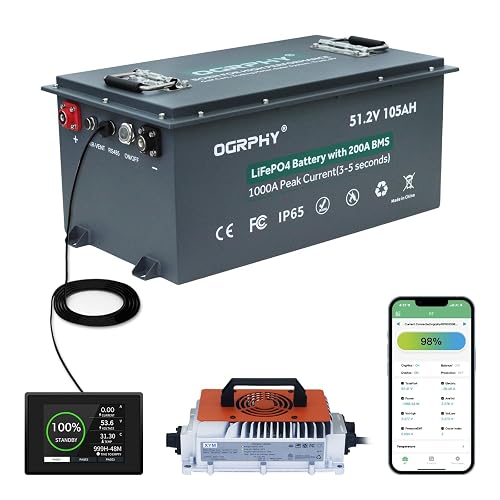 TOP CHOICEBest for golf carts48V Lithium Golf Cart Battery, 200A BMS with Touch MonitorView on Amazon
- 3
 TOP CHOICEBest for modular solar banks2V 200Ah(V2) Lithium LiFePO4 Solar Battery (2 Pack 51.2V 100AH)View on Amazon
- 4
 Best for high-current inverters200A Smart BMS TEMGO 48V (51.2V) 100Ah LiFePO4 Golf Cart BatteryView on Amazon
- 5Best for wall-mount home backupUL1973 Wall Mounted 48V 200Ah(205Ah) LiFePO4 Battery with 250A BreakerView on Amazon
- 6
 Best for large systemswith Breakers, 200A Active Balancing BMS, Aerosol Fire Protection, 7"View on Amazon
- 7
 Best for cold climates and marine useLow-Temp Protection, 15000+ Deep Cycles, 10 Years Lifespan, 5120Wh EneView on Amazon
Our Top Picks
Quick Comparison
| Product | Best for | Key feature |
|---|---|---|
| 48V 200Ah(205Ah) LiFePO4 Wall Mounted | Overall home and off-grid use | 200A PACE BMS, UL1973 |
| 48V Lithium Golf Cart Battery 105Ah | Golf carts and mixed solar | Touch monitor, 18A charger |
| 51.2V 200Ah(V2) Lithium Solar Battery | Modular solar banks | Inverter communication, Bluetooth |
| TEMGO 48V 100Ah Golf Cart Battery | High-current loads | 200A smart BMS, LCD screen |
| UL1973 Wall Mounted 48V 200Ah(205Ah) | Home backup | 250A breaker, app control |
| ECO-WORTHY Powermega 48V 314Ah | Large energy storage | 200A active balancing BMS |
| HumsiENK 24V 200Ah Plus | Cold weather and marine | Low-temp protection, 15000+ cycles |
Wall Mounted 48V 200Ah(205Ah) LiFePO4 Battery with 200A PACE BMS
48V 200Ah(205Ah) LiFePO4 Battery Wall Mounted with 200A PACE BMS, UL1973, 10.5kWh Solar Storage Battery, WiFi&Bluetooth APP Control, 250A Breaker,A Cells, 8000+ Cycles for Off-Grid, RV, Home Energy
Best for: Overall home and off-grid storage
This unit suits homeowners who want a wall-mountable 10.5 kWh pack with app monitoring and a UL1973 listing for stationary storage.
Pros
- 200A BMS with a 250A breaker included
- WiFi and Bluetooth app control
Cons
- Heavy to mount without a helper
48V Lithium Golf Cart Battery, 200A BMS with Touch Monitor
48V Lithium Golf Cart Battery, 200A BMS(1000A Peak Current), with Touch Monitor & Mobile APP, 4000+ Cycles 48V Lithium Battery with 18A Charger, Perfect for Golf Carts, Solar(105AH)
Best for: Golf carts and mixed solar use
Owners converting a golf cart or running a small solar setup often want a bundled charger and a clear state-of-charge display.
Pros
- Touch monitor and mobile app
- 18A charger included
Cons
- Capacity is listed as 105Ah, so confirm the exact rating before comparing
51.2V 200Ah(V2) Lithium LiFePO4 Solar Battery (2 Pack 51.2V 100AH)
51.2V 200Ah(V2) Lithium LiFePO4 Solar Battery(2 Pack 51.2V 100AH), Support Inverter Communication, Built-in 100A BMS with Bluetooth,10.24kWh Capacity, Perfect for Off-Grid, Solar, Backup Power
Best for: Modular solar battery banks
Builders who prefer two 100Ah modules over a single large pack can use this design to scale capacity later.
Pros
- Inverter communication support
- Built-in 100A BMS with Bluetooth
Cons
- Two-pack configuration needs careful parallel wiring
200A Smart BMS TEMGO 48V (51.2V) 100Ah LiFePO4 Golf Cart Battery
200A Smart BMS, Max 10.24kW Output, LCD Screen, 58.4V 18A Charger and App TEMGO 48V (51.2V) 100Ah LiFePO4 Lithium Golf Cart Battery
Best for: High-current inverter loads
A 200A smart BMS and LCD screen suit users running higher-draw inverters or motors.
Pros
- 200A smart BMS with LCD readout
- Includes 58.4V 18A charger
Cons
- Rated 100Ah, not 200Ah
UL1973 Wall Mounted 48V 200Ah(205Ah) LiFePO4 Battery with 250A Breaker
Best for: Home backup systems
Households building a stationary backup bank often look for UL1973 listing and an integrated breaker.
Pros
- 250A breaker and WiFi/Bluetooth control
- Rated for 8000+ cycles by the manufacturer
Cons
- Installation needs a qualified electrician for most homes
Buying Guide
Usable Capacity vs. Rated Capacity
A battery labeled 200Ah is only part of the story. Check how much energy is actually usable after the battery management system (BMS) limits discharge, since some listings round up or quote nominal figures. Compare the stated kWh value across models so you are measuring the same thing.
Lithium iron phosphate batteries generally allow deeper discharge than lead-acid, which means more of the rated capacity is available day to day. Still, plan your loads around the usable figure rather than the headline number.
BMS Rating and Protection Features
The BMS controls charging, discharging, temperature limits, and balancing between cells. Pay attention to the continuous current rating, because it determines how much power your inverter or motor can draw safely. A higher peak rating helps with startup surges from motors and pumps, but the continuous rating matters more for sustained loads.
Look for protections against overcharge, over-discharge, short circuit, and high or low temperature. Built-in balancing and Bluetooth or app monitoring make it easier to spot a weak cell before it becomes a problem.
Cycle Life and Warranty
Cycle life claims vary widely and are usually tested under specific conditions, such as a set depth of discharge and temperature. Treat a high cycle count as a rough indicator rather than a guarantee. A clear warranty period and a responsive seller or manufacturer are often more useful for long-term confidence.
Compatibility with Inverters and Chargers
If you plan to pair the battery with a solar inverter, confirm that it supports communication protocols such as CAN or RS485, since these let the inverter read state of charge and adjust charging. For golf carts and other vehicles, confirm the included charger voltage and that it matches your existing setup.
Mounting, Enclosure, and Safety Certifications
Wall-mounted and rack-mount designs save floor space and suit fixed installations, while metal-cased packs are better suited to vehicles and rough environments. Look for UL 1973 certification for stationary energy storage, and consider models that include fire suppression or breakers if the battery will be installed in a home or enclosed space.
FAQ
Can I connect two 48V 200Ah batteries in parallel?
Many lithium packs can be paralleled to increase capacity, but only if the manufacturer explicitly supports it and the units share the same voltage and BMS type. Mixing batteries of different ages or brands can cause imbalance and safety issues. Always check the manual before connecting packs together.
How long will a 48V 200Ah lithium battery last?
Lifespan depends on cycle count, depth of discharge, temperature, and charging habits. Lithium iron phosphate batteries typically last many years of regular use, but actual results vary with how the battery is managed. Keeping the battery within its recommended temperature range helps extend its life.
Do I need a special charger for a 48V lithium battery?
Yes, you should use a charger designed for lithium iron phosphate chemistry at 48V nominal. Lead-acid chargers may not reach the correct voltage profile and can shorten battery life. Some kits include a matched charger, which simplifies setup.
Is a built-in BMS enough to keep the battery safe?
A quality BMS protects against overcharge, over-discharge, and short circuits, but it should be paired with correct wiring, appropriately sized breakers, and proper ventilation. Installing a fuse or breaker close to the battery adds another layer of protection. Following the manufacturer’s installation guide is essential.
Can I use these batteries in cold weather?
Most lithium iron phosphate batteries should not be charged below freezing unless the model includes low-temperature charging protection or heating. Discharge in cold conditions is usually more tolerated, but performance drops. Check the operating temperature range listed for each model before installing outdoors or in an unheated space.
Conclusion
For a fixed home solar or backup setup, the wall-mounted and rack-mount options with UL 1973 certification and strong communication support are the most practical choices. For golf carts and mobile use, the metal-cased kits with included chargers and touch or app monitoring make the most sense.
Match the battery to your inverter, your installation space, and your largest starting load, then confirm the BMS ratings and warranty before buying. Choosing based on these factors will serve you better than comparing headline capacity alone.
Related reading
- Lifepo4 Lithium Battery 48v 100ah: Sizing, Wiring and Setup Steps
- 7 Best Lifepo4 12v 200ah Battery Options for Solar and Off-Grid (2026)
- 7 Best 48V 100Ah LiFePO4 Battery Options for Golf Carts and Solar (2026)
- 7 Best 24V 200Ah LiFePO4 Battery Options for Solar and Off-Grid (2026)
About Claire Whitaker
Claire Whitaker is part of our editorial team and reviews and edits our DIY solar power systems guides, checking product details against manufacturer specifications and owner feedback.




