As an Amazon Associate I earn from qualifying purchases. This page may contain affiliate links.
Choosing among diy off grid solar power kits means weighing inverter output, battery capacity, panel wattage and how much of the system you still need to source yourself. Most buyers are trying to answer one question: which kit will run their home, cabin, shed or RV without leaving them short on power after dark? This guide compares nine complete kits and explains how to read their specifications. Each pick was evaluated from manufacturer specifications, brand reputation and the patterns owners tend to report, not from hands-on testing. Selection criteria included inverter continuous output and voltage (120V, 240V split-phase or 12V/24V/48V DC), usable battery energy in kWh, total panel wattage, whether the kit includes a charge controller and combiner hardware, and how well the package suits a beginner who plans to do the wiring.
Our Top Picks
Quick Comparison
| Product | Best for | Key feature |
|---|---|---|
| Whole House System 10KW 120V/240V Split Phase Solar Kit | Full-home backup and whole-house loads | 10 kW split-phase inverter with 16 kWh battery |
| ECO-WORTHY 10KW Off Grid Solar System Complete Kit | Large homes wanting high storage | About 20 kWh of battery across four 48V units |
| Solar Panel Kit 12PCS 195W with 10KW Inverter | Homes that want a balanced panel-to-battery ratio | 2340 W array with 9.36 kWh system capacity |
| Off Grid Solar Panel Kit with Battery and Inverter 5KW | Smaller homes, cabins and workshops | 5 kW inverter with 48V LiFePO4 battery |
| SUNGOLDPOWER 10000W Off Grid Solar System Kit | Owners who want UL-listed components | 10 kW inverter listed to UL1741 with UL1973 batteries |
| ECO-WORTHY 1.6KWH Complete Solar Panel Kit 12V | RVs, vans and small off-grid cabins | 12V system with MPPT controller and Bluetooth monitoring |
| ECO-WORTHY 10000W Off-Grid Kit with 32.2 kWh Storage | High-consumption homes and long outages | Two 48V 314Ah batteries for 32.2 kWh storage |
| DIY Off-Grid Solar Power Systems Bible | Builders who want to plan before buying | Guide covering panel install, battery sizing and kit selection |
| 3000W 24V Solar Power System Complete Kit | Mid-size backup for RVs and home backup | 24V system with 1440 W array and 5.12 kWh battery |
Whole House System: 10KW 120V/240V Split Phase Solar Inverter Kit

Whole House System:10KW 120V/240V Split Phase Solar Inverter| 48V 314Ah 16kWh High Capacity Energy Storage| 2950W Solar Panel ECO WORTHY 10000W Output Complete Off-Grid Solar Panel Kit for Home
This kit suits homeowners who want a whole-house backup system and are comfortable with split-phase wiring or hiring an electrician for the service connection.
Key specs
- 10 kW inverter with 120V/240V split-phase output
- 48V 314Ah lithium storage, about 16 kWh total
- About 2950 W of solar panel capacity listed
Pros
- Large inverter headroom for air conditioning and well pumps
- Substantial battery reserve for overnight loads
- Complete package reduces the number of separate parts to match
Cons
- Panel array is modest relative to the inverter and battery, so recharge time may be long on cloudy days
- Split-phase installation requires qualified wiring and permits
ECO-WORTHY 10KW Off Grid Solar System Complete Kit

ECO-WORTHY 10KW Output Off Grid Solar System Complete Kit:10KW 120V/240V Output Split Phase Inverter| 4Pcs 48V 100Ah 20.48kWh High Capacity Energy Storage| 5310 Watts Solar Panel PV
Best for larger homes that run heavy evening loads and want storage measured in the tens of kilowatt-hours.
Key specs
- 10 kW inverter, 120V/240V split-phase output
- Four 48V 100Ah batteries, about 20.48 kWh total
- About 5310 W of solar panel capacity listed
Pros
- Strong storage-to-inverter ratio for evening use
- Modular batteries make it easier to expand later
- Panel array is well matched to the battery bank
Cons
- Four battery units mean more cabling and a larger physical footprint
- Owners often report that the full system is heavy and needs two people to move
Solar Panel Kit: 12PCS 195W Panels with 10KW Inverter and 9.36 kWh Storage

Solar Panel Kit:12PCS 195W Solar Panels(2340W)+2PCS 48V 100AH Cubix Lithium Battery(10.24kWh)+10KW Solar Inverter 120V/240V ECO-WORTHY 10KW Output 9.36KWH Off Grid Solar System Complete Kit for Home
A balanced option for households that want a 2340 W array and enough battery for a day of moderate use without oversizing the system.
Key specs
- 12 panels at 195 W each, 2340 W total
- 10 kW inverter, 120V/240V output
- Two 48V 100Ah lithium batteries, about 10.24 kWh listed
Pros
- Panel-to-battery ratio suits daily cycling
- Split-phase inverter covers standard household voltages
- Clear component list makes wiring planning straightforward
Cons
- Listed system capacity is slightly below the battery nameplate, so confirm usable energy before sizing loads
- Requires a suitable roof or ground mount, which must be sourced separately
Off Grid Solar Panel Kit with Battery and Inverter: 5KW ECO-WORTHY System

Off Grid Solar Panle Kit with Battery & Inverter:12x195W Panels, 48V 5000W Solar Inverter, 48V 100AH Cubix LiFePO4 Battery ECO-WORTHY 5KW Off Grid Solar System Complete Kit 2340W
Suited to cabins, sheds, workshops and smaller homes where a 5 kW inverter covers the peak load.
Key specs
- 12 panels at 195 W, 2340 W total
- 48V 5000 W solar inverter
- 48V 100Ah LiFePO4 battery
Pros
- Lower inverter rating keeps the system manageable for a first build
- LiFePO4 chemistry is generally long-lived compared with lead-acid
- Good match for lighting, refrigeration and tools
Cons
- One 100Ah battery gives limited reserve for multi-day outages
- Not suitable for large resistive loads such as electric water heating
SUNGOLDPOWER 10000W Off Grid Solar System Complete Kit (SGR-10K25S)

SUNGOLDPOWER 10000W Off Grid Solar system Complete Kit, 1*10KW 120V/240Vac Solar inverter (UL1741) + 12*550W solar panel ( 6.6KW) +5 *100Ah 51.2V Lifepo4 Battery (UL1973),For House storage(SGR-10K25S)
Best for buyers who put weight on certification, since the inverter is listed to UL1741 and the batteries to UL1973.
Key specs
- 10 kW inverter, 120V/240V, UL1741 listed
- Twelve 550 W panels, about 6.6 kW array
- Five 51.2V 100Ah LiFePO4 batteries, UL1973 listed
Pros
- UL listings are a meaningful advantage when inspectors ask for certified equipment
- Panel array is sized well above what the inverter can use at once
- Battery bank provides a sizable reserve
Cons
- Panel and battery counts make this a heavy, multi-person install
- Owners who are new to high-voltage DC may want professional commissioning
ECO-WORTHY 1.6KWH Complete Solar Panel Kit 400W 12V for RV Off Grid
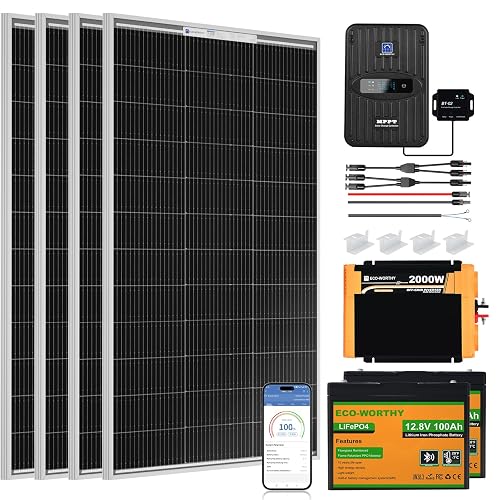
4 * 100W Solar Panel + 40A MPPT Controller + 2 * 12V 100Ah Lithium Battery + Upgraded 2000W Power Inverter + Bluetooth Module ECO-WORTHY 1.6KWH Complete Solar Panel Kit 400W 12V for RV Off Grid
Designed for RVs, vans, boats and small off-grid cabins running 12V loads.
Key specs
- Four 100 W panels, 400 W total
- 40A MPPT charge controller
- Two 12V 100Ah lithium batteries, about 1.6 kWh listed
- 2000 W power inverter
Pros
- MPPT controller improves harvest compared with PWM units at the same array size
- Bluetooth module allows monitoring from a phone
- Compact layout fits mobile installations
Cons
- 2000 W inverter limits what appliances can run at once
- Battery capacity is modest for extended cloudy periods
ECO-WORTHY 10000W Off-Grid Solar Panel Kit with 32.2 kWh Storage

ECO-WORTHY 10000W Output Complete Off-Grid Solar Panel Kit for Home| 10KW 120V/240V Output Split Phase Inverter| 2pcs 48V 314Ah 32.2kWh High Capacity Energy Storage| 10620 Watts Solar Panel PV
Best for high-consumption homes, or households that want several days of autonomy during long winter outages.
Key specs
- 10 kW inverter, 120V/240V split-phase
- Two 48V 314Ah batteries, about 32.2 kWh total
- About 10,620 W of solar panel capacity listed
Pros
- Very large storage capacity for extended backup
- Panel array matches the inverter output well
- Fewer battery units than the four-battery 20 kWh kit
Cons
- Large battery modules are heavy and need proper handling and mounting
- Full system cost in components and labor is substantial, so right-size loads first
DIY Off-Grid Solar Power Systems Bible

The DIY Off-Grid Solar Power Systems Bible: Install Panels with Confidence, Choose Better Kits, Size Batteries, and Plan for Home, RV, and Air Conditioner Use
This is a reference book rather than hardware, aimed at readers who want to understand panel installation, battery sizing and kit selection before committing to a purchase.
Key specs
- Covers panel installation, battery sizing and system planning
- Addresses home, RV and air conditioner use cases
Pros
- Useful for working out load calculations before buying a kit
- Covers multiple use cases, from RVs to whole homes
- Helps buyers avoid undersized batteries or inverters
Cons
- Does not include any equipment, so you still need to buy a kit or parts
- Details may lag behind newer product generations, so check current specifications
3000W 24V Solar Power System Complete Kit with 5.12 kWh Battery

3000W 24V Solar Power System Complete Kit with 1440W (12×120W) Solar Panel 3KW Peak 6KW Pure Sine Wave Inverter, 5.12KWH Battery,PV Combiner Box,MPPT Solar Controller,Off-Grid Home RV Backup
A mid-size option for RVs and home backup circuits where 24V DC bus voltage is a good fit.
Key specs
- 1440 W array from 12 panels at 120 W each
- 3 kW inverter, 6 kW peak, pure sine wave
- 5.12 kWh battery storage
- Includes PV combiner box and MPPT controller
Pros
- Pure sine wave output suits sensitive electronics
- Combiner box and MPPT controller are included
- 24V architecture reduces current compared with 12V at similar power
Cons
- 1440 W array is light for large loads or fast recharge
- Owners may need to add wiring and mounting hardware separately
Buying Guide
Selection Criteria
Start with your daily energy use in kilowatt-hours, not with the kit list. Add up the wattage and hours for every load you want to run, then add a margin of about 20 percent for inefficiency and aging batteries. That number drives battery size. Inverter size comes from the largest simultaneous load, including motor start surges. Panel wattage should be enough to recharge the battery within a reasonable window on typical sun hours. For more on reading panel data, see Solar Panel Specifications for DIY Systems: What Each Number Means.
Important Features
- Battery chemistry: LiFePO4 is widely used in kits for its cycle life and tolerance of partial discharge.
- Inverter type: Pure sine wave output is preferred for motors, electronics and sensitive equipment.
- Charge controller: MPPT controllers generally harvest more energy than PWM, especially when panel voltage is higher than battery voltage.
- Protection: Look for built-in overcurrent, overvoltage and low-voltage cutoff protection.
Specs to Check
- Inverter continuous and surge ratings
- Battery nominal voltage and usable kWh (not just nameplate)
- Total panel wattage and maximum input voltage of the controller
- Certifications such as UL1741 for inverters and UL1973 for batteries
- Expansion options for adding batteries or panels later
For a broader comparison of kit types, see DIY Solar Energy Kit Guide: Pick, Size and Wire a Kit Right and Off-Grid, Backup and Hybrid Solar Systems: How They Differ.
Choosing by Need
For a cabin or shed with lights, a fan and a few outlets, a 12V or 24V kit around 1.5 to 5 kWh is usually enough. For a full home with air conditioning, a 10 kW split-phase system with 16 kWh or more of storage is more realistic. Owners running an RV or van should prioritize a 12V or 24V system with an MPPT controller. For planning a small outbuilding, Off-Grid Solar for Sheds, Cabins and Workshops: Planning Guide walks through load calculations. If you want to start small and expand, 7 Best DIY Solar System Kits for Beginners and Off-Grid Builders (2026) covers entry-level options.
Things to Watch Out For
- Nameplate battery kWh is often higher than usable kWh once depth of discharge limits apply.
- Panel wattage does not equal daily output; local sun hours and tilt determine real harvest.
- Split-phase and high-voltage DC systems carry real shock and fire risk. Owners should follow the National Electrical Code and local permit rules.
- Heavy battery modules require secure mounting and proper ventilation.
Electrical installations involve safety hazards. Consult a licensed electrician or qualified installer, especially for grid-adjacent or whole-house systems.
FAQ
What size off grid solar kit do I need for a small cabin?
Most small cabins that run LED lighting, a refrigerator and a few electronics use between 1 and 3 kWh per day. A 2 to 5 kWh battery with a matching panel array of about 1000 to 2000 W is a common starting point. Calculate your own loads to confirm.
Can a DIY kit power a whole house?
Yes, if the inverter, battery and panel array are sized for the whole-house load. Systems in the 10 kW class with 16 kWh or more of storage are often considered for whole-house use, but air conditioning and electric heat can push consumption much higher.
Is LiFePO4 better than lead-acid for off-grid kits?
LiFePO4 batteries generally offer more usable capacity, longer cycle life and lighter weight than flooded or AGM lead-acid. They also cost more up front and need a battery management system compatible with the charger and inverter.
Do I need a permit to install an off-grid solar kit?
Requirements vary by jurisdiction. Many areas require permits for electrical work, and split-phase or grid-tied connections almost always do. Check with your local building department before installation.
What is the difference between an MPPT and PWM charge controller?
MPPT controllers adjust input voltage to extract maximum power from the panels, which usually yields more energy, especially when panel voltage is well above battery voltage. PWM controllers are simpler and less expensive but typically harvest less energy.
How long will the battery run my loads?
Runtime equals usable battery kWh divided by your average load in kilowatts. A 5 kWh usable battery running a 500 W average load lasts about 10 hours. Account for inverter losses, which commonly run around 10 to 15 percent.
Conclusion
For a cabin, shed or RV, the smaller 12V and 24V kits are the most practical starting point, particularly the ECO-WORTHY 1.6 kWh 12V kit for mobile use and the 3000 W 24V kit for mid-size backup. For a full home, the 10 kW split-phase kits are the realistic category, with the Solar Panel Kit with 9.36 kWh suiting moderate use, the 20 kWh four-battery system suiting heavier evening loads, and the 32.2 kWh system suiting long outages. Buyers who want certification evidence should look at the SUNGOLDPOWER UL-listed option. Anyone still unsure about loads should read the sizing reference before choosing a kit, and any installation involving split-phase or high-voltage DC should be reviewed by a licensed professional.