 By Graham Fisher
Updated November 2026
Choosing a renogy solar charge controller comes down to three things: the battery voltage your system runs on, the maximum current your array can push, and whether you need MPPT or PWM regulation. This list compares six Renogy models on those criteria, along with battery chemistry support, input voltage limits and the kind of build each one suits. Recommendations are based on manufacturer specifications and common owner feedback patterns, not on any testing of our own.
Our top picks at a glance
- 1
 TOP CHOICEBest overallRenogy Solar Charge Controller Rover 40A 12V24V Auto Parameter MPPTView on Amazon
- 2
 TOP CHOICEBest for high-current arraysRenogy 60A MPPT Solar Charge Controller Rover LiteView on Amazon
- 3
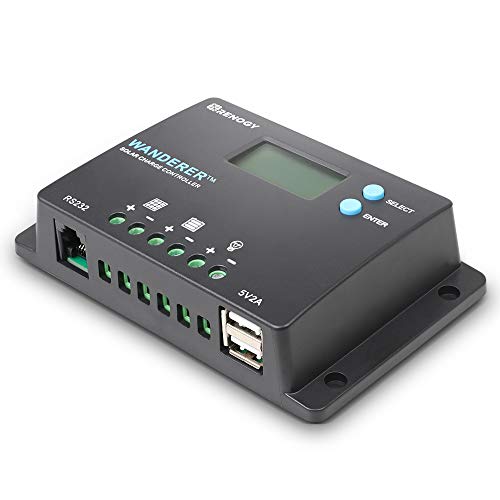 TOP CHOICEBest for small RV and cabin setupsRenogy Wanderer 10A 12/24V PWM Solar Charge ControllerView on Amazon
- 4
 Best for lithium batteries on a budgetRenogy Wanderer Li 30A 12V PWM Solar Charge ControllerView on Amazon
- 5Best for larger off-grid banksRenogy Rover 60A MPPT Solar Charge Controller 12/24/36/48VView on Amazon
- 6
 Best for mid-size 12V and 24V systemsRenogy Rover 30A 12V/24V Auto DC Input MPPT Solar Charge Controller PaView on Amazon
Our Top Picks
Quick Comparison
| Product | Best for | Key feature |
|---|---|---|
| Renogy Rover 40A MPPT | Overall DIY use | Adjustable LCD, 12V/24V auto |
| Renogy Rover Lite 60A MPPT | High-current arrays | 150V maximum solar input |
| Renogy Wanderer 10A PWM | Small RV and cabin setups | Overcharge and short protection |
| Renogy Wanderer Li 30A PWM | Lithium batteries on a budget | Manual lithium battery setting |
| Renogy Rover 60A MPPT | Larger off-grid banks | Multi-voltage 12V to 48V |
| Renogy Rover 30A MPPT | Mid-size 12V and 24V systems | Parameter-adjustable LCD |
Renogy Solar Charge Controller Rover 40A 12V24V Auto Parameter MPPT
Renogy Solar Charge Controller Rover 40A 12V24V Auto Parameter DC Input MPPT Charge Controllers for Solar Panels Adjustable LCD for Gel Sealed Flooded Lithium Battery
Best for: Overall DIY use with lead-acid or lithium batteries.
This 40A unit suits builders who want one controller that handles 12V and 24V banks and can be configured for gel, flooded, AGM or lithium chemistries. It is a common pick for mid-size cabin and van builds.
Pros
- Auto voltage detection for 12V and 24V systems
- Adjustable LCD for charge parameters
Cons
- Requires careful parameter setup for lithium batteries
Renogy 60A MPPT Solar Charge Controller Rover Lite
Renogy 60A MPPT Solar Charge Controller 12V/24V/36V/48V Auto, 150V Maximum Solar Input, for Gel Sealed Flooded and Lithium Battery, Rover Lite 60A
Best for: High-current arrays that need a higher solar input limit.
Builders stringing higher-wattage panels in series will find the 150V maximum input and 60A output useful. Owners often report it fits larger arrays where a 40A controller would clip.
Pros
- Supports 12V, 24V, 36V and 48V battery banks
- Wide solar input window for series-wired panels
Cons
- Larger footprint than entry-level PWM models
Renogy Wanderer 10A 12/24V PWM Solar Charge Controller
Renogy Wanderer 10A PWM Solar Charge Controller 12/24V for Solar Panels | 50V PV input, AGM/Gel/Flooded (auto), Li (manual), LCD, overcharge/ short protection, negative ground, temp comp, for RVs
Best for: Small RV and cabin setups with a modest panel array.
This PWM unit is a practical choice for a single 100W to 200W panel feeding a 12V battery. It is widely used in RV and small off-grid kits where cost and simplicity matter more than harvesting every watt.
Pros
- Overcharge, short-circuit and temperature compensation protection
- Simple wiring for small kits
Cons
- PWM design wastes more panel output than MPPT on the same array
Renogy Wanderer Li 30A 12V PWM Solar Charge Controller
Renogy Wanderer Li 30A PWM Solar Charge Controller 12V for Solar Panels | 25V PV input, LED,AGM/Gel/Flooded (auto), Li (manual), overcharge/short protection, negative ground, temp comp, for RVs
Best for: Lithium batteries on a budget.
The Wanderer Li is aimed at builders running a 12V LiFePO4 pack who want PWM simplicity. Manufacturer specs list a manual lithium setting alongside auto detection for lead-acid chemistries.
Pros
- Manual lithium setting for LiFePO4 packs
- LED status indicators for quick checks
Cons
- Limited to 12V systems and 30A output
Renogy Rover 60A MPPT Solar Charge Controller 12/24/36/48V
Best for: Larger off-grid banks running 48V.
This MPPT model covers the full 12V to 48V range and is listed for off-grid use with a 150V array input. It suits builders planning a bigger battery bank and a multi-panel array.
Pros
- Covers 12V, 24V, 36V and 48V systems
- Manufacturer lists 99% MPPT efficiency
Cons
- Overkill for a single small panel
Buying Guide
Battery Voltage Compatibility
Match the controller to your battery bank voltage first. Most of the Renogy models here support 12V and 24V systems automatically, while the Rover 60A variants also cover 36V and 48V setups. Choosing the wrong voltage class is one of the most common mistakes in DIY solar builds, so confirm your battery bank voltage before comparing anything else.
MPPT Versus PWM Regulation
MPPT controllers track the panel’s maximum power point and can convert higher panel voltage down to battery voltage, which usually yields more usable energy from the same array. PWM controllers are simpler and less expensive, but they require the panel voltage to closely match the battery voltage. For larger arrays or cloudy-climate installations, MPPT is generally the better fit.
Battery Chemistry Support
Check that the controller supports your battery type, whether that is sealed gel, flooded lead-acid, AGM or lithium. Some models detect the chemistry automatically, while others need a manual setting for lithium batteries. Using the wrong charge profile can shorten battery life, so this detail matters as much as current rating.
Current Rating and Array Size
Size the controller’s amp rating to your array’s total output, with some headroom for real-world conditions. An undersized controller will limit charging on sunny days, while an oversized one simply costs more. Calculate your panel wattage, divide by your system voltage, and choose a rating that comfortably exceeds that figure.
Monitoring and Protection Features
Look for built-in protections such as overcharge, short-circuit and reverse-polarity safeguards, along with a clear display or app connectivity for monitoring. Bluetooth or LCD readouts make it easier to track charging status and spot problems early. These features are especially useful for off-grid systems where you cannot easily check the hardware every day.
FAQ
Can I use a Renogy solar charge controller with lithium batteries?
Many Renogy models support lithium batteries, but some require you to set the battery type manually rather than detecting it automatically. Always confirm the lithium charge profile in the manual and match it to your battery’s specifications. Using the correct setting helps protect the battery and extends its service life.
What is the difference between MPPT and PWM controllers?
MPPT controllers optimize power extraction from the panels and can convert higher panel voltage into lower battery voltage, often producing more energy. PWM controllers are simpler and cheaper but work best when panel and battery voltages are closely matched. For most DIY systems with larger arrays, MPPT is the more efficient choice.
How do I know what amp rating I need?
Divide your total solar panel wattage by your battery bank voltage to estimate the current your array can produce. Choose a controller rated above that number to allow for peak output and future expansion. Leaving some margin helps prevent the controller from limiting your charging capacity.
Can one controller handle a 12V and 24V system?
Models that list automatic 12V and 24V support can detect the system voltage and adjust accordingly, which covers both common configurations. Some Rover models also extend to 36V and 48V. Still, confirm the exact voltage range in the product specifications before buying.
Do I need Bluetooth monitoring?
Bluetooth monitoring is not required for a working system, but it is convenient for checking charge levels, battery status and fault conditions from your phone. It is most helpful for remote or off-grid installations where regular physical access is limited. If you are installing in an easily accessible location, an LCD display may be enough.
Conclusion
For larger DIY arrays and lithium or flexible battery setups, the MPPT models with higher amp ratings and multi-voltage support are the best match. For smaller, budget-conscious builds on a 12V system, a PWM model or a lower-amp MPPT unit can cover the job well.
Start by confirming your battery voltage, chemistry and total array wattage, then pick the model whose ratings fit those numbers with some room to spare.
Related reading
- Renogy PWM Solar Charge Controller: How to Choose and Wire One
- Solar Charge Controller Repair: A Step-by-Step Guide for DIY Builders
- Solar Charge Controller Lithium Ion: How to Choose and Wire One (Step-by-Step)
- Solar Charge Controller DIY: Wire and Size One in 7 Steps
- Solar Charge Controller 20 Ampere: How to Size and Wire One (2026)
- Solar Charge Controller 100 Amp: How to Size and Wire One Safely
About Graham Fisher
Graham Fisher is part of our editorial team and reviews and edits our DIY solar power systems guides, checking product details against manufacturer specifications and owner feedback.





