As an Amazon Associate I earn from qualifying purchases. This page may contain affiliate links.
Choosing an off grid solar system for house use means matching panel output, battery storage and inverter capacity to how your home actually draws power. A cabin that runs a fridge and a few lights needs very different hardware than a full-time residence with an electric range, well pump and central air. This guide compares ten complete kits sold on Amazon US, grouped by the features that matter most for a whole-house off-grid build: inverter voltage and surge rating, battery bank size and chemistry, total panel wattage, expandability, and monitoring. Each entry lists who the kit suits and what owners tend to praise or criticize, so you can narrow the field before you start running load calculations.
Our Top Picks
Quick Comparison
| Product | Best for | Key feature |
|---|---|---|
| ECO-WORTHY Whole House System 10KW 120V/240V with 16kWh battery | Full-time homes with split-phase loads | Split-phase 10 kW inverter with 16 kWh storage |
| SUNGOLDPOWER 10000W Off Grid Solar System Complete Kit | Whole-house builds wanting a large panel array | 12 panels totaling 6.6 kW with five 100Ah LiFePO4 batteries |
| ECO-WORTHY Solar Panel Kit 10KW Off Grid System with 10.24kWh battery | Medium homes that want modular expansion | Two 48V 100Ah lithium batteries with 10 kW inverter |
| ECO-WORTHY Off Grid Solar Panel Kit 5KW with 2340W panels | Smaller homes and efficiency-focused setups | 5 kW 48V inverter with 12 × 195W panels |
| 3000W 24V Solar Power System Complete Kit with 5.12kWh battery | Cabins, RVs and light backup duty | Pure sine wave inverter with built-in MPPT controller and combiner box |
| 12000W Solar Power System Kit with 12KWh battery | High-demand homes with electric heating | 12 kW split-phase hybrid inverter with dual 200A MPPT inputs |
| ECO-WORTHY 7.168KWH 800W Solar Panel Kit for RV Off Grid | Small off-grid cabins and RV-scale loads | 3000W UPS-style inverter charger with 60A MPPT controller |
| ECO-WORTHY Solar Complete System with Powermega 48V 314Ah batteries | Homes prioritizing long backup runtime | Two 314Ah 48V batteries with 10 kW hybrid inverter |
| ECO-WORTHY 10KW Output Off Grid Solar System with custom 48V 314Ah battery | Buyers who want to configure components | Standard kit with customizable battery and panel options |
| ECO-WORTHY 10KW Home Off-Grid Solar Power System with 15.36kWh LiFePO4 | Whole-house systems with app monitoring | Dual MPPT inverter with 4920W panels and app monitoring |
ECO-WORTHY Whole House System 10KW 120V/240V Split Phase Solar Inverter 16kWh

Whole House System:10KW 120V/240V Split Phase Solar Inverter| 48V 314Ah 16kWh High Capacity Energy Storage| 2950W Solar Panel ECO WORTHY 10000W Output Complete Off-Grid Solar Panel Kit for Home
This kit suits full-time homeowners who need 120V and 240V circuits for appliances such as electric ranges, dryers and well pumps. The split-phase inverter output is the defining feature for whole-house service.
Key specs
- Inverter: 10 kW, 120V/240V split phase
- Battery storage: 48V, 314Ah, 16 kWh
- Solar array: 2950W of panels
Pros
- Split-phase output supports 240V appliances directly
- Large battery capacity suits multi-day autonomy goals
- Single-kit approach reduces component-matching work
Cons
- The 2950W array is modest for a 16 kWh battery, so recharge time on cloudy days can be long
- Installation of split-phase service typically requires a licensed electrician
SUNGOLDPOWER 10000W Off Grid Solar System Complete Kit

SUNGOLDPOWER 10000W Off Grid Solar system Complete Kit, 1*10KW 120V/240Vac Solar inverter (UL1741) + 12*550W solar panel ( 6.6KW) +5 *100Ah 51.2V Lifepo4 Battery (UL1973),For House storage(SGR-10K25S)
This kit fits homeowners who want a large panel array paired with a sizable lithium bank, and who plan to size the system to a substantial daily load.
Key specs
- Inverter: 10 kW, 120V/240V split phase
- Panels: 12 × 550W (6.6 kW total)
- Battery: 5 × 100Ah 51.2V LiFePO4
Pros
- 6.6 kW array gives strong daytime generation capacity
- LiFePO4 chemistry offers long cycle life
- Split-phase inverter matches whole-house wiring
Cons
- Five 100Ah batteries total about 25.6 kWh, which may require careful wiring and balancing
- Panel count and roof or ground mounting require significant structural planning
ECO-WORTHY Solar Panel Kit 10KW Off Grid System with 10.24kWh Battery

Solar Panel Kit:12PCS 195W Solar Panels(2340W)+2PCS 48V 100AH Cubix Lithium Battery(10.24kWh)+10KW Solar Inverter 120V/240V ECO-WORTHY 10KW Output 9.36KWH Off Grid Solar System Complete Kit for Home
Medium-sized homes that want a 10 kW inverter with a mid-size battery bank will find this kit a reasonable match. It suits buyers who plan to add batteries later.
Key specs
- Inverter: 10 kW, 120V/240V
- Panels: 12 × 195W (2340W total)
- Battery: 2 × 48V 100Ah Cubix lithium (10.24 kWh)
Pros
- Two-battery configuration is a sensible starting bank
- Inverter capacity leaves room for motor starting loads
- Clear component list makes expansion planning simpler
Cons
- The 2340W array is light for a 10 kW inverter and 9.36 kWh of usable storage
- Owners often report needing to add panels to keep up with daily consumption
ECO-WORTHY Off Grid Solar Panel Kit 5KW with 2340W Panels

Off Grid Solar Panle Kit with Battery & Inverter:12x195W Panels, 48V 5000W Solar Inverter, 48V 100AH Cubix LiFePO4 Battery ECO-WORTHY 5KW Off Grid Solar System Complete Kit 2340W
This kit is aimed at smaller homes or a whole-house system with moderate loads, such as a home that uses an electric heat pump only seasonally.
Key specs
- Inverter: 5 kW, 48V
- Panels: 12 × 195W (2340W)
- Battery: 48V 100Ah Cubix LiFePO4
Pros
- Lower inverter rating suits a more efficient home
- Single battery keeps wiring simple
- Good starting point for learning system behavior
Cons
- One 100Ah battery provides limited storage for a full house
- A 5 kW inverter may struggle with simultaneous large loads
3000W 24V Solar Power System Complete Kit with 5.12kWh Battery

3000W 24V Solar Power System Complete Kit with 1440W (12×120W) Solar Panel 3KW Peak 6KW Pure Sine Wave Inverter, 5.12KWH Battery,PV Combiner Box,MPPT Solar Controller,Off-Grid Home RV Backup
Cabins, workshops and RVs that run modest loads will find this kit suitable. It bundles panels, battery, controller and inverter in one package.
Key specs
- Inverter: 3000W, 24V, pure sine wave (6 kW peak)
- Panels: 12 × 120W (1440W)
- Battery: 5.12 kWh
Pros
- Pure sine wave output is compatible with sensitive electronics
- Integrated combiner box and MPPT controller simplify wiring
- Lower voltage suits small structures
Cons
- 3 kW continuous output is too small for most full-house electric loads
- The 1440W array is modest for recharging a 5 kWh battery daily in winter
12000W Solar Power System Kit: 12KW 48V Split Phase Hybrid with 12KWh Battery
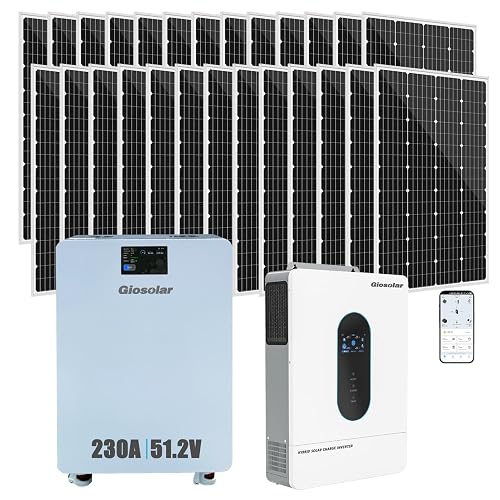
12000W Solar Power System Kit: 12KW 48V Split Phase Hybrid Solar Inverter with Dual 200A MPPT & WiFi, 12KWh 51.2V 230Ah Battery, 26pcs 120W Rigid Solar Panels for Home Off-Grid/Backup Power
Homes with electric heating, well pumps and EV charging will need this higher capacity. It suits owners planning for high-demand, extended off-grid living.
Key specs
- Inverter: 12 kW, 48V split phase, hybrid
- Battery: 12 kWh, 51.2V 230Ah
- Panels: 26 × 120W rigid (about 3.1 kW)
Pros
- Dual 200A MPPT inputs support higher array voltages
- Hybrid inverter can accept grid or generator input as backup
- WiFi monitoring helps track consumption
Cons
- Panel array is light relative to the inverter and battery size
- Higher power levels require careful wire sizing and a qualified installer
ECO-WORTHY 7.168KWH 800W Solar Panel Kit for RV Off Grid Complete System

4PCS 195W Solar Panels, 3000W UPS Inverter Charger, 2PCS 12.8V 280AH Lithium Batteries, 60A MPPT Controller Bluetooth ECO-WORTHY 7.168KWH 800W Solar Panel Kit for RV Off Grid Complete System
Small off-grid cabins or RV setups with compact loads are the best match. This is the most modest kit in the list, and it is not sized for a conventional house.
Key specs
- Inverter: 3000W UPS-style inverter charger
- Panels: 4 × 195W (780W)
- Battery: 2 × 12.8V 280Ah lithium (about 7.168 kWh)
Pros
- Integrated inverter charger handles grid backup
- 60A MPPT controller with Bluetooth monitoring
- Good energy storage for the panel size
Cons
- Panel array is small for a full house
- 3000W output limits simultaneous appliance use
ECO-WORTHY Solar Complete System with Powermega 48V 314Ah Batteries

Solar Complete System with 590W N-Type Solar panel(6pcs)+Powermega 48V 314Ah(2 Pack)+Liber 10KP 10kW Hybrid Inverter+Cable ECO-WORTHY Solar Panel Kit LiFePO4 Energy Storage System for Home Backup
Homeowners who prioritize backup runtime for outages will find the battery bank here attractive. It pairs a 10 kW hybrid inverter with two large 48V batteries.
Key specs
- Inverter: 10 kW hybrid
- Panels: 6 × 590W N-type (3540W)
- Battery: 2 × 48V 314Ah (about 30 kWh)
Pros
- Large battery capacity supports extended outage runtime
- N-type panels offer high per-panel output
- Hybrid inverter supports grid-tied backup
Cons
- A 3.5 kW array needs several sunny days to refill a 30 kWh bank
- Battery weight and placement require planning
ECO-WORTHY 10KW Output Off Grid Solar System with Custom 48V 314Ah Battery

Standard: 4x590W Solar Panels+48V 10kW Inverter +48V 314AH Battery+Cable. Customize the System to Fit Your Needs. ECO-WORTHY 10KW Output Off Grid Solar System Complete Kit& Custom 48V 314Ah
Builders who want a standard package they can adjust will find this kit flexible. It is useful when you want to size panels and battery independently.
Key specs
- Inverter: 10 kW, 48V
- Panels: 4 × 590W (2360W standard)
- Battery: 48V 314Ah, customizable
Pros
- Customizable configuration suits specific load profiles
- Large 314Ah battery provides substantial storage
- Single inverter simplifies system architecture
Cons
- The standard panel count is light for a 10 kW inverter
- Customization adds planning work and possible compatibility checks
ECO-WORTHY 10KW Home Off-Grid Solar Power System with 15.36kWh LiFePO4

10KW Home Off-Grid Solar Power System Complete Kit 120V/240V Output with 15.36kWh LiFePO4 Battery (3×51.2V 100Ah), 4920W Solar Panels (12×410W), Dual MPPT Inverter, App Monitoring for Whole House
Whole-house systems that need a balanced combination of generation, storage and monitoring are the target. This kit has the most complete panel array in the list.
Key specs
- Inverter: 10 kW, 120V/240V, dual MPPT
- Panels: 12 × 410W (4920W)
- Battery: 3 × 51.2V 100Ah LiFePO4 (15.36 kWh)
Pros
- 4920W array gives stronger daily generation than most kits here
- Dual MPPT inputs improve panel string flexibility
- App monitoring helps track consumption and state of charge
Cons
- Rooftop or ground array installation requires solid planning
- App features and firmware updates vary across owner reports
Buying Guide
Selection Criteria We Used
These picks were chosen by comparing published specifications, brand reputation for off-grid equipment, and common patterns in owner feedback. We did not test any of these kits. The criteria were:
- Inverter rating and output configuration (120V, 240V split phase, or 24V/48V)
- Battery capacity in kWh and chemistry (LiFePO4 is the common choice for off-grid storage)
- Total panel wattage relative to inverter and battery size
- Expandability and whether components can be added later
- Monitoring and protection features
Important Features in a Whole-House Kit
A whole-house system differs from a cabin kit in three ways. The inverter must handle your peak simultaneous load, not your average. The battery must cover your nightly and multi-day needs. And the array must recharge that battery within a realistic window, even in winter. Look for a split-phase inverter if you have 240V appliances, a battery in the range your daily use requires, and an MPPT charge controller that matches your array voltage.
Specs to Check Before You Buy
- Inverter continuous and surge rating: Compare against your largest motor loads, such as a well pump.
- Battery voltage and capacity: Convert Ah to kWh by multiplying voltage by amp-hours and dividing by 1000.
- Array voltage limits: Confirm the MPPT controller’s maximum open-circuit voltage.
- Protection: Breakers, fusing and battery management system (BMS) features should be listed.
Choosing by Need
- Small cabin or RV: A 3 kW class system with a 5 kWh battery is usually enough.
- Medium home without large electric heat: A 5 to 10 kW inverter with 10 to 15 kWh storage is a common range.
- Full-time home with electric heat or EV charging: Plan for 12 kW or larger and a battery bank that covers at least one cloudy day.
Things to Watch Out For
- Panel wattage that looks large on paper but is too small for the battery and inverter combined.
- Kits sold as “whole house” that do not list split-phase output if you need 240V.
- Installation requirements that call for permits and inspection in your area.
For electrical service connections and load panel work, consult a licensed electrician. For sizing methods, see Solar Sizing Formulas for Loads, Batteries and Inverters and How to Size an Inverter for a DIY Solar System.
FAQ
How much solar do I need for a whole house off grid?
It depends on your daily kilowatt-hour use. Add up your appliance loads over a typical day, then divide by your local peak sun hours to estimate array wattage, adding a margin for losses. Many full-time homes end up between 5 kW and 12 kW of panels. How to Size Solar Panels for a DIY System walks through the calculation.
Do I need a split-phase inverter?
If your home has 240V appliances such as an electric range, dryer or well pump, a split-phase output is typically required. Single-phase 120V-only inverters will not run those circuits directly.
What battery size is practical for an off-grid house?
Many owners size storage for one to two days of autonomy. Battery banks in the 10 to 30 kWh range are common for full-time homes, but the right number depends on your load and how much sun you expect.
Is LiFePO4 better than other battery chemistries for off-grid?
LiFePO4 is widely used in off-grid systems because it offers good cycle life and a stable chemistry. It typically requires a compatible charge controller and inverter settings. Check the battery’s BMS and manufacturer specifications.
Can I expand a kit later?
Some kits, particularly those built around a standard inverter and modular battery, allow additional panels or batteries. Confirm the inverter’s maximum array and battery input limits before buying expansion parts. For broader planning, see How to Plan a DIY Solar System on Paper.
Do these kits require a permit?
Requirements vary by location. Many jurisdictions require permits for grid-adjacent or whole-house electrical work. Check with your local building department and consult a licensed electrician before connecting any system to your home wiring.
What is the difference between off-grid, backup and hybrid systems?
An off-grid system runs without any utility connection. A backup system stays idle until the grid fails. A hybrid system combines both. Off-Grid, Backup and Hybrid Solar Systems: How They Differ explains the design differences.
Conclusion
For a full-time off grid solar system for house use, the strongest candidates are the larger split-phase kits: the 10 kW ECO-WORTHY whole-house system with 16 kWh storage, the SUNGOLDPOWER 10000W kit with its 6.6 kW array, and the 12 kW hybrid kit for high-demand homes. Buyers with medium loads and a plan to expand may prefer the 10 kW kit with two 48V 100Ah batteries or the customizable 314Ah standard package. Smaller cabins and RVs are better served by the 3000W 24V kit or the 800W RV-scale system. Whichever you choose, verify your load profile, confirm split-phase needs, and have a licensed electrician review the installation.