 By Graham Fisher
Updated November 2026
An off grid solar charge controller regulates the current flowing from your panels into your battery bank, and it decides how well your system harvests sunlight and how long your batteries last. This comparison looks at six MPPT controllers sold on Amazon US, judged on battery chemistry support, maximum PV input voltage, current rating, and the monitoring features owners tend to rely on. Every pick is based on manufacturer specifications and patterns in owner feedback.
Note: check your panel string voltage and battery voltage before buying. A controller that cannot handle your array’s open-circuit voltage will not work, no matter how good its specs look.
Our top picks at a glance
- 1
 TOP CHOICEBest overallVictron Energy SmartSolar MPPT 100V 30 amp 12/24-Volt Solar Charge Controller (Bluetooth)View on Amazon
- 2
 TOP CHOICEBest for RV and high-current builds100A MPPT Solar Charge Controller,250VDC Max PV Input,99.9% EfficiencyView on Amazon
- 3
 TOP CHOICEBest for LiFePO4 mid-size systems60A MPPT Solar Charge Controllers,200V Max PV Input,99.9% Efficiency,1View on Amazon
- 4
 Best for multi-voltage flexibilitySolar Charge Controller 100A 12V 24V 36V 48V Intelligent Recognition LView on Amazon
- 5
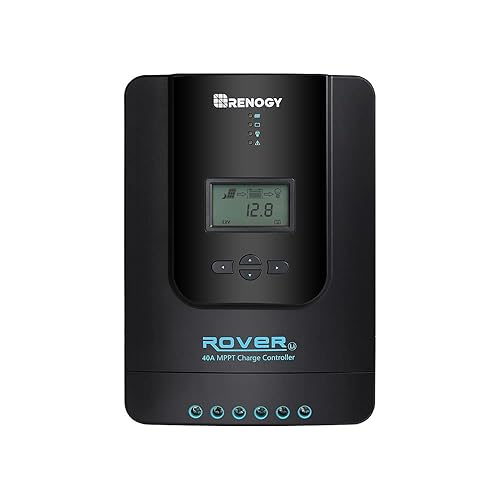 Best for a proven small systemRenogy Solar Charge Controller Rover 40A 12V24V Auto Parameter DC InpuView on Amazon
- 6
 Best budget high-current pickUpgraded 100A MPPT Solar Charge Controller 12V 24V 36V 48V LCD DisplayView on Amazon
Our Top Picks
Quick Comparison
| Product | Best for | Key feature |
|---|---|---|
| Victron Energy SmartSolar MPPT 100V 30A | Best overall | Bluetooth monitoring |
| 100A MPPT Solar Charge Controller (B0GFDDW9GF) | RV and high-current builds | 250VDC max PV input |
| 60A MPPT Solar Charge Controllers (B0GGHVSCPM) | LiFePO4 mid-size systems | 200V max PV input |
| Solar Charge Controller 100A (SA100A) | Multi-voltage flexibility | Auto 12/24/36/48V |
| Renogy Rover 40A MPPT | Proven small system | Adjustable LCD display |
| Upgraded 100A MPPT Solar Charge Controller | Budget high-current pick | Dual USB outputs |
Victron Energy SmartSolar MPPT 100V 30 amp 12/24-Volt Solar Charge Controller (Bluetooth)
Victron Energy SmartSolar MPPT 100V 30 amp 12/24-Volt Solar Charge Controller (Bluetooth)
Best for: Best overall
This suits owners who want a well-documented controller with a dedicated monitoring app and a strong brand behind it.
Pros:
- Bluetooth app shows charge stages and history
- Widely referenced in off-grid wiring guides
Cons:
- Limited to 12/24V systems at 30 amps
100A MPPT Solar Charge Controller,250VDC Max PV Input,99.9% Efficiency,12V 24V 36V 48V Auto,APP Monitoring,LCD Display,100 Amp Solar Panel Regulator for Lead-Acid/Lithium Battery,RV Off-Grid
100A MPPT Solar Charge Controller,250VDC Max PV Input,99.9% Efficiency,12V 24V 36V 48V Auto,APP Monitoring,LCD Display,100 Amp Solar Panel Regulator for Lead-Acid/Lithium Battery,RV Off-Grid
Best for: RV and high-current builds
Best for owners running larger arrays who need high PV input headroom and automatic voltage detection.
Pros:
- 250VDC maximum PV input allows longer string designs
- Auto-detects 12V through 48V battery banks
Cons:
- Listing-level specs only; verify with the manual before wiring
60A MPPT Solar Charge Controllers,200V Max PV Input,99.9% Efficiency,12V/24V/36V/48V Auto,APP Monitoring,LCD Display,60 Amp Power Controller Regulator for LiFePO4/Lead Acid Battery,RV Off-Grid
60A MPPT Solar Charge Controllers,200V Max PV Input,99.9% Efficiency,12V/24V/36V/48V Auto,APP Monitoring,LCD Display,60 Amp Power Controller Regulator for LiFePO4/Lead Acid Battery,RV Off-Grid
Best for: LiFePO4 mid-size systems
Fits owners with a 60-amp-or-smaller array who want lithium-compatible charging and app monitoring.
Pros:
- Supports both LiFePO4 and lead-acid profiles
- 200V max PV input covers common string sizes
Cons:
- Lower current ceiling than the 100A models
Solar Charge Controller 100A 12V 24V 36V 48V Intelligent Recognition LCD Display Battery Intelligent Regulator Maximum 100V Input Dual USB for Lead Acid/Lithium Battery (SA100A)
Solar Charge Controller 100A 12V 24V 36V 48V Intelligent Recognition LCD Display Battery Intelligent Regulator Maximum 100V Input Dual USB for Lead Acid/Lithium Battery (SA100A)
Best for: Multi-voltage flexibility
Good for builders who may change battery voltage later or want a single controller across several bank sizes.
Pros:
- Intelligent voltage recognition across four battery levels
- Built-in dual USB outputs for small loads
Cons:
- Maximum 100V input leaves less margin for long strings
Renogy Solar Charge Controller Rover 40A 12V24V Auto Parameter DC Input MPPT Charge Controllers for Solar Panels Adjustable LCD for Gel Sealed Flooded Lithium Battery
Renogy Solar Charge Controller Rover 40A 12V24V Auto Parameter DC Input MPPT Charge Controllers for Solar Panels Adjustable LCD for Gel Sealed Flooded Lithium Battery
Best for: Proven small system
Suits smaller cabins, sheds, and camper setups running a modest panel array on a 12V or 24V bank.
Pros:
- Adjustable LCD and battery-type settings
- Compatible with gel, flooded, and lithium batteries
Cons:
- 40-amp rating caps array size
Buying Guide
Battery Chemistry and Voltage Compatibility
Make sure the controller supports your battery type, whether that is lead-acid (flooded, gel, or AGM) or lithium iron phosphate. It also needs to match your system voltage, such as 12V, 24V, or 48V. Some controllers detect voltage automatically, which can simplify setup, but you should still confirm the battery profile settings match your chemistry.
Maximum PV Input Voltage
The maximum PV input rating is the most important safety limit on the spec sheet. Calculate your panel string’s open-circuit voltage, especially in cold weather when voltage rises, and choose a controller with a comfortable margin above that number. Exceeding the rating can permanently damage the controller.
Current Rating and Array Size
The amp rating determines how much charging current the controller can handle at your battery voltage. Divide your total panel wattage by your battery voltage to estimate the current, then choose a controller rated above that figure. Leaving some headroom helps the unit run cooler and gives room for future expansion.
Monitoring, Displays, and Connectivity
An LCD screen or smartphone app lets you watch charge state, daily yield, and fault codes without climbing onto the roof. Bluetooth or app-based monitoring is especially useful for remote cabins or RV setups where you may not check the system daily. Simple controllers with only basic indicators are fine if you prefer a hands-off approach.
FAQ
Do I need an MPPT controller instead of a PWM controller?
MPPT controllers generally harvest more energy, especially when panel voltage is well above battery voltage, which is common in colder weather or with higher-voltage arrays. PWM controllers are simpler and cheaper but tend to waste more of the panel’s potential output. For most home off-grid systems, MPPT is the better choice.
Can I use the same controller for lead-acid and lithium batteries?
Many modern controllers offer selectable battery profiles that work with both lead-acid and lithium chemistries. Check that the specific model lists your battery type and that you can adjust the charge voltage settings. Always follow your battery manufacturer’s charging recommendations.
What happens if my panels produce more voltage than the controller allows?
Exceeding the maximum PV input voltage can permanently damage the controller and may void its warranty. Cold temperatures increase open-circuit voltage, so calculate the worst-case voltage for your location before wiring panels in series. Reducing the number of panels per string is the usual fix.
Should I size the controller larger than my current array?
A controller with some extra current capacity gives you room to add panels later and helps it run cooler under load. Going far beyond your needs adds cost without much benefit, so a moderate margin is usually the sensible choice. Match the rating to your planned array size rather than your current one alone.
Do I need a separate battery monitor if my controller has a display?
A controller display shows charging information, but it may not track the full battery state of charge as accurately as a dedicated battery monitor. If you need precise tracking of energy in and out of the battery bank, a separate shunt-based monitor can provide more detail. Many owners use both for complete visibility.
Conclusion
If you want the most detailed monitoring and are comfortable with a connected app, the Victron SmartSolar is a strong choice for home systems. Buyers with larger arrays or higher-voltage setups should look at the higher-amp options, while those with smaller systems or budget constraints may find the 40A Renogy unit covers their needs.
Before you buy, verify your panel open-circuit voltage, battery chemistry, and total charging current, then select the controller that fits those numbers with some margin. Matching the controller to your specific system matters more than choosing the model with the most features.
Related reading
- 7 Best Outback Solar Charge Controller Options for DIY Off-Grid Systems
- 6 Best Solar Charge Controller RV Options for Off-Grid Campers (2026)
- 5 Best Solar Charge Controller 48V for Off-Grid Systems (2026)
- 4 Best Solar Power Charge Controller Inverter Combos for Off-Grid Use (2026)
- Can an Off Grid Solar System Charge an EV? Sizing Math and Limits
- 6 Best Solar Controllers with Inverter Units for Off-Grid Homes (2026)
About Graham Fisher
Graham Fisher is part of our editorial team and reviews and edits our DIY solar power systems guides, checking product details against manufacturer specifications and owner feedback.


