By Claire Whitaker
Updated November 2026
A solar panel pole mounting kit lets you raise one or more panels on a vertical post, which suits yards, sheds, cabins and off-grid sites where a roof is not an option. The right kit depends on panel count and wattage, pole diameter, how much tilt adjustment you need and whether the kit includes a wall bracket. The five picks below are ranked by how well each one fits those criteria, based on manufacturer listings, brand reputation and common owner feedback.
Best overall: Solar Panel Pole Mount, Universal Double Arm – View on Amazon
Best for small arrays on a fixed pole: Adjustable Solar Panel Pole Mounting Bracket Rack Kit – View on Amazon
Best for ground-level multi-panel setups: ECO-WORTHY Upgraded Solar Ground Mount Kit – View on Amazon
Best for low-wattage panels: Solar Panel Mounting Bracket Pole Mounts Kit – View on Amazon
Best for larger panels with tilt control: Universal Solar Panel Double Arm – View on Amazon
Our Top Picks
Quick Comparison
| Product | Best for | Key feature |
|---|---|---|
| Solar Panel Pole Mount, Universal Double Arm | Two-panel pole arrays | 0-90° tilt adjustment |
| Adjustable Solar Panel Pole Mounting Bracket Rack Kit | Small 20–30W panels | Fits 40–80mm poles |
| ECO-WORTHY Upgraded Solar Ground Mount Kit | Multi-panel ground arrays | Modular multi-panel frame |
| Solar Panel Mounting Bracket Pole Mounts Kit | Low-wattage panels | Compact pole clamp design |
| Universal Solar Panel Double Arm | Larger panels up to 400W | Wide panel span support |
Solar Panel Pole Mount, Universal Double Arm with Support Pole and Wall Mount Bracket

Solar Panel Pole Mount, Universal Double Arm with Support Pole and Wall Mount Bracket, 0-90° Tilt Angle, up to 2PCS 220W/60.63" Widtht
Best for: Two-panel pole arrays that need seasonal tilt changes.
This kit suits owners who want to mount panels on a post and adjust the angle through the year. The wall bracket option adds flexibility for mounting near a structure.
Pros
- Tilt adjustable from 0 to 90 degrees
- Includes a support pole and wall mount bracket
Cons
- Panel weight and wind load should be checked against the rated limits
Adjustable Solar Panel Pole Mounting Bracket Rack Kit for 20W 30W Solar Panel

Adjustable Solar Panel Pole Mounting Bracket Rack Kit for 20W 30W Solar Panel – Fit Pole Dia 1.5 – 3.0 Inch / 40mm – 80mm
Best for: Small 20–30W panels on a fixed pole.
Good for garden lights, small sheds or trickle-charging setups where the panel is compact and the pole is standard size.
Pros
- Clamp range fits poles from 40mm to 80mm
- Simple bracket design with few parts
Cons
- Not suitable for larger panels
ECO-WORTHY Upgraded Solar Ground Mount Adjustable Multi-Pieces Solar Panel Mounting Brackets Kit
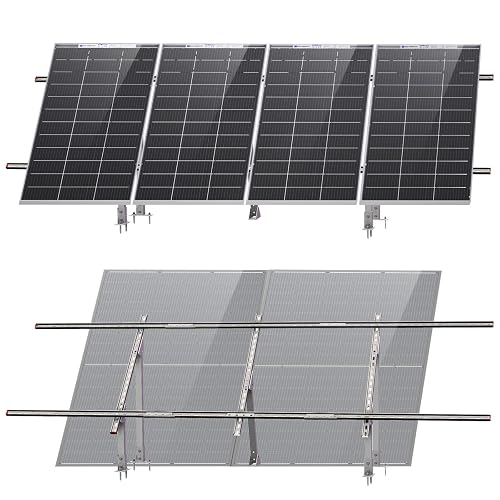
ECO-WORTHY Upgraded Solar Ground Mount Adjustable Multi-Pieces Solar Panel Mounting Brackets Kit System for 4pcs 200W/3pcs 300W/2pcs 400W Solar Panels for Ground,Open Space, Cabins and Backyard Sheds
Best for: Multi-panel ground-level arrays for sheds and cabins.
Suits owners who want to expand an array over time, since the modular pieces can be arranged for several panel counts.
Pros
- Modular frame supports 2 to 4 panels
- Adjustable layout for different yard spaces
Cons
- Assembly takes more time than a single pole clamp
Solar Panel Mounting Bracket Pole Mounts Kit Up to 30W
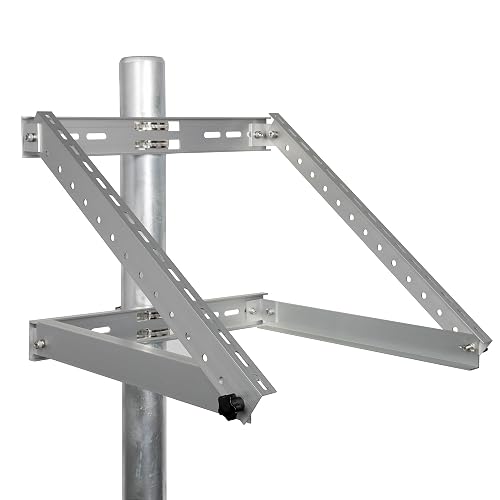
Solar Panel Mounting Bracket Pole Mounts Kit Up to 30W (Pole not Included)
Best for: Low-wattage panels where a simple clamp is enough.
A practical choice for hobby projects and small battery-charging panels mounted on an existing post.
Pros
- Lightweight and quick to attach
- Works with standard round posts
Cons
- Pole is not included, so you must source one
Universal Solar Panel Double Arm with Support Pole and Wall Mount Bracket

Universal Solar Panel Double Arm with Support Pole and Wall Mount Bracket, 0-90° Tilt Angle, up to 400W/55.51" Width
Best for: Larger panels up to 400W with tilt control.
Fits owners running a bigger off-grid array who need a wide span and adjustable angle on a single pole.
Pros
- Supports panels up to 400W
- Tilt range from 0 to 90 degrees
Cons
- Heavier panels need a pole rated for the combined load
Buying Guide
Panel Count and Wattage
Check the maximum panel size and wattage each kit lists before you buy. Exceeding the rated panel width or weight can bend arms and strain the pole. For sizing your array, see Solar Panel Mounting Options: Ground, Pole, Roof and Portable.
Pole Diameter
Measure your post before ordering. Clamp ranges such as 40–80mm are common, and a pole outside that range will not seat properly.
Tilt Adjustment
Adjustable tilt helps you chase the sun in winter and summer. Fixed-angle kits are simpler but give up some output.
Wind and Structural Load
A panel on a pole acts like a sail. Set the pole in concrete or use guy wires where wind is strong, and confirm the kit’s load rating. For mounting method details, see Solar Panel Pole Mount Diy: Build a Sturdy Pole Mount Step by Step.
Good picks for this: Solar Panel Pole Mount, Universal Double Arm and Universal Solar Panel Double Arm
FAQ
Can a solar panel pole mounting kit hold more than one panel?
Yes. Several kits in this roundup support two or more panels, and some ground-mount systems are built for three or four. Check the listed panel count and total wattage against the panels you plan to use, since exceeding the rated load can stress the arms and the pole.
What pole diameter do I need?
Pole diameter is one of the most important compatibility checks. Some brackets clamp onto a range of sizes, while others are sized for a specific pipe. Measure your pole before buying, and confirm the kit’s stated fit range to avoid a loose or unsafe connection.
Why does tilt angle matter for off-grid use?
Tilt angle controls how directly the panel faces the sun, which affects how much energy it produces across the year. Kits with adjustable tilt let you change the angle by season, while fixed-angle brackets are simpler but less flexible. Choose adjustable tilt if your site has seasonal swings in sun position.
Is a pole included with these kits?
It depends on the product. Some kits include a support pole, while others are brackets only and require you to supply your own pole. Read the listing carefully so you do not end up with hardware that cannot be installed as expected.
How do I know if a mount can handle wind?
Wind load depends on panel area, pole height, the strength of the bracket and how firmly the pole is anchored in the ground or a base. Taller setups and larger panels catch more wind, so plan for a sturdy footing and check the manufacturer’s stated load limits. When in doubt, consult a local installer or engineer for exposed sites.
Can I use a wall bracket with a pole kit?
Some kits include a wall mount bracket that lets you attach the panel to a building instead of a free-standing pole. Make sure the wall surface is solid enough to bear the panel’s weight and wind forces. Use appropriate fasteners for your wall material.
Conclusion
For most off-grid owners with one to three panels on a standard pole, the double-arm kits offer the best balance of flexibility and value. If you have a larger ground-mount project for a shed, cabin or backyard, the multi-panel ground system is the better fit. Smaller, low-wattage setups do well with the compact rack or the basic pole bracket.
Before you buy, confirm panel count, wattage, pole diameter and whether the pole is included. Matching those details to your site will do more to ensure a safe, lasting installation than any single feature.
Related reading
- Top 3 Solar Panel Mounting Kit Options Compared for Roofs and RVs
- 7 Best Solar Panel Rail Mounting Kits (2026): Our Picks
- 7 Best Solar Panel Pole Mount Kits for Off-Grid and Yard Use
About Claire Whitaker
Claire Whitaker is part of our editorial team and reviews and edits our DIY solar power systems guides, checking product details against manufacturer specifications and owner feedback.