 By Claire Whitaker
Updated November 2026
Choosing a solar panel kit with battery and inverter for shed use comes down to matching panel wattage, battery capacity and inverter output to the tools and lights you plan to run. This guide compares seven complete kits so you can see where each one fits. The selection criteria were built from manufacturer specifications, brand reputation and common owner feedback patterns: the total panel wattage, battery chemistry and capacity, inverter continuous output and surge rating, whether a charge controller is included, and how well each kit suits a small outbuilding versus a larger off-grid load.
Our top picks at a glance
- 1
 TOP CHOICEBest overallwith Battery and Inverter: 2*100W Solar Panel + 30A Charge ControllerView on Amazon
- 2
 TOP CHOICEBest for small sheds with light loadswith Battery and Inverter: 200W Solar Panels+30A Charge Controller+50AView on Amazon
- 3
 TOP CHOICEBest for mixed shed tools1280WH Complete Off-Grid Solar Panel Kit with 1000W Pure Sine Wave InverterView on Amazon
- 4
 Best for workshops with heavier loadsOff Grid Solar Panle Kit with Battery & Inverter:12x195W Panels, 48V 5View on Amazon
- 5
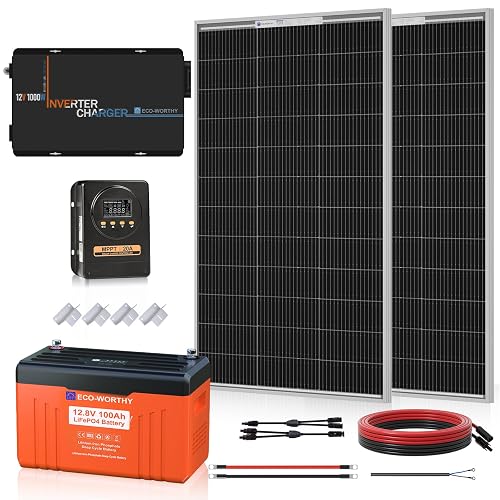 Best budget pickECO WORTHY 12V 200W Solar Panel Kit with Battery and Inverter (Bluetooth MPPT)View on Amazon
- 6
 Best for whole-building backupECO-WORTHY 10000W Output Complete Off-Grid Solar Panel Kit for Home, 10KW Split PhaseView on Amazon
- 7
 Best for higher output inverter setupsComplete Solar Inverter Kit 4000W/6000W with 100W Panels and 50A Charge ControllerView on Amazon
Our Top Picks
Quick Comparison
| Product | Best for | Key feature |
|---|---|---|
| ECO-WORTHY 200W Kit with 100Ah Battery and 1100W Inverter | Well-rounded shed setups | 100Ah lithium battery with 1100W inverter |
| ECO-WORTHY 200W Kit with 50Ah Battery and 600W Inverter | Small sheds with light loads | Compact 600W inverter |
| 1280Wh Off-Grid Kit with 1000W Inverter | Mixed shed tools and lighting | Pure sine wave inverter with MPPT controller |
| ECO-WORTHY 5KW Off-Grid Kit | Workshops with heavier loads | 48V system with 5000W inverter |
| ECO-WORTHY 12V 200W Kit with Battery and Inverter | Budget-minded buyers | Bluetooth-enabled 20A MPPT controller |
| ECO-WORTHY 10KW Whole House Kit | Whole-building backup | Split phase 120V/240V output |
| Complete Solar Inverter Kit 4000W/6000W | Higher output inverter needs | 4000W/6000W inverter with 50A controller |
ECO-WORTHY 200 Watt 12V Complete Solar Panel Starter Kit with 100Ah Lithium Battery and 1100W Inverter
with Battery and Inverter: 2*100W Solar Panel + 30A Charge Controller + 100Ah Lithium Battery + 1100W Premium Solar Inverter ECO-WORTHY 200 Watt 12V Complete Solar Panel Starter Kit for RV Off Grid
Best for: Well-rounded shed setups that run lights, a small fan, charging tools and occasional power tools.
This kit suits someone building a first off-grid system for a shed who wants enough battery capacity to ride through cloudy days without oversizing the array.
Key specs
- 2 x 100W solar panels (200W total)
- 30A charge controller
- 100Ah lithium battery, 12V
- 1100W inverter
Pros
- Lithium battery offers a usable capacity well suited to 12V shed loads
- Panel wattage and battery size are matched reasonably for a starter system
- Includes controller and inverter, so fewer separate purchases
Cons
- 200W of panels is modest for heavy daily loads in winter
- Inverter surge capacity should be checked against motor-driven tools
Bottom line: A strong pick for a shed owner who wants balanced capacity and a single kit that covers the main pieces.
ECO-WORTHY 200 Watt 12V Complete Solar Panel Starter Kit with 50Ah Lithium Battery and 600W Inverter
with Battery and Inverter: 200W Solar Panels+30A Charge Controller+50Ah Lithium Battery+600W Solar Power Inverter ECO-WORTHY 200 Watt 12V Complete Solar Panel Starter Kit for RV Off Grid
Best for: Small sheds with light loads such as LED lighting, phone and laptop charging, and small pumps.
This kit fits a compact outbuilding where daily energy use is low and budget and space are limited.
Key specs
- 200W solar panels (12V array)
- 30A charge controller
- 50Ah lithium battery, 12V
- 600W inverter
Pros
- Smaller battery and inverter keep the footprint manageable
- Good match for lighting and electronics
- Lithium chemistry generally tolerates partial charge cycles well
Cons
- 50Ah limits runtime for anything beyond light loads
- 600W continuous output rules out larger power tools
Bottom line: Best for shed owners whose needs stay under a few hundred watts of intermittent use.
1280WH Complete Off-Grid Solar Panel Kit with 1000W Pure Sine Wave Inverter
1280WH Complete Off-Grid Solar Panel Kit with 1000W Pure Sine Wave Inverter, 20A MPPT Controller & 100Ah 12.8V Battery, 2×120W Monocrystalline Solar Panels for RV Boat Cabin Shed Home Backup
Best for: Mixed shed tools and lighting, including battery chargers and small corded tools used in short bursts.
This kit is aimed at users who want a pure sine wave inverter, which is generally the safer choice for sensitive electronics and many motor loads.
Key specs
- 2 x 120W monocrystalline solar panels
- 20A MPPT charge controller
- 100Ah, 12.8V battery (about 1280Wh)
- 1000W pure sine wave inverter
Pros
- Pure sine wave output is well suited to sensitive devices
- MPPT controller typically harvests more energy than PWM designs
- Battery capacity is clearly stated in watt-hours, simplifying load math
Cons
- 240W of panels may run short during long overcast periods
- Continuous 1000W output limits simultaneous high-draw tools
Bottom line: A balanced choice for a shed with a moderate, mixed load profile.
ECO-WORTHY 10000W Output Complete Off-Grid Solar Panel Kit for Home, 10KW Split Phase
Whole House System:10KW 120V/240V Split Phase Solar Inverter| 48V 314Ah 16kWh High Capacity Energy Storage| 2950W Solar Panel ECO WORTHY 10000W Output Complete Off-Grid Solar Panel Kit for Home
Best for: Whole-building backup or large off-grid loads that go well beyond a typical shed.
This is a home-scale system. It suits someone converting a large outbuilding or house to backup power and who understands electrical code requirements.
Key specs
- 10KW split phase inverter (120V/240V)
- 48V battery storage, about 16kWh
- About 2950W of solar panels
Pros
- Split phase output can support household-style loads
- Large battery bank provides substantial reserve capacity
- Scales well for future expansion
Cons
- Far more system than most sheds require, with higher complexity
- Installation typically needs a licensed electrician for permits and code compliance
Bottom line: Only worth considering when the load is genuinely whole-building scale; consult a licensed electrician before installing.
Off Grid Solar Panel Kit with Battery and Inverter: 12x195W Panels, 48V 5000W Inverter, 48V 100Ah LiFePO4
Off Grid Solar Panle Kit with Battery & Inverter:12x195W Panels, 48V 5000W Solar Inverter, 48V 100AH Cubix LiFePO4 Battery ECO-WORTHY 5KW Off Grid Solar System Complete Kit 2340W
Best for: Workshops and sheds with heavier loads such as air compressors, welders with inverter-style tools, or multiple power tools.
The 48V architecture reduces current for a given power level, which is one reason larger systems often use it.
Key specs
- 12 x 195W solar panels (about 2340W)
- 48V 5000W solar inverter
- 48V 100Ah LiFePO4 battery
Pros
- 48V system is efficient for higher power draw
- LiFePO4 chemistry is known for long cycle life
- Substantial array suits daily workshop use
Cons
- Requires more roof or ground space for the array
- Heavier and more involved wiring than 12V kits
Bottom line: Ideal for a workshop shed with real daily power demand and room for a larger array.
ECO WORTHY 12V 200W Solar Panel Kit with Battery and Inverter (Bluetooth MPPT)
2 PCS 100W Solar Panel,12V 100Ah Lithium Battery,Upgrade 1000W 12V Inverter Charger,20A MPPT Controller with Bluetooth ECO WORTHY 12V 200W Solar Panel Kit with Battery and Inverter
Best for: Budget-minded buyers who want a 12V kit with a modern controller and monitoring.
This kit works for a shed owner comfortable managing a modest system and wanting to track charge status from a phone.
Key specs
- 2 x 100W solar panels (200W)
- 12V 100Ah lithium battery
- 2000W 12V inverter
- 20A MPPT controller with Bluetooth
Pros
- Bluetooth monitoring helps track battery state
- MPPT controller is generally more efficient than PWM
- Good battery capacity for the array size
Cons
- 20A controller limits charging current with larger future arrays
- 2000W inverter is a modest rating for high-draw tools
Bottom line: A sensible value choice for a shed that stays within 12V-scale loads.
Complete Solar Inverter Kit 4000W/6000W with 100W Panels and 50A Charge Controller
Complete Solar Inverter Kit 4000W/6000W Inverter with 100W Panels & 50A Charge Controller, Off-Grid Power System for Home Backup, RV, Cabin, Outdoor Energy Use(6000W,12V-220V)
Best for: Shed setups that need a higher-output inverter for intermittent heavier loads.
This kit suits someone who wants inverter headroom with a larger charge controller than typical starter kits include.
Key specs
- 4000W / 6000W inverter (12V to 220V)
- 100W solar panels
- 50A charge controller
Pros
- High inverter rating gives room for motor-driven loads
- 50A controller supports higher charging current
- Suitable for home backup and cabin use as well
Cons
- A 100W panel array is light for the inverter capacity
- Battery sizing is not clearly stated, so check before buying
Bottom line: Worth a look if inverter output is the main priority, but confirm battery capacity and array size match your loads.
Buying Guide
Match the battery capacity to your daily load
Add up the watt-hours your shed devices use each day, then add a margin for cloudy days. Lithium batteries can usually be discharged deeper than lead-acid, so a smaller nominal capacity can deliver more usable energy.
Good picks for this: ECO-WORTHY 200W Kit with 100Ah Battery; 1280Wh Off-Grid Kit
Check inverter continuous and surge ratings
The continuous rating must cover your running load, and the surge rating must cover motor startup. Power tools and compressors often draw several times their running wattage when starting.
Good picks for this: 1280Wh Off-Grid Kit; ECO-WORTHY 5KW Off-Grid Kit
Prefer pure sine wave output for sensitive electronics
Pure sine wave inverters produce cleaner power that most electronics and many motors handle better than modified sine wave units.
Good picks for this: 1280Wh Off-Grid Kit; ECO-WORTHY 200W Kit with 100Ah Battery
Confirm panel wattage against your sun hours
Multiply panel wattage by your local peak sun hours and derate for losses to estimate daily energy. A 200W array rarely delivers its nameplate watts all day.
Good picks for this: ECO-WORTHY 200W Kit with 50Ah Battery; ECO WORTHY 12V 200W Kit
Verify the charge controller type and current rating
MPPT controllers are generally more efficient than PWM, especially in cooler conditions. The controller’s amp rating should exceed the array’s short-circuit current.
Good picks for this: ECO WORTHY 12V 200W Kit; Complete Solar Inverter Kit 4000W/6000W
Plan for space, mounting and wiring
Larger arrays need more roof or ground area and heavier cable runs. Keep battery and inverter in a ventilated, dry location away from direct sun.
Good picks for this: ECO-WORTHY 5KW Off-Grid Kit; ECO-WORTHY 10KW Whole House Kit
Consider durability and battery chemistry
LiFePO4 batteries are generally noted for long cycle life and stable chemistry. Protect any battery from freezing during charging according to manufacturer guidance.
Good picks for this: ECO-WORTHY 5KW Off-Grid Kit; ECO-WORTHY 200W Kit with 100Ah Battery
FAQ
Can a 200W solar kit run a shed fully?
It can run lighting, electronics and small loads, but heavy tools and long runtimes usually need a larger array and battery.
What size inverter do I need for a shed?
Size the continuous rating to your running load plus margin, and check that the surge rating covers any motor startup current.
Is lithium better than lead-acid for a shed?
Lithium batteries typically offer more usable capacity per pound and longer cycle life, though they cost more up front and need a compatible charger.
Do I need a charge controller with a kit?
Yes. A charge controller regulates voltage from the panels to the battery and protects against overcharging.
Can I install a shed solar kit myself?
Low-voltage DC wiring is within reach for many DIYers, but any connection to building wiring should be handled by a licensed electrician. Consult a professional for anything involving permits or household circuits.
How long will the battery last per charge?
It depends on battery capacity and load. Divide usable watt-hours by your load in watts to estimate runtime, and remember that real-world losses reduce results.
Conclusion
For most sheds, the ECO-WORTHY 200W kit with the 100Ah lithium battery and 1100W inverter offers a balanced starting point. Smaller sheds with light loads will do well with the 50Ah version, while workshops with heavier tools should look at the 48V 5KW system. The 1280Wh kit suits mixed use with a pure sine wave inverter, the budget-focused 200W Bluetooth kit suits 12V-scale needs, and the 10KW and 4000W/6000W kits fit larger or higher-output scenarios. Match your daily watt-hours and peak motor load to the specs, and verify the details on each listing before purchase.
Sources
- Guidance on off-grid solar systems, batteries and sizing fundamentals (energy.gov)
- Research on photovoltaic performance, sun hours and system losses (nrel.gov)
- Electrical installation and safety standards relevant to wiring and battery storage (nfpa.org)
Before you buy: helpful guides
Related reading
- 7 Best Off Grid Solar Panel Kits with Battery and Inverter for Homes (2026)
- 7 Best 400 Watt Solar Panel Kits with Battery and Inverter for Home and RV (2026)
About Claire Whitaker
Claire Whitaker is part of our editorial team and reviews and edits our DIY solar power systems guides, checking product details against manufacturer specifications and owner feedback.


