 By Claire Whitaker
Updated November 2026
Shoppers looking for a cheap DIY solar battery bank usually want one thing: a portable pack that stores solar energy, charges phones and small devices, and does not require a full electrical build. This list compares five solar-capable battery banks sold on Amazon US. Selection criteria were based on published specifications such as stated capacity in milliampere-hours (mAh), output ports, charging inputs, water resistance ratings and included accessories, along with broad patterns in owner feedback. No products were tested in a lab or used in the field for this article, so every claim below reflects manufacturer specifications or commonly reported owner experiences.
Our top picks at a glance
- 1
 TOP CHOICEBest overallSolar Charger Power Bank 49800mAh Portable 15W Fast Charging Power BankView on Amazon
- 2
 TOP CHOICEBest for multi-device householdsSolar Power Bank 33800mAh with Super Bright LED FlashlightView on Amazon
- 3
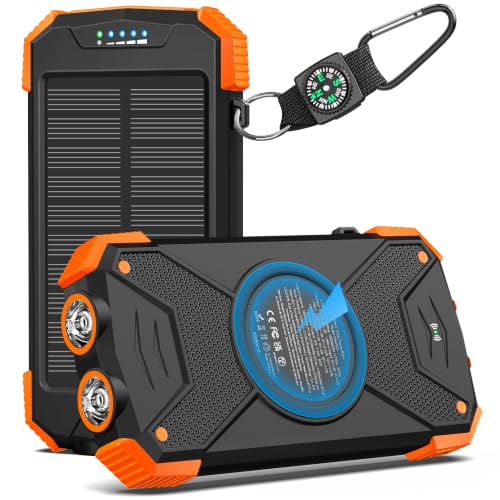 TOP CHOICEBest budget pickBLAVOR Solar Power Bank 10,000mAh Portable Wireless ChargerView on Amazon
- 4
 Best for Apple usersBLAVOR Solar Power Bank 20000mAh Wireless ChargerView on Amazon
- 5
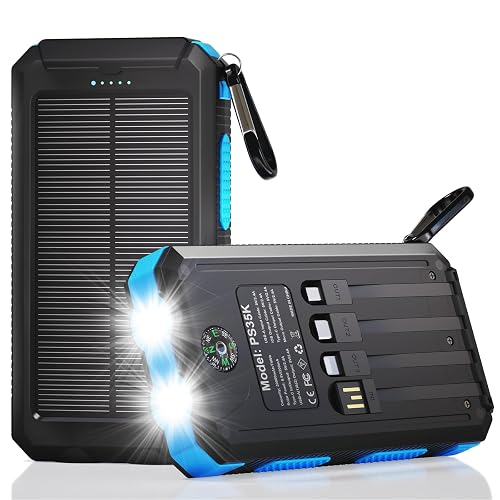 Best for camping lightingDurecopow Solar Charger Power Bank 20,000mAhView on Amazon
Our Top Picks
Quick Comparison
| Product | Best for | Key feature |
|---|---|---|
| Solar Charger Power Bank 49800mAh Portable 15W Fast Charging Power Bank | Long camping trips and backup power | Largest listed capacity, QC3.0 USB-C output |
| Solar Power Bank 33800mAh with Super Bright LED Flashlight | Groups and multi-device charging | Built-in cables, wireless charging and compass |
| BLAVOR Solar Power Bank 10,000mAh Portable Wireless Charger | Light trips and emergency kits | Compact size with IPX5 waterproof rating |
| BLAVOR Solar Power Bank 20000mAh Wireless Charger | Phones and Apple Watch charging | 20W USB-C fast charging with built-in cables |
| Durecopow Solar Charger Power Bank 20,000mAh | Camping and outdoor emergencies | Dual flashlight and four cables |
Solar Charger Power Bank 49800mAh Portable 15W Fast Charging Power Bank
Solar Charger Power Bank 49800mAh Portable 15W Fast Charging Power Bank with QC3.0 USB-C & Dual USB-A Ports for Cell Phones, LED Flashlight, Carabiner, Waterproof Solar Panel for Camping, Outdoor
Best for: Long camping trips and backup power for multiple devices
This is the highest-capacity option in this list and suits people who need several full phone charges between solar top-ups. It fits campers, van travelers and anyone building a small emergency reserve.
Key specs
- Listed capacity: 49,800 mAh
- USB-C with QC3.0 fast charging support
- Dual USB-A ports
- Integrated LED flashlight
- Carabiner clip and waterproof solar panel listed
Pros
- Large capacity covers many phone charges
- QC3.0 output supports faster charging on compatible devices
- Carabiner makes it easy to clip to a pack
Cons
- Heavier than smaller banks, which matters for day hikes
- Solar recharge time is long under cloudy conditions, as with most small solar panels
Bottom line: Choose this if capacity matters more than weight. It is a strong fit for extended trips or home backup for phones and small electronics.
Solar Power Bank 33800mAh with Super Bright LED Flashlight
Solar Power Bank 33800mAh with Super Bright LED Flashlight, Built-in 4 Cables & Wireless Charging, Portable Charger with Compass, 7 Outputs & 4 Inputs for Camping/Hiking
Best for: Groups and multi-device charging on camping or hiking trips
Built for people who charge several devices at once. The four built-in cables reduce the number of loose cords to pack, and the compass adds a practical extra for trail use.
Key specs
- Listed capacity: 33,800 mAh
- Built-in cables and wireless charging pad
- Seven outputs and four inputs listed
- Super bright LED flashlight and compass
Pros
- Built-in cables reduce accessory clutter
- Multiple outputs suit group trips
- Flashlight and compass add useful outdoor functions
Cons
- Many ports mean more cables and a bulkier shape than minimalist banks
- Wireless charging is slower than wired charging
Bottom line: A good pick for families or hiking groups who need several devices charged at once without carrying extra cords.
BLAVOR Solar Power Bank 10,000mAh Portable Wireless Charger
BLAVOR Solar Power Bank 10,000mAh Portable Wireless Charger for Cell Phones | 20W USB-C battery pack, battery bank, IPX5 waterproof, 2 flashlights, camping essentials, hiking gear, emergency solar bac
Best for: Light trips, emergency kits and a budget-friendly first solar pack
This is the most compact option here. It suits day hikers, commuters who want a backup charger, or anyone adding a solar bank to a go-bag.
Key specs
- Listed capacity: 10,000 mAh
- 20W USB-C output listed
- IPX5 water resistance rating listed
- Two flashlights and wireless charging listed
Pros
- Small enough to carry in a jacket pocket
- IPX5 rating resists splashes and light rain
- Lower capacity keeps the overall outlay modest
Cons
- Capacity supports only about two phone charges
- Solar input is slow, so it works best as a supplement
Bottom line: Pick this for light use and emergency backup rather than sustained off-grid power.
BLAVOR Solar Power Bank 20000mAh Wireless Charger
Portable battery pack, 4 built-in cables, 20W USB-C fast charging, IPX5 waterproof, camping flashlight, outdoor emergencies BLAVOR Solar Power Bank 20000mAh, Wireless Charger for Phones & Apple Watch
Best for: Phones and Apple Watch charging on the go
A middle-capacity bank that suits someone who wants more reserve than a 10,000 mAh pack but does not need a 50,000 mAh unit. Owners who carry an Apple Watch alongside a phone may find the wireless option useful.
Key specs
- Listed capacity: 20,000 mAh
- 20W USB-C fast charging listed
- Four built-in cables listed
- IPX5 waterproof rating listed
Pros
- Built-in cables simplify charging
- Wireless charging covers compatible watches and phones
- Good balance of capacity and portability
Cons
- Solar charging alone takes a long time to refill it
- Wireless output is slower than wired charging
Bottom line: A sensible middle choice for daily commuting and weekend trips where phone and watch charging is the main goal.
Durecopow Solar Charger Power Bank 20,000mAh
Durecopow Solar Charger Power Bank 20,000mAh, Portable Charger, 4 Cables 3 Ports Fast Charging External Battery Pack with USB C for Cell Phones, Solar Panel Charger with Dual Flashlight for Camping
Best for: Camping and outdoor emergencies where lighting matters
Suited to campers and households that want a battery bank that doubles as a light source during power outages or overnight camp tasks.
Key specs
- Listed capacity: 20,000 mAh
- Four cables and three ports listed
- USB-C fast charging listed
- Dual flashlight listed
Pros
- Dual flashlight is useful for camp setup
- Four cables and three ports cover mixed devices
- Mid-range capacity suits short trips
Cons
- Owners often report solar input is slow compared with the stated capacity
- Less compact than the 10,000 mAh option
Bottom line: A reasonable choice for car camping or emergency kits where a built-in light is worth the extra bulk.
Buying Guide
Capacity (mAh) and What It Really Delivers
Listed capacity is measured at the cell level, and real output is lower because of conversion losses, typically around 15 to 25 percent depending on the converter. A 20,000 mAh bank at 3.7 V holds roughly 74 Wh, which delivers about 55 to 65 Wh to a phone. A typical phone battery holds around 12 to 15 Wh, so a 20,000 mAh pack usually gives four to five full charges.
Good picks for this: Solar Charger Power Bank 49800mAh Portable 15W Fast Charging Power Bank, BLAVOR Solar Power Bank 20000mAh Wireless Charger
Charging Input and Solar Recharge Time
Most small solar panels on these banks produce only a few watts in full sun. Recharging a 20,000 mAh unit from solar alone can take a full day or more, and clouds slow it further. Check whether the bank also accepts USB-C or micro-USB wall input, which is far faster.
Good picks for this: Solar Power Bank 33800mAh with Super Bright LED Flashlight, Durecopow Solar Charger Power Bank 20,000mAh
Output Ports and Fast Charging Standards
USB-C with Power Delivery or QC3.0 support allows faster charging on compatible devices. Check the total output wattage, since several ports sharing one converter often reduce each port’s power.
Good picks for this: Solar Charger Power Bank 49800mAh Portable 15W Fast Charging Power Bank, BLAVOR Solar Power Bank 20000mAh Wireless Charger
Water Resistance and Durability
The IP rating indicates protection. IPX4 resists splashes, IPX5 resists low-pressure water jets, and IPX6 handles heavier spray. None of these ratings means the unit is submersible. Keep ports covered and dry the unit before charging.
Good picks for this: BLAVOR Solar Power Bank 10,000mAh Portable Wireless Charger, BLAVOR Solar Power Bank 20000mAh Wireless Charger
Size, Weight and Carry Method
A bank above roughly 30,000 mAh is noticeably heavier. For day hikes, a 10,000 to 20,000 mAh unit is usually easier to carry. For vehicle or base-camp use, extra weight matters less.
Good picks for this: BLAVOR Solar Power Bank 10,000mAh Portable Wireless Charger, Durecopow Solar Charger Power Bank 20,000mAh
Built-In Cables and Accessories
Built-in cables reduce what you need to pack, but they can wear at the connector end over time. Check whether the bank has a carabiner, flashlight or compass if those features matter for your use.
Good picks for this: Solar Power Bank 33800mAh with Super Bright LED Flashlight, Durecopow Solar Charger Power Bank 20,000mAh
Safety Features
Look for overcharge, over-discharge, short-circuit and temperature protection listed by the manufacturer. Lithium batteries should not be exposed to high heat, such as left on a dashboard. For guidance on lithium battery safety, consult the Consumer Product Safety Commission or a qualified electrician for any fixed installation.
Good picks for this: Solar Charger Power Bank 49800mAh Portable 15W Fast Charging Power Bank, BLAVOR Solar Power Bank 20000mAh Wireless Charger
FAQ
Can a solar battery bank fully charge a phone?
Yes, but the bank must hold more energy than the phone’s battery. A 20,000 mAh unit can typically provide four to five full phone charges, accounting for conversion losses. Solar recharging of the bank itself is usually the slowest part.
How long does it take to recharge a solar power bank?
Recharge time depends on panel size, sunlight intensity and the bank’s input rating. Small built-in panels often need a full day or more of direct sun for a 20,000 mAh unit. Wall charging through USB-C is much faster.
What does IPX5 mean on a battery bank?
IPX5 indicates protection against low-pressure water jets from any direction. It handles rain and splashes but is not designed for submersion. Keep port covers closed.
Is a higher mAh rating always better?
Not always. Higher capacity means more weight and longer recharge times. Choose capacity based on how many charges you need between recharges.
Can I use these banks as a home backup power source?
Portable banks are designed for small devices such as phones, tablets and LED lights. They are not sized to run refrigerators, heaters or household circuits. For whole-home backup, consult a licensed electrician about a dedicated battery system.
Do solar battery banks work on cloudy days?
They work, but output drops sharply under cloud cover. Owners often report that solar input is most useful as a slow top-up, with wall or vehicle charging used when speed matters.
Conclusion
For the highest reserve and longest trips, the 49800 mAh Solar Charger Power Bank is the strongest match in this list. Groups who charge many devices at once will find the 33800 mAh model with built-in cables more practical. If weight and budget matter most, the 10,000 mAh BLAVOR pack fits light use. The 20,000 mAh BLAVOR unit suits Apple Watch and phone owners, and the Durecopow bank is worth considering when a built-in flashlight matters. Check listed specifications against your own device needs before buying.
For a deeper look at sizing and wiring, see Solar Battery Bank DIY: Build and Size Your Own in 6 Steps and DIY Solar Power Bank: Build a Portable Battery Pack Step by Step (2026). Readers planning a larger system can also review How to Size a Solar Battery Bank: Autonomy, Depth of Discharge and Voltage and DIY Solar Sizing Calculations: Panels, Battery Banks and Inverters.
Sources
- Background on battery storage types, energy capacity and safe operation (energy.gov)
- Consumer safety guidance on lithium-ion battery products and recalls (cpsc.gov)
- Research on solar energy and storage technologies (nrel.gov)
Before you buy: helpful guides
About Claire Whitaker
Claire Whitaker is part of our editorial team and reviews and edits our DIY solar power systems guides, checking product details against manufacturer specifications and owner feedback.


