 By Ethan Brooks
Updated November 2026
Choosing an off grid solar system for motorhome use comes down to three things: how much power you actually draw each day, how much roof space you have for panels, and whether you need 12V, 24V or 48V battery architecture. The picks below were selected from product listings, manufacturer specifications and patterns in owner feedback, with attention to battery capacity, inverter output, panel wattage and whether each kit suits a motorhome or a larger off-grid home. We did not bench-test any of these kits.
Our top picks at a glance
- 1
 TOP CHOICEBest overallOff Grid Solar Panle Kit with Battery & InverterView on Amazon
- 2
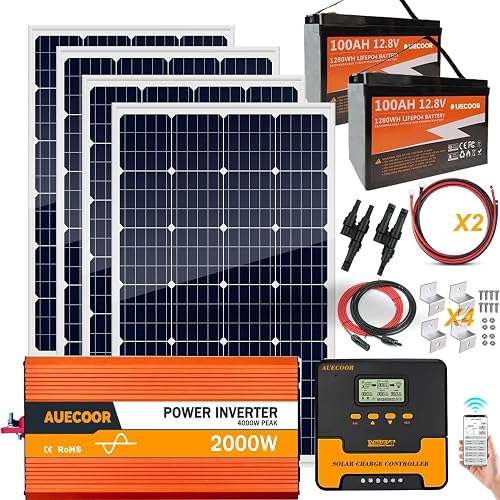 TOP CHOICEBest for a compact RV92KWH Complete Solar Panel Kit for RV Off Grid Solar SystemView on Amazon
- 3
 TOP CHOICEBest for 24V battery banksSUNGOLDPOWER 3000W 24V Off Grid System Solar Kit CompleteView on Amazon
- 4
 Best for 400W roof arraysECO-WORTHY 400 Watt 12 Volt Premium Solar Panel KitView on Amazon
- 5
 Best for 800W mixed use4PCS N-Type Bifacial 195W Solar Panel Kit with 2000W InverterView on Amazon
- 6
 Best for heavy house-style loadsECO-WORTHY 10KW Output Off Grid Solar System Complete Kit:10KW 120V/24View on Amazon
- 7
 Best for 3kW peak with 5 kWh storage3000W 24V Solar Power System Complete Kit with 1440W (12×120W) Solar PView on Amazon
Our Top Picks
Quick Comparison
| Product | Best for | Key feature |
|---|---|---|
| ECO-WORTHY 10KW Output Off Grid Solar System Complete Kit | Heavy home-style loads | 20.48 kWh storage, split-phase output |
| 1.92KWH Complete Solar Panel Kit for RV Off Grid Solar System | Compact RV setups | 2560 Wh lithium storage |
| SUNGOLDPOWER 3000W 24V Off Grid System Solar Kit | 24V battery banks | 3000W 120V inverter |
| Off Grid Solar Panle Kit with Battery & Inverter | Best overall balance | 5000W inverter, 2340W panels |
| 4PCS N-Type Bifacial 195W Solar Panel Kit | Mixed RV use | 60A MPPT controller |
| ECO-WORTHY 400 Watt 12 Volt Premium Solar Panel Kit | Roof arrays on a budget | 40A MPPT with Bluetooth |
| 3000W 24V Solar Power System Complete Kit | 3kW peak loads | 5.12 kWh battery, PV combiner |
Off Grid Solar Panle Kit with Battery & Inverter
Off Grid Solar Panle Kit with Battery & Inverter:12x195W Panels, 48V 5000W Solar Inverter, 48V 100AH Cubix LiFePO4 Battery ECO-WORTHY 5KW Off Grid Solar System Complete Kit 2340W If you want more background, see Types of Home Solar Systems: Grid-Tied, Hybrid, Off-Grid.
Best for: Best overall balance of panels, storage and inverter output
Suits owners who want a full 48V system with enough panel capacity to recharge a large battery bank on sunny days, including larger motorhomes with a generator for backup.
- Pros: 48V architecture with a 5000W inverter; 12 panels provide substantial daily generation.
- Pros: 100Ah LiFePO4 battery is a common, well-documented chemistry.
- Cons: Panel array and inverter may be more than a small motorhome roof can carry.
1.92KWH Complete Solar Panel Kit for RV Off Grid Solar System
1.92KWH Complete Solar Panel Kit for RV Off Grid Solar System |2x100Ah 12.8V Batteries 2560WH| 4x120W Mono Rigid Solar Panels |2000W Power Inverter|MPPT Controller|Trailer, Camper, Marine
Best for: Compact RV setups with modest daily loads
Fits owners of Class B or small Class C motorhomes who run lights, a fridge, fans and charging electronics without high-draw appliances.
- Pros: Lithium batteries and an MPPT controller in one package.
- Pros: Rigid mono panels suit roof mounting on most RV profiles.
- Cons: 2000W inverter limits simultaneous high-draw appliances.
SUNGOLDPOWER 3000W 24V Off Grid System Solar Kit Complete
SUNGOLDPOWER 3000W 24V Off Grid System Solar Kit Complete,1 * 3000W 120Vac Solar Inverter+4 * 200W Solar Panels+2pcs 24V 100Ah LifePO4 Battery,for RV,House Storage, Farm,Off Grid System
Best for: 24V battery banks with a 3000W inverter
Works for owners who prefer 24V wiring to reduce current in cabling and want a 120V output for standard appliances.
- Pros: 3000W 120V inverter covers most RV appliances.
- Pros: Four 200W panels give a clear, expandable array.
- Cons: Two 24V batteries may need a cabinet space check in a motorhome.
ECO-WORTHY 400 Watt 12 Volt Premium Solar Panel Kit
ECO-WORTHY 400 Watt 12 Volt Premium Solar Panel Kit :4pcs 100W Solar Panel+ 40A MPPT Charge Controller+ Bluetooth Module+ Mounting Z Brackets, 400W 12V Solar Power Off Grid System for Home, RV, Boat.
Best for: Roof arrays on a limited budget with a 12V system
Aimed at weekend campers and vans that need modest daily power without a large battery bank.
- Pros: 40A MPPT controller with a Bluetooth module for monitoring.
- Pros: Z-brackets included for roof mounting.
- Cons: 400W total limits generation on cloudy days.
4PCS N-Type Bifacial 195W Solar Panel Kit with 2000W Inverter
4PCS N-Type Bifacial 195W Solar Panel+12.8V 314Ah Lithium Battery+60A MPPT Charge Controller+2000W Pure Sine Wave Inverter ECO-WORTHY 800W Off Grid Solar System Complete Kit for RV Off Grid
Best for: Mixed RV use with an 800W array
For owners who want a mid-size 12.8V lithium system and a pure sine wave inverter for sensitive electronics.
- Pros: Pure sine wave inverter suits laptops and medical-style chargers.
- Pros: Bifacial panels can add output from reflected light.
- Cons: 314Ah battery bank is modest for multi-day autonomy.
Buying Guide
Daily Power Use and Battery Capacity
Start by adding up what you run each day, including fridge, lights, water pump, phone and laptop charging, and any fans or heaters. Battery capacity should cover that daily total with some margin, so you are not draining the bank to empty every night. Kits with larger battery banks give you more flexibility, especially on cloudy days or when you are parked in the shade.
Battery Voltage: 12V, 24V or 48V
Voltage affects efficiency and wire size. Many motorhomes run on 12V systems, which are simple and widely supported, but higher-voltage kits such as 24V or 48V can carry more power with thinner wiring and less loss. If you plan to expand later or run larger loads, a higher-voltage system is often the better long-term choice.
Inverter Output and Surge Capacity
The inverter converts battery power to household-style AC for appliances. Check that its continuous rating covers your heaviest running load at the same time, and that its surge rating can handle motor-driven items like air conditioners or power tools when they start. A pure sine wave inverter is the safer choice for sensitive electronics and most modern appliances.
Roof Space and Panel Wattage
Measure the usable roof area before you buy, because panel wattage only helps if the panels physically fit. Rigid panels typically give more output per square foot than flexible ones, while flexible panels can suit curved roofs but usually cost more per watt. Plan for enough panel wattage to recharge the batteries within a few sunny hours, and remember that shading from roof fixtures or nearby trees will reduce output.
Charge Controller Type and Expandability
An MPPT charge controller generally harvests more energy from panels than a PWM controller, especially when panel voltage is higher than battery voltage. Look at the controller’s amperage rating against your planned panel array, and check whether the kit allows you to add more panels or batteries later. Expandability matters if your needs grow after your first season on the road.
FAQ
How many solar panels do I need for a motorhome?
The number depends on your daily energy use and how much sun your typical camping spots receive. Most motorhome owners start by estimating daily watt-hours, then size the panel array to recharge the batteries within a few hours of good sunlight. Leaving some margin for cloudy days is a sensible rule.
Can an off grid solar system run an air conditioner?
Air conditioners are high-draw appliances, so most small motorhome kits will not run one comfortably for long periods. Larger systems with substantial battery banks and high-output inverters can handle them, but you should confirm the surge and running requirements before buying. Many owners pair solar with a generator for heavy loads.
Do I need lithium batteries for an RV solar setup?
Lithium iron phosphate batteries are lighter, last through more charge cycles and tolerate partial discharge well, which is why many kits use them. Lead-acid batteries cost less upfront but are heavier and need more care to stay healthy. Choose based on your budget, weight limits and how often you plan to use the system.
Is a 12V or 24V system better for a motorhome?
A 12V system is simpler and matches many existing RV components, which makes it a good fit for smaller setups. A 24V or 48V system is more efficient for larger loads and allows thinner wiring over longer runs. If you expect to grow your system, the higher-voltage option is often worth considering.
Can I install a solar kit on my motorhome myself?
Many owners install panels, batteries and controllers themselves with basic tools and electrical knowledge. Roof mounting requires careful sealing to prevent leaks, and wiring should follow the manufacturer’s diagrams and local electrical codes. If you are unsure about any step, a qualified RV technician can handle the installation.
How long does a solar system battery last?
Lifespan depends on battery chemistry, depth of discharge, temperature and how often you cycle the battery. Lithium batteries generally last through many more cycles than lead-acid types under similar use. Keeping the battery within its recommended charge range and avoiding extreme heat will help it last longer.
Conclusion
If you want a larger, expandable system for a big rig or a home-like setup, the higher-capacity kits with 48V or 24V architecture are the best fit. Owners with a compact motorhome and modest daily loads will likely find the smaller 12V kits easier to install and more than sufficient for lights, fridge, pump and device charging.
Match the kit to your real daily power use and roof space first, then choose the inverter and controller that support your loads and future plans. A well-sized system chosen with these factors in mind will serve you far better than the biggest kit on the list.
Related reading
- Wiring Diagram for Off-Grid Solar System: A Step-by-Step Guide
- Wind Solar Hybrid Off Grid System: How to Size and Wire One
- Whole House Off-Grid Solar System: Sizing Steps and Parts for Your Home
About Ethan Brooks
Ethan Brooks is part of our editorial team and reviews and edits our DIY solar power systems guides, checking product details against manufacturer specifications and owner feedback.


