By Graham Fisher
Updated November 2026
A smart solar charge controller regulates the power flowing from your panels into your battery bank while giving you live data on voltage, current and charge state, often through a phone app. For DIY builders, the criteria that matter most are maximum solar input voltage, charge current rating, battery chemistry support, and whether the unit uses MPPT tracking. We compared seven widely sold models against these points, based on manufacturer specifications, product listings and common owner feedback patterns. We did not bench-test any of them.
Our top picks at a glance
- 1
 TOP CHOICEBest overallVictron Energy SmartSolar MPPT Solar Charge Controller 100V, 50A, 12/24VView on Amazon
- 2
 TOP CHOICEBest for small kitsVictron Energy SmartSolar MPPT 100V 30 amp 12/24-Volt Solar Charge ControllerView on Amazon
- 3
 TOP CHOICEBest for 36V and 48V banksVictron Energy SmartSolar MPPT Charge Controller 150V, 45A, 12/24/36/48VView on Amazon
- 4
 Best for lithium and flooded batteriesRenogy 60A MPPT Solar Charge Controller 12V/24V/36V/48V Auto, Rover Lite 60AView on Amazon
- 5
 Best for 12V and 24V budget buildsVictron Energy BlueSolar MPPT Solar Charge Controller 75V, 15A, 12/24VView on Amazon
- 6
 Best for high-current arraysVictron EnergyBluetooth MPPT solar charge controller with Tr terminalsView on Amazon
- 7
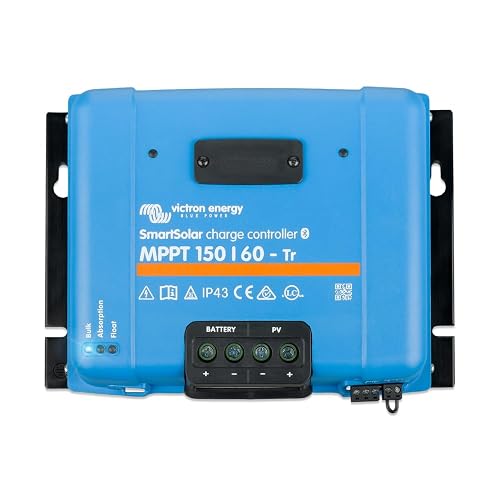 Best for large arrays with terminal blocksVictron SmartSolar Charge Controller (150V 60A Tr)View on Amazon
Our Top Picks
Quick Comparison
| Product | Best for | Key feature |
|---|---|---|
| Victron SmartSolar MPPT 100V 50A | Best overall | Bluetooth app monitoring |
| Victron SmartSolar MPPT 100V 30A | Small kits | Compact 30A rating |
| Victron SmartSolar MPPT 150V 45A | 36V and 48V banks | 150V input, multi-voltage |
| Renogy Rover Lite 60A MPPT | Lithium and flooded batteries | Auto voltage detection |
| Victron BlueSolar MPPT 75V 15A | 12V and 24V budget builds | Low-current MPPT |
| Victron SmartSolar MPPT 150V 100A Tr | High-current arrays | 100A with VE.Can |
| Victron SmartSolar 150V 60A Tr | Large arrays | Terminal block wiring |
Victron Energy SmartSolar MPPT Solar Charge Controller 100V, 50A, 12/24V
Bluetooth Charge Controllers for Solar Panels, Certified to UL1741 Victron Energy SmartSolar MPPT Solar Charge Controller 100V, 50A, 12/24V
Best for: Overall fit for 12V and 24V systems up to a mid-size array.
This suits builders who want a Bluetooth-monitored controller with enough headroom for a modest off-grid array.
Pros
- Bluetooth app shows live charge data
- 50A rating covers most small and mid-size arrays
Cons
- Limited to 12V and 24V battery banks
Victron Energy SmartSolar MPPT 100V 30 amp 12/24-Volt Solar Charge Controller
Victron Energy SmartSolar MPPT 100V 30 amp 12/24-Volt Solar Charge Controller (Bluetooth)
Best for: Small kits and cabins with a few hundred watts of panels.
It fits builders running a compact 12V or 24V system who want the same app monitoring at a lower current rating.
Pros
- Same Bluetooth monitoring as larger models
- Compact footprint for small enclosures
Cons
- 30A ceiling rules out larger arrays
Victron Energy SmartSolar MPPT Charge Controller 150V, 45A, 12/24/36/48V
Victron EnergyBluetooth Solar Charge Controllers for Solar Panels, Certified to UL1741 SmartSolar MPPT Charge Controller 150V, 45A, 12/24/36/48V
Best for: 36V and 48V battery banks and higher-voltage string arrays.
It suits builders who need a controller that supports higher battery voltages and a 150V solar input.
Pros
- Supports 36V and 48V battery banks
- 150V maximum solar input allows longer string designs
Cons
- Higher voltage setup demands more careful wiring
Renogy 60A MPPT Solar Charge Controller 12V/24V/36V/48V Auto, Rover Lite 60A
Renogy 60A MPPT Solar Charge Controller 12V/24V/36V/48V Auto, 150V Maximum Solar Input, for Gel Sealed Flooded and Lithium Battery, Rover Lite 60A
Best for: Lithium and flooded lead-acid batteries with automatic voltage detection.
It fits builders who want the controller to detect system voltage automatically and handle several battery chemistries.
Pros
- Automatic 12V to 48V voltage detection
- 150V maximum solar input
Cons
- Owners often report the app experience varies by setup
Victron Energy BlueSolar MPPT Solar Charge Controller 75V, 15A, 12/24V
Victron EnergyCharge Controllers for Solar Panels, Certified to UL1741 BlueSolar MPPT Solar Charge Controller 75V, 15A, 12/24V
Best for: 12V and 24V builds on a tight budget with a small panel count.
It suits hobby setups, such as a single panel charging a 12V battery, where a lower-current MPPT unit is enough.
Pros
- Simple MPPT operation for small arrays
- Victron build quality and documentation
Cons
- 15A rating limits expansion
Buying Guide
Maximum Solar Input Voltage
Check the maximum PV input voltage listed for each controller and compare it to the open-circuit voltage of your panel string. Staying below that limit, even on cold mornings when panel voltage rises, protects the controller from damage. Series-wired panels add voltage quickly, so this is the factor DIY builders most often overlook.
Charge Current Rating and System Size
The charge current rating, measured in amps, determines how much power the controller can pass to your batteries at once. Match this rating to your total array wattage divided by your battery voltage, and leave some headroom for future expansion. A controller sized too small will clip your harvest on sunny days.
Battery Chemistry Support
Confirm that the controller offers charge profiles for your battery type, such as flooded lead-acid, gel, AGM or lithium. Lithium batteries typically need different absorption and float voltages, and some smart controllers let you adjust these settings through the app. Using the wrong profile can shorten battery life noticeably.
MPPT Tracking and Bluetooth Monitoring
MPPT controllers adjust the operating point of your panels to extract more usable energy than simpler PWM designs, especially when panel voltage is well above battery voltage. Bluetooth or app-based monitoring lets you watch voltage, current and charge state from your phone, which is useful for troubleshooting and tuning your system. Decide whether live data is worth the added setup for your project.
FAQ
Do I need an MPPT controller for a small solar setup?
Not always, but an MPPT controller usually makes better use of panel output, particularly when your panels run at a higher voltage than your battery bank. Smaller systems with panels close to battery voltage may see less benefit. Comparing expected harvest against cost will help you decide.
What does UL1741 certification mean for a DIY system?
UL1741 is a safety standard covering inverters and related grid-interactive equipment in the United States. It is most relevant when a controller or inverter connects to a grid or is part of a permitted installation. Check your local requirements before assuming a listing applies to your setup.
Can I use a lithium battery with any of these controllers?
Many smart controllers support lithium charge profiles, but you should verify that the specific model includes a lithium setting or allows custom voltage adjustments. Confirm the recommended absorption and float voltages with your battery manufacturer. Wrong settings can reduce battery life or create safety concerns.
Why does the maximum solar input voltage matter so much?
Panel voltage rises as temperature drops, so an open-circuit reading on a cold day can exceed the listed rating even when your array seems correctly sized. Exceeding the maximum input can permanently damage the controller. Calculate your string voltage using the coldest expected temperature for your location.
Do I need Bluetooth if I only want to charge my batteries?
No, a basic charging setup works without app monitoring. Bluetooth becomes useful when you want to check performance, adjust settings or diagnose problems without climbing onto a roof or opening an enclosure. Weigh the convenience against any added cost.
Conclusion
For larger DIY systems with high-voltage panel strings, the higher-rated Victron SmartSolar and Victron SmartSolar 150V models are better suited to demanding arrays. For smaller or budget-conscious builds, the Victron 30 amp and BlueSolar 15A options cover lighter loads, while the Renogy Rover Lite 60A suits mid-sized systems with mixed battery types.
Before buying, confirm that your panel voltage, array wattage and battery chemistry all fall within the controller’s ratings. Choosing based on those specifications will serve you better than choosing by brand alone.
Related reading
- Top 6 Wanderer Solar Charge Controllers Compared for DIY Systems
- Top 6 Solar 12V Charge Controller Options Compared for DIY Systems
- Top 6 MPPT Solar Charge Controllers for Lithium Batteries Compared
- Top 5 Solar Charge Controller Lithium Ion Battery Picks Compared (2026)
- Top 5 Rich Solar Charge Controllers Compared for DIY Systems
About Graham Fisher
Graham Fisher is part of our editorial team and reviews and edits our DIY solar power systems guides, checking product details against manufacturer specifications and owner feedback.