 By Graham Fisher
Updated November 2026
Choosing a solar charge controller for lithium battery banks comes down to charge profile support, voltage compatibility, panel input headroom and monitoring. Lithium chemistries like LiFePO4 need different absorption and float settings than lead-acid, so a controller with a lithium mode or fully adjustable setpoints matters. The picks below were compared on manufacturer specifications, brand reputation and common owner feedback patterns. We did not bench-test these units.
Our top picks at a glance
- 1
 TOP CHOICEBest overallVictron Energy SmartSolar MPPT 100V 30 amp 12/24-Volt Solar Charge Controller (Bluetooth)View on Amazon
- 2
 TOP CHOICEBest for Bluetooth monitoringVictron Energy SmartSolar MPPT Solar Charge Controller 100V, 50AView on Amazon
- 3
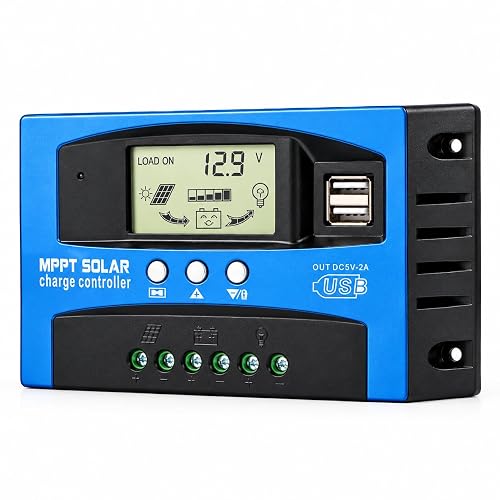 TOP CHOICEBest for budget 12V buildsSolar Charge Controller MPPT 12/24V Auto-Switch Universal Controller fView on Amazon
- 4
 Best for waterproof portable useSOLPERK MPPT Solar Charge Controller 10A 12V Waterproof ControllerView on Amazon
- 5
 Best for higher-voltage systemsUpgraded 100A MPPT Solar Charge Controller 12V 24V 36V 48V LCD DisplayView on Amazon
- 6
 Best for low-cost PWM setups30A PWM Solar Charge Controller for Sealed/Gel/Flooded/LiFePO4/LithiumView on Amazon
- 7
 Best for large RV and off-grid banksAuraSolar 80A MPPT Solar Charge Controller 12V 24V 36V 48V Auto, 80 AmView on Amazon
Our Top Picks
Quick Comparison
| Product | Best for | Key feature |
|---|---|---|
| Victron Energy SmartSolar MPPT 30A | Best overall | Bluetooth, lithium-ready profiles |
| Victron Energy SmartSolar MPPT 50A | Bluetooth monitoring | UL1741 listed, 100V input |
| Universal MPPT 12/24V 30A | Budget 12V builds | Auto 12/24V voltage detection |
| SOLPERK MPPT 10A | Waterproof portable use | IP67 rated enclosure |
| Upgraded MPPT 100A | Higher-voltage systems | 12V to 48V, LCD display |
| PWM 30A Bluetooth | Low-cost PWM setups | 7 load modes, app control |
| AuraSolar MPPT 80A | Large RV and off-grid banks | Timer and dual USB |
Victron Energy SmartSolar MPPT 100V 30 amp 12/24-Volt Solar Charge Controller (Bluetooth)
Victron Energy SmartSolar MPPT 100V 30 amp 12/24-Volt Solar Charge Controller (Bluetooth)
Best for: Best overall lithium-compatible control with app monitoring.
Suited to DIYers who want documented charge profiles and remote status checks on a 12V or 24V bank.
Pros
- Bluetooth app for monitoring and setup
- Well-documented lithium charge settings
Cons
- Higher cost than basic controllers
Victron Energy SmartSolar MPPT Solar Charge Controller 100V, 50A
Victron EnergyBluetooth Charge Controllers for Solar Panels, Certified to UL1741 SmartSolar MPPT Solar Charge Controller 100V, 50A, 12/24V
Best for: Bluetooth monitoring on larger arrays.
Fits builders stepping up to a 50A output who want the same app-based control as the smaller Victron unit.
Pros
- Higher current handling for bigger banks
- 100V input allows series-wired panels
Cons
- Oversized for small 12V systems
Solar Charge Controller MPPT 12/24V Auto-Switch Universal Controller for Lead-Acid & Lithium Batteries (30A)
Solar Charge Controller MPPT 12/24V Auto-Switch Universal Controller for Lead-Acid & Lithium Batteries (30A)
Best for: Budget 12V builds that need lithium support.
A practical match for small cabin or shed systems where the bank voltage may change between 12V and 24V.
Pros
- Automatic 12V/24V detection
- Lithium and lead-acid modes
Cons
- Limited data logging compared with app-based units
SOLPERK MPPT Solar Charge Controller 10A 12V Waterproof Controller
Solar Controller Intelligent Portable Controller IP67 Solar Panel Controllers for AGM, Gel, Flooded and Lithium Battery SOLPERK MPPT Solar Charge Controller 10A 12V Waterproof Controller
Best for: Waterproof portable use.
Useful for small portable panel kits, camping setups and outdoor enclosures exposed to moisture.
Pros
- IP67 rated housing
- Covers lithium and lead-acid types
Cons
- Only 10A, so limited to small arrays
Upgraded 100A MPPT Solar Charge Controller 12V 24V 36V 48V LCD Display
Upgraded 100A MPPT Solar Charge Controller 12V 24V 36V 48V LCD Display Battery Intelligent Regulator Max 100V Input Dual USB for Lead-Acid/Lithium
Best for: Higher-voltage systems.
Aimed at builders running 36V or 48V battery banks who want an LCD readout on the unit itself.
Pros
- Supports 12V through 48V banks
- LCD display and dual USB output
Cons
- Owners report a learning curve for setting lithium parameters
Buying Guide
Battery Chemistry and Charge Profile Support
Lithium batteries, especially LiFePO4, need a charge profile with a specific bulk, absorption and float voltage that differs from lead-acid. Look for a controller with a dedicated lithium setting or fully adjustable voltage setpoints so the battery is charged correctly and not damaged by overcharging.
Check the battery manufacturer’s recommended voltages before buying, then confirm the controller can be set to match them.
System Voltage and Compatibility
Make sure the controller supports your battery bank voltage, whether 12V, 24V, 36V or 48V. Auto-detecting controllers can simplify setup, but it is still worth confirming the detected voltage matches your system.
Panel Input Headroom
MPPT controllers can accept higher panel voltages than the battery bank, which allows longer wire runs and more flexible panel arrays. Check the maximum input voltage and the amperage rating against your planned solar array size, and leave some margin for cold-weather voltage rise.
Monitoring and Control Features
An LCD display, Bluetooth connection or app support makes it easier to watch charge status, battery voltage and history. Some units also offer load control modes or timers, which can be useful for off-grid cabins, RVs and home backup setups.
Build Quality and Environment
If the controller will be mounted outdoors or in a vehicle, consider the enclosure rating and how it handles heat and moisture. Good ventilation and secure mounting help the unit run reliably over the long term.
FAQ
Can a standard lead-acid charge controller be used with lithium batteries?
Some controllers can, but only if their charge settings can be adjusted to lithium voltages. Using a lead-acid profile on a lithium battery can lead to undercharging or overcharging, which shortens battery life.
Do I need an MPPT controller or is PWM enough?
MPPT controllers generally harvest more energy from the same panels, especially when panel voltage is higher than battery voltage. PWM controllers are simpler and less expensive, but they usually work best with panels whose voltage closely matches the battery bank.
How do I size a charge controller for my solar array?
Start with the total wattage of your panels and divide by the battery voltage to estimate the current. Choose a controller rated above that current with some extra margin, and confirm its maximum input voltage is higher than your panel string’s open-circuit voltage.
Why is a Bluetooth or app connection useful?
It lets you check battery voltage, charge current and charging stage without opening the enclosure. It is especially helpful for remote systems where you want to spot problems early.
Should I match the controller brand to my battery brand?
No specific pairing is required, as long as the controller supports lithium charging and the voltage settings match the battery manufacturer’s specifications. Always confirm compatibility in the manual before connecting.
Conclusion
For most lithium battery owners who want advanced monitoring and high-performance charging, the higher-capacity MPPT models with Bluetooth or LCD displays are a strong fit. Budget-minded users with smaller systems may find a simpler 10A or 30A unit with adjustable lithium settings meets their needs.
Before buying, match the controller’s voltage, current and charge profile to your battery and array, then choose the monitoring features that fit how you plan to use the system.
Related reading
- Top 6 MPPT Solar Charge Controllers for Lithium Batteries Compared
- Solar Charge Controller Lithium Ion: How to Choose and Wire One (Step-by-Step)
- 6 Best LiFePO4 Battery Solar Charge Controllers Compared for DIY Systems
- 6 Best Dual Battery Solar Charge Controller Options for RVs and Boats (2026)
- 5 Best Solar Panel Battery Charge Controllers for DIY Systems (2026)
- 5 Best Lithium Solar Charge Controllers for DIY Systems (2026)
- Top 5 Rich Solar Charge Controllers Compared for DIY Systems
- Top 5 Mppt Solar Charge Controller 12v Options Compared for DIY Systems
About Graham Fisher
Graham Fisher is part of our editorial team and reviews and edits our DIY solar power systems guides, checking product details against manufacturer specifications and owner feedback.


