 By Claire Whitaker
Updated November 2026
Choosing a solar panel kit for shed power means matching panel wattage, battery capacity and inverter output to what you plan to run. This list compares seven kits from well-known brands, ordered by how well each fits typical shed loads like lights, tools, fans and small chargers. Selection criteria were system completeness, battery and inverter inclusion, controller type, expansion options and owner feedback patterns. Worth reading next: Top 7 200 W Solar Panel Kit Options Compared for Off-Grid Use (2026).
Our top picks at a glance
- 1
 TOP CHOICEBest overallRenogy 400Watt Premium Solar Kit with 40A MPPT Charge ControllerView on Amazon
- 2
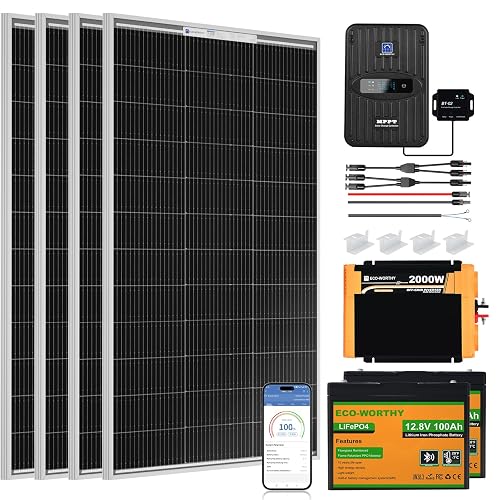 TOP CHOICEBest for a complete battery and inverter setupECO-WORTHY 1.6KWH Complete Solar Panel Kit 400W 12V for RV Off GridView on Amazon
- 3
 TOP CHOICEBest for a shed with mid-size tool loads1280WH Complete Off-Grid Solar Panel Kit with 1000W Pure Sine Wave InverterView on Amazon
- 4
 Best for a starter lighting circuitRenogy 100W 12V Solar Panel Starter Kit with 30A PWM ControllerView on Amazon
- 5
 Best for a lithium battery starter packageECO-WORTHY 200 Watt 12V Complete Solar Panel Starter Kit for RV Off GridView on Amazon
- 6
 Best for a 12V or 24V mixed systemECO-WORTHY 200 Watts 12 Volt/24 Volt Solar Panel Kit with High EfficieView on Amazon
- 7
 Best for a simple PWM controller upgrade pathAdventurer 30A LCD PWM Charge Controller + Mounting Brackets for RVs,View on Amazon
Our Top Picks
| Product | Best for | Key feature |
|---|---|---|
| Renogy 400Watt Premium Solar Kit | Overall shed use | 40A MPPT controller |
| ECO-WORTHY 1.6KWH Complete Kit | Full battery and inverter | Four 100W panels |
| 1280WH Complete Off-Grid Kit | Mid-size tool loads | 1000W pure sine inverter |
| Renogy 100W Starter Kit | Starter lighting circuit | 30A PWM controller |
| ECO-WORTHY 200W Starter Kit | Lithium battery package | Included inverter |
| ECO-WORTHY 200W 12V/24V Kit | Mixed voltage systems | 12V or 24V support |
| Renogy 200W N-Type RV Kit | PWM controller upgrades | Adventurer 30A controller |
Renogy 400Watt Premium Solar Kit with 40A MPPT Charge Controller
4x100W monocrystalline panels. 40A MPPT charge controller. Includes Bluetooth module, Z-brackets, cables, adaptor kit. Renogy 400Watt Premium Solar Kit with 40A MPPT Charge Controller
Best for: Overall shed use with room to grow.
This kit suits a shed owner who wants a capable controller and expansion headroom. Manufacturers specify four 100W monocrystalline panels with a 40A MPPT controller and a Bluetooth module.
Pros
- MPPT controller improves harvest on partly cloudy days
- Bluetooth monitoring included
Cons
- Batteries and inverter are sold separately
ECO-WORTHY 1.6KWH Complete Solar Panel Kit 400W 12V for RV Off Grid
ECO-WORTHY4 * 100W Solar Panel + 40A MPPT Controller + 2 * 12V 100Ah Lithium Battery + Upgraded 2000W Power Inverter + Bluetooth Module 1.6KWH Complete Solar Panel Kit 400W 12V for RV Off Grid
Best for: A complete battery and inverter setup.
This kit fits a shed owner who wants everything in one box. The listing includes four 100W panels, a 40A MPPT controller, two 12V 100Ah lithium batteries and a 2000W inverter.
Pros
- Battery and inverter included
- Bluetooth module for monitoring
Cons
- Full system needs careful wiring and sizing
1280WH Complete Off-Grid Solar Panel Kit with 1000W Pure Sine Wave Inverter
1280WH Complete Off-Grid Solar Panel Kit with 1000W Pure Sine Wave Inverter, 20A MPPT Controller & 100Ah 12.8V Battery, 2×120W Monocrystalline Solar Panels for RV Boat Cabin Shed Home Backup
Best for: A shed with mid-size tool loads.
This kit suits a workshop shed running a small compressor or power tools in short bursts. The listing describes two 120W panels, a 20A MPPT controller, a 100Ah 12.8V battery and a 1000W pure sine inverter.
Pros
- Pure sine wave inverter suits sensitive electronics
- Lithium battery included
Cons
- Panel count is modest for heavy continuous loads
Renogy 100W 12V Solar Panel Starter Kit with 30A PWM Controller
Complete kit includes Monocrystalline solar panel, Charger Controller, cables, Z-brackets. For RVs, campers, off-grid. Renogy 100W 12V Solar Panel Starter Kit with 30A PWM Controller
Best for: A starter lighting circuit.
This kit fits a shed with LED lights, a radio and a phone charger. It includes one monocrystalline panel, a 30A PWM controller, cables and Z-brackets.
Pros
- Simple, low-complexity wiring
- Includes mounting hardware
Cons
- Output is limited for larger loads
ECO-WORTHY 200 Watt 12V Complete Solar Panel Starter Kit for RV Off Grid
with Battery and Inverter: 2*100W Solar Panel + 30A Charge Controller + 100Ah Lithium Battery + 1100W Premium Solar Inverter ECO-WORTHY 200 Watt 12V Complete Solar Panel Starter Kit for RV Off Grid
Best for: A lithium battery starter package.
This kit suits someone building a small shed system from one purchase. The listing includes two 100W panels, a 30A controller, a 100Ah lithium battery and a 1100W inverter.
Pros
- Lithium battery included
- Inverter included for AC devices
Cons
- Lower panel wattage limits recharge speed
Buying Guide
Match Panel Wattage to Your Daily Energy Needs
Start by listing the devices you plan to run in your shed and how many hours each one runs per day. Add those watt-hours together to estimate your daily energy use, then choose a panel array that can recharge the battery within a typical sunny day. Undersized panels leave you with a drained battery, while oversized panels cost more than you need.
Check the Battery Type and Capacity
Kits may include lithium or lead-acid batteries, and the usable capacity differs from the printed amp-hour rating. Lithium batteries generally allow deeper discharge and longer life, while lead-acid batteries are lower cost but need more maintenance and careful charging. Confirm the voltage matches the rest of the system, whether 12V or 24V.
Verify the Inverter Output Covers Your Loads
If you want to run power tools, a small refrigerator or a shop vacuum, the inverter must handle both the continuous wattage and the higher surge wattage these devices draw at startup. A pure sine wave inverter is the safer choice for sensitive electronics and motors. Kits without an inverter can still power 12V lights and fans directly.
Choose the Right Charge Controller
PWM controllers are simpler and less expensive, but they work best with panels whose voltage closely matches the battery. MPPT controllers extract more power from the panels, especially in cooler weather or when panel voltage is much higher than battery voltage, and they suit larger arrays. Make sure the controller’s amperage rating can handle the current from your panels.
Plan for Mounting and Future Expansion
Consider whether the included brackets fit your shed roof or wall, and whether you have a clear, shade-free spot that faces the sun for much of the day. If you expect your power needs to grow, look for a kit whose controller and inverter can accept additional panels or batteries later.
FAQ
Can a solar panel kit run everything in my shed?
It depends on the total wattage and daily energy use of your devices compared with the kit’s panel output and battery capacity. Lighting and small fans are usually very manageable, while heavy tools or appliances may require a larger system. Calculating your daily watt-hour needs before buying will give you a clear answer.
Do I need a battery with a solar shed kit?
A battery lets you use stored power at night or on cloudy days, which is important for most shed uses. Without one, the panels only provide power while the sun is shining. Kits that include a battery are generally the simplest choice for beginners.
What is the difference between PWM and MPPT controllers?
PWM controllers are affordable and reliable for smaller systems with matching voltages. MPPT controllers are more efficient, often harvesting noticeably more energy from the same panels, which makes them a better fit for larger or higher-voltage arrays.
How long does a shed solar kit take to charge the battery?
Charging time depends on panel wattage, sunlight strength, weather and the battery’s state of charge. On a clear day with good sun exposure, many systems can recharge a largely depleted battery within several hours of direct sun. Cloudy conditions will extend that time considerably.
Can I install a solar panel kit myself?
Many people mount panels and connect the controller, battery and loads themselves, especially with clear included instructions. Working with batteries and electrical connections requires care, so follow the wiring diagram and check polarity carefully. If you are unsure, a licensed electrician can handle the installation safely.
Do solar shed kits work in winter?
They still produce power in winter, but shorter days and lower sun angles reduce output. Snow covering the panels can stop production entirely until it clears. Planning for a larger battery or panel array can help you get through the darker months.
Conclusion
If you want the most complete, ready-to-run setup with a battery and inverter for powering a variety of shed tools and appliances, a larger kit with a lithium battery and pure sine wave inverter is the better fit. Those with modest lighting and small device needs will be well served by a smaller 12V starter kit with a simpler PWM controller.
Match the kit to your actual daily energy use, confirm the inverter handles your heaviest load, and leave room to expand later. Doing that math first will point you to the right option for your shed.
Related reading
- Top 7 DIY Solar Panel Installation Kit Options Compared for Beginners
- Top 5 Solar Panel Systems for Off Grid Cabin Kits Compared (2026)
- Top 3 Solar Panel Mounting Kit Options Compared for Roofs and RVs
- Top 3 Solar Panel Kit 1000 Watt Options Compared for Home and Off-Grid Use
- Top 3 Kit Panel Solar 1000W Options Compared for Home and Off-Grid Use
- Solar Thermal Panel Kit: How to Choose and Install One in 6 Steps
About Claire Whitaker
Claire Whitaker is part of our editorial team and reviews and edits our DIY solar power systems guides, checking product details against manufacturer specifications and owner feedback.




