 By Graham Fisher
Updated November 2026
Choosing a renogy rover li 40 amp mppt solar charge controller comes down to three things: whether the unit supports lithium battery charge profiles, whether its amperage fits your solar array, and whether it can handle the system voltage you plan to run. This list compares six Renogy Rover-family MPPT controllers, with the 40A Li-capable models placed first. Selection criteria were based on published specifications, brand documentation, and patterns in owner feedback, including battery compatibility, input voltage ceilings, Bluetooth monitoring, and build durability. Nothing here reflects bench testing by the author.
Our top picks at a glance
- 1
 TOP CHOICEBest overallRenogy Rover MPPT Solar Charge Controller with Bluetooth 40A 12V/24VView on Amazon
- 2
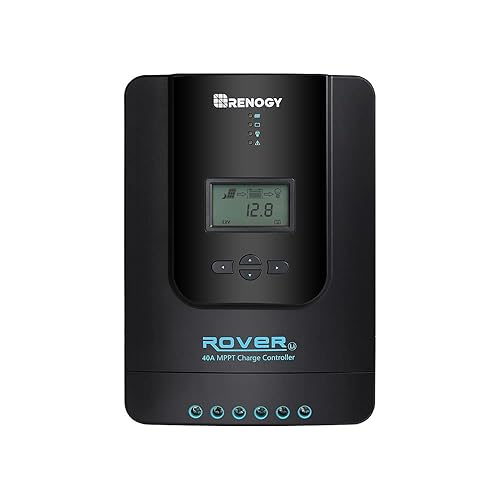 TOP CHOICEBest for lithium-focused buildsRenogy Solar Charge Controller Rover 40A 12V24V Auto ParameterView on Amazon
- 3
 TOP CHOICEBest for dual-peak tracking and ModbusRenogy Charge Controller-Rover 40A MPPT 12V/24V Auto-Detect LCD DisplayView on Amazon
- 4
 Best for smaller arraysRenogy Rover 30A 12V/24V Auto DC Input MPPT Solar Charge ControllerView on Amazon
- 5
 Best for higher-voltage systemsRenogy 60A MPPT Solar Charge Controller Rover Lite 60AView on Amazon
- 6
 Best budget pickRenogy Rover MPPT Solar Charge Controller with Bluetooth 30A 12V/24VView on Amazon
Our Top Picks
Quick Comparison
| Product | Best for | Key feature |
|---|---|---|
| Renogy Rover MPPT Solar Charge Controller with Bluetooth 40A 12V/24V | Overall 40A DIY systems | Bluetooth monitoring and Li manual setting |
| Renogy Solar Charge Controller Rover 40A 12V24V Auto Parameter | Lithium-focused builds | Adjustable LCD parameters |
| Renogy Charge Controller-Rover 40A MPPT 12V/24V Auto-Detect LCD Display | Users wanting Modbus integration | Dual-peak tracking and Modbus support |
| Renogy Rover 30A 12V/24V Auto DC Input MPPT Solar Charge Controller | Smaller arrays under 30A output | Auto 12V/24V detection |
| Renogy 60A MPPT Solar Charge Controller Rover Lite 60A | Higher-voltage, higher-current systems | 12V through 48V auto detection |
| Renogy Rover MPPT Solar Charge Controller with Bluetooth 30A 12V/24V | Budget-conscious 12V/24V builds | Bluetooth monitoring at 30A |
Renogy Rover MPPT Solar Charge Controller with Bluetooth 40A 12V/24V
Renogy100V PV input,AGM/Gel/Flooded (auto), Li (manual), MPPT 99%,overcharge/short protection, negative ground,Bluetooth monitoring Rover MPPT Solar Charge Controller with Bluetooth 40A 12V/24V
Best for: Overall 40A DIY systems that need Bluetooth monitoring and lithium support.
This is the model most often recommended for a general-purpose 40-amp build. It suits DIYers who want a single controller that handles sealed lead-acid and lithium batteries and lets them check charge status from a phone.
Key specs
- 40A rated charge current
- 12V and 24V system support with auto detection
- PV input rated to 100V
- MPPT tracking with listed efficiency around 99%
- Bluetooth monitoring
- Manual Li battery setting; auto setting for AGM, gel and flooded
Pros
- Bluetooth lets you watch battery and array data without wiring a display
- Manual lithium setting gives control over the charge profile
- Overcharge and short-circuit protection are standard on the listing
Cons
- Lithium mode is manual, so you must confirm the setting matches your battery
- The 100V PV ceiling limits how many panels you can string in series
Bottom line: A strong default choice for a 40A lithium or mixed-chemistry build that benefits from remote monitoring.
Renogy Solar Charge Controller Rover 40A 12V24V Auto Parameter
Renogy Solar Charge Controller Rover 40A 12V24V Auto Parameter DC Input MPPT Charge Controllers for Solar Panels Adjustable LCD for Gel Sealed Flooded Lithium Battery
Best for: Lithium-focused builds where adjustable charge parameters matter.
This model is aimed at DIYers who want to tune charge voltages to match a specific lithium chemistry rather than rely on preset profiles.
Key specs
- 40A rated output
- 12V and 24V nominal system support
- Adjustable LCD parameters
- Gel, sealed, flooded and lithium battery compatibility
Pros
- Adjustable parameters suit custom lithium setpoints
- Auto voltage detection reduces setup steps
- LCD gives on-device readouts without a phone
Cons
- Setting parameters incorrectly can damage batteries, so the manual must be read carefully
- No Modbus option is listed for this model
Bottom line: Best for builders comfortable adjusting setpoints who want lithium flexibility at 40A.
Renogy Charge Controller-Rover 40A MPPT 12V/24V Auto-Detect LCD Display
Renogy Charge Controller-Rover 40A MPPT 12V/24V Auto-Detect LCD Display | 99.9% Efficiency for Gel/Flooded/Lithium Batteries | Dual-Peak Tracking & Modbus Support
Best for: Users who want dual-peak tracking and Modbus integration with a monitoring system.
This variant is suited to DIYers building a monitored off-grid system who plan to read controller data into a logger or home automation platform.
Key specs
- 40A MPPT rating
- 12V/24V auto-detect
- LCD display
- Dual-peak tracking support
- Modbus support
Pros
- Modbus opens integration with data loggers and monitoring software
- Dual-peak tracking helps with partial-shading conditions
- Auto-detect simplifies 12V/24V setup
Cons
- Modbus wiring and register mapping take extra effort to set up
- Listing claims are manufacturer-stated and should be checked against current documentation
Bottom line: Pick this if you want data integration and plan to log charge performance over time.
Renogy Rover 30A 12V/24V Auto DC Input MPPT Solar Charge Controller
Renogy Rover 30A 12V/24V Auto DC Input MPPT Solar Charge Controller Parameter Adjustable LCD Display Solar Panel Regulator fit for Gel Sealed Flooded and Lithium Battery, Rover 30A,Black
Best for: Smaller arrays where 40A capacity is more than you need.
A good fit for a modest 12V or 24V array, such as a weekend cabin or small shed system, where the extra headroom of a 40A unit is unnecessary.
Key specs
- 30A rated output
- 12V/24V auto DC input
- Adjustable LCD display
- Compatible with gel, sealed, flooded and lithium batteries
Pros
- Lower current rating can suit smaller, less expensive array builds
- Auto voltage detection keeps setup simple
- Adjustable LCD parameters carry over from the larger Rover line
Cons
- 30A caps your array size; oversizing panels wastes capacity
- Fewer advanced features than the Bluetooth or Modbus variants
Bottom line: A sensible step down for smaller systems that do not need the full 40A rating.
Renogy 60A MPPT Solar Charge Controller Rover Lite 60A
Renogy 60A MPPT Solar Charge Controller 12V/24V/36V/48V Auto, 150V Maximum Solar Input, for Gel Sealed Flooded and Lithium Battery, Rover Lite 60A
Best for: Higher-voltage and higher-current systems that outgrow a 40A controller.
Builders planning a 48V system or a larger array who want to stay within one Rover-family product line may find this model more appropriate than a 40A unit.
Key specs
- 60A rated output
- 12V, 24V, 36V and 48V auto detection
- 150V maximum solar input
- Compatible with gel, sealed, flooded and lithium batteries
Pros
- Wider voltage range covers 48V battery banks
- 150V PV input allows longer series strings
- 60A headroom suits larger arrays
Cons
- Overkill for a 40A-class array, and costs more for capacity you may not use
- Larger footprint than the 30A and 40A models
Bottom line: Choose this if your build is larger than 40A or runs 36V or 48V.
Renogy Rover MPPT Solar Charge Controller with Bluetooth 30A 12V/24V
Renogy95V PV input,AGM/Gel/Flooded (auto), Li (manual), MPPT 99%,overcharge/short protection, negative ground, Bluetooth monitoring Rover MPPT Solar Charge Controller with Bluetooth 30A 12V/24V
Best for: Budget-conscious 12V/24V builds that still want Bluetooth monitoring.
This is a practical choice for a small system where remote monitoring is wanted but a 40A rating is not required.
Key specs
- 30A rated output
- 12V/24V system support
- PV input rated to 95V
- MPPT tracking
- Bluetooth monitoring
- Manual Li setting; auto setting for AGM, gel and flooded
Pros
- Bluetooth monitoring at a lower current tier
- Overcharge and short-circuit protection are listed
- Manual lithium setting for chemistry control
Cons
- 95V PV ceiling is lower than the 100V rating on the 40A Bluetooth model
- 30A limit rules out larger arrays
Bottom line: A good pick for a small monitored system that will never need more than 30A.
Buying Guide
Charge current rating (amperage)
The amp rating is the maximum current the controller can pass from panels to battery. Divide your array’s total wattage by your nominal battery voltage to estimate the current you will see. A 600W array on a 12V bank produces roughly 50A at peak, so a 40A unit would clip. Leave some margin, and do not treat the rating as a target to fill exactly.
Good picks for this: Renogy Rover MPPT Solar Charge Controller with Bluetooth 40A 12V/24V; Renogy 60A MPPT Solar Charge Controller Rover Lite 60A
Battery chemistry and charge profile
Lithium iron phosphate batteries need a different absorption and float voltage than lead-acid. Confirm the controller offers a lithium setting, and check whether it is automatic or manual. Set the voltages to match your battery manufacturer’s datasheet, not a generic preset.
Good picks for this: Renogy Solar Charge Controller Rover 40A 12V24V Auto Parameter; Renogy Rover MPPT Solar Charge Controller with Bluetooth 40A 12V/24V
Maximum PV input voltage
The PV input ceiling limits how many panels you can wire in series. Calculate your panels’ open-circuit voltage at the coldest expected temperature, which rises above the rated Voc in cold weather, and keep the total below the controller’s maximum. Exceeding this rating can destroy the unit.
Good picks for this: Renogy Charge Controller-Rover 40A MPPT 12V/24V Auto-Detect LCD Display; Renogy 60A MPPT Solar Charge Controller Rover Lite 60A
System voltage compatibility
Confirm the controller supports your battery bank voltage. Many Rover models auto-detect 12V and 24V, while the higher-capacity model covers up to 48V. Mismatched voltage is a common setup error, so check the label before wiring.
Good picks for this: Renogy Rover 30A 12V/24V Auto DC Input MPPT Solar Charge Controller; Renogy 60A MPPT Solar Charge Controller Rover Lite 60A
Monitoring and connectivity
Bluetooth lets you check charge state from a phone. Modbus support allows integration with data loggers. Decide whether you need remote visibility before paying for connectivity you will not use.
Good picks for this: Renogy Charge Controller-Rover 40A MPPT 12V/24V Auto-Detect LCD Display; Renogy Rover MPPT Solar Charge Controller with Bluetooth 30A 12V/24V
Wiring and fusing
Size conductors for the controller’s maximum current, not your average load. Install a fuse or breaker on the battery side close to the battery terminals, and keep runs short. Refer to the NEC for conductor and overcurrent requirements where applicable, and consult a licensed electrician for permanent installations.
Good picks for this: Renogy Rover MPPT Solar Charge Controller with Bluetooth 40A 12V/24V; Renogy Rover 30A 12V/24V Auto DC Input MPPT Solar Charge Controller
Durability and environment
Controllers are usually installed indoors or in a sheltered enclosure. Keep them away from direct sun, dust and moisture, and provide airflow, since heat reduces the rated current. Check the enclosure rating and mounting method before choosing a location.
Good picks for this: Renogy 60A MPPT Solar Charge Controller Rover Lite 60A; Renogy Solar Charge Controller Rover 40A 12V24V Auto Parameter
FAQ
Can a 40A controller handle a lithium battery?
Yes, as long as the model offers a lithium charge profile and you set it correctly. Check your battery’s datasheet for absorption, float and low-voltage cutoff values, then match them in the controller.
How do I size a 40A controller for my panels?
Multiply total panel wattage by the system’s nominal voltage divisor, then compare the result to 40A. Keep a margin below the rating, because panels can exceed their nameplate output in cold, bright conditions.
Does a Bluetooth model need a phone app connection to work?
No. Bluetooth is for monitoring and adjustment. The controller charges the battery regardless of whether a phone is connected.
What is the difference between the 40A and 30A Rover models?
The main difference is the current rating. The 40A unit can pass more current from a larger array, while the 30A unit suits smaller systems and generally costs less to buy.
Can I use this controller on a 48V system?
Only models that list 48V support can do so. The 60A Rover Lite lists 12V through 48V auto detection; confirm the rating for any other model before wiring a 48V bank.
Do I need a fuse between the controller and the battery?
Yes. A fuse or breaker close to the battery protects the wiring if a short occurs. Sizing should follow the controller’s maximum current and your conductor rating.
Is professional installation necessary?
For a small DIY setup, careful reading of the manual and correct wiring is usually enough. For permanent or high-voltage installations, consult a licensed electrician.
Conclusion
For most 40A lithium or mixed-chemistry builds, the Bluetooth-equipped Rover 40A is the most balanced choice. Builders who want to tune lithium parameters should look at the adjustable-parameter 40A model, while those planning data logging should consider the Modbus variant. Smaller arrays fit the 30A models, and larger or 48V systems point to the 60A Rover Lite. Match the controller to your array’s current, your battery chemistry, and your system voltage before buying.
Sources
- Guidance on solar energy systems, components and how charge controllers fit into off-grid designs (energy.gov)
- National Electrical Code requirements for conductor sizing and overcurrent protection in PV systems (nfpa.org)
- Research on photovoltaic performance, MPPT operation and system sizing (nrel.gov)
Before you buy: helpful guides
Related reading
- 7 Best Renogy Rover 40 Amp MPPT Solar Charge Controllers Compared (2026)
- 5 Best 30 Amp MPPT Solar Charge Controller Options Compared (2026)
- 3 Best Mppt Solar Charge Controller 60 Amps Compared for DIY Systems (2026)
- Top 6 MPPT Solar Charge Controllers for Lithium Batteries Compared
About Graham Fisher
Graham Fisher is part of our editorial team and reviews and edits our DIY solar power systems guides, checking product details against manufacturer specifications and owner feedback.


