 By Ethan Brooks
Updated November 2026
An off grid solar system for air conditioner use has to do one job well: cover the surge when the compressor starts and then keep running for hours on stored energy. This list compares six complete kits by inverter output, battery capacity, panel array size and how each one fits a home with cooling loads. Each pick is judged on how well its published specs match typical central or window AC demands, and what owners commonly say about setup and performance.
Our top picks at a glance
- 1
 TOP CHOICEBest overallSUNGOLDPOWER 6500W Off Grid System Complete Solar KitView on Amazon
- 2
 TOP CHOICEBest for whole-house coolingWhole House System: 10KW Split Phase Solar Inverter Off-Grid KitView on Amazon
- 3
 TOP CHOICEBest for larger battery reserveSolar Panel Kit: 12PCS 195W Panels with 10KW Inverter and 9.36kWh StorageView on Amazon
- 4
 Best for customizable sizingStandard: 4x590W Solar Panels with 48V 10kW Inverter and 314Ah BatteryView on Amazon
- 5
 Best for small or RV-scale loadsSolar Panel Kit: 4PCS 195W Bifacial Panels with 2000W Inverter and 60A MPPTView on Amazon
- 6
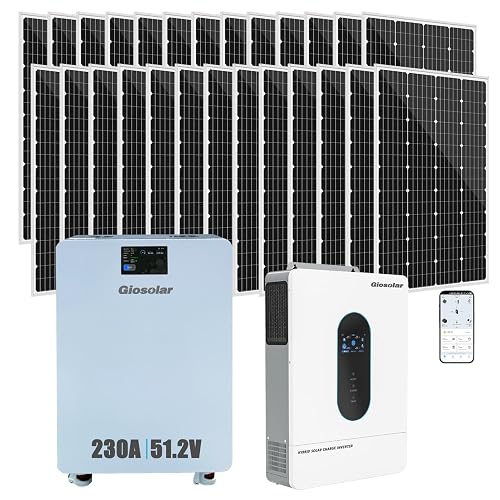 Best for high-capacity hybrid backup12000W Solar Power System Kit: 12KW 48V Split Phase Hybrid Solar InverView on Amazon
Our Top Picks
| Product | Best for | Key feature |
|---|---|---|
| SUNGOLDPOWER 6500W Kit | Overall AC coverage | 6500W inverter, 100Ah battery |
| ECO-WORTHY 10KW Whole House Kit | Whole-house cooling | 10kW split-phase, 16kWh storage |
| ECO-WORTHY 10KW with 10.24kWh Battery | Larger battery reserve | 2340W panels, 9.36kWh |
| ECO-WORTHY 10KW Custom Kit | Customizable sizing | 4x590W panels, 314Ah battery |
| ECO-WORTHY 800W Kit | Small or RV-scale loads | 60A MPPT, 2000W inverter |
| 12000W Hybrid Solar Kit | High-capacity backup | Dual 200A MPPT, 12kWh battery |
SUNGOLDPOWER 6500W Off Grid System Complete Solar Kit
SUNGOLDPOWER 6500W Off Grid System Complete Solar Kit, 1 * 6500W 120/240Vac Solar Inverter UL1741+6 * 370W Mono Solar Panels + 1 * 100Ah 51.2V Lifepo4 Battery UL1973, for House Storage (SGM-655M)
Best for: Overall AC coverage in a single-room or small-home setup.
This kit suits homeowners who want a balanced package with a 6500W inverter and six 370W panels, enough to start a typical mini-split or window unit.
Pros
- 6500W inverter output handles common AC start-up surges.
- Includes a 51.2V LiFePO4 battery for steady overnight runtime.
Cons
- A single 100Ah battery limits runtime on hot, cloudy days.
Whole House System: 10KW Split Phase Solar Inverter Off-Grid Kit
Whole House System:10KW 120V/240V Split Phase Solar Inverter| 48V 314Ah 16kWh High Capacity Energy Storage| 2950W Solar Panel ECO WORTHY 10000W Output Complete Off-Grid Solar Panel Kit for Home
Best for: Whole-house cooling with central air.
Designed for homes that run central AC alongside appliances, this kit pairs a 10kW split-phase inverter with 16kWh of storage.
Pros
- Split-phase 120V/240V output matches standard US home wiring.
- 16kWh battery bank supports longer cooling cycles.
Cons
- Installation typically requires a licensed electrician for the service panel tie-in.
Solar Panel Kit: 12PCS 195W Panels with 10KW Inverter and 9.36kWh Storage
Solar Panel Kit:12PCS 195W Solar Panels(2340W)+2PCS 48V 100AH Cubix Lithium Battery(10.24kWh)+10KW Solar Inverter 120V/240V ECO-WORTHY 10KW Output 9.36KWH Off Grid Solar System Complete Kit for Home
Best for: Larger battery reserve for extended AC use.
Owners who want more stored energy for evening cooling will find the two-battery layout useful for longer runtime.
Pros
- Two 48V batteries provide about 10.24kWh combined capacity.
- 2340W array gives solid daytime recharge for typical loads.
Cons
- Array size may be tight for high-wattage central AC in winter.
Standard: 4x590W Solar Panels with 48V 10kW Inverter and 314Ah Battery
Standard: 4x590W Solar Panels+48V 10kW Inverter +48V 314AH Battery+Cable. Customize the System to Fit Your Needs. ECO-WORTHY 10KW Output Off Grid Solar System Complete Kit& Custom 48V 314Ah
Best for: Customizable sizing around your AC load.
This kit is built around a 314Ah battery and 590W panels, letting you adjust configuration to match a specific compressor.
Pros
- Panel and battery options can be adjusted to your load.
- Large 314Ah battery supports sustained cooling.
Cons
- Customization means more planning work before ordering.
Solar Panel Kit: 4PCS 195W Bifacial Panels with 2000W Inverter and 60A MPPT
4PCS N-Type Bifacial 195W Solar Panel+12.8V 314Ah Lithium Battery+60A MPPT Charge Controller+2000W Pure Sine Wave Inverter ECO-WORTHY 800W Off Grid Solar System Complete Kit for RV Off Grid
Best for: Small or RV-scale loads such as a window unit.
A good match for a cabin, shed or RV where the AC is a smaller unit rather than central cooling.
Pros
- Pure sine wave 2000W inverter is suitable for many compressor motors.
- Compact footprint for limited installation space.
Cons
- Not sized for whole-house central AC.
Buying Guide
Surge Capacity and Inverter Rating
Air conditioners draw several times their running wattage for a moment when the compressor starts. Choose an inverter whose continuous rating comfortably exceeds the AC unit’s running load, and confirm it can handle the starting surge listed in the AC nameplate or manual.
Split-phase 120V/240V inverters are the standard for central air in North American homes, while smaller 120V-only units suit window or mini-split units. Match the voltage to your equipment before you compare anything else.
Battery Capacity and Runtime
Battery kilowatt-hours determine how long cooling can run without sunshine. Estimate your AC’s hourly consumption, multiply by the hours you want covered, and add a margin for cloudy days and nighttime use.
Lithium iron phosphate (LiFePO4) batteries generally offer longer cycle life and deeper usable depth of discharge than older lead-acid options, which makes them a common choice for daily cycling.
Solar Array Size and Daily Production
Panel wattage needs to be large enough to recharge the battery during the day while also powering the AC directly. Consider your location’s peak sun hours, since a system that works well in the Southwest may underperform in the Pacific Northwest.
Roof space, panel orientation, and shading also affect real-world output. Bifacial and higher-wattage panels can help when space is limited.
Expandability and Compatibility
Some kits can be expanded with additional batteries or panels as your cooling needs grow. Check whether the inverter and charge controller support those additions and whether the battery chemistry is compatible.
Look at included wiring, mounting hardware, and monitoring options. Built-in WiFi or app monitoring makes it easier to track state of charge during hot afternoons.
Installation Requirements and Local Codes
Complete kits still require proper wiring, grounding, and in many areas a licensed electrician and permit. Check local interconnection and building code rules before purchase, especially if you plan to run the system as your primary power source.
Factor in the cost of professional installation when comparing kits, since a lower sticker price may not reflect the full project cost.
FAQ
Can an off grid solar system run central air conditioning?
Yes, a properly sized system with a split-phase inverter and enough battery storage can run central air. Whole-house kits are designed for this, but the runtime depends on your AC’s size, efficiency, and how many hours you need it. Reviewing your unit’s power draw before buying is the best first step.
How much battery storage do I need to run an AC overnight?
Overnight cooling usually requires several kilowatt-hours of stored energy, depending on the AC’s running wattage and hours of use. Multiply the unit’s average hourly consumption by the number of hours you need covered, then add a buffer. A larger battery bank gives more margin on cloudy days.
Do I need a generator as a backup?
A backup generator is recommended for extended periods without sunshine or during very high cooling demand. Many owners pair solar with a generator to keep batteries charged when production is low. Check whether your inverter supports generator input before you buy.
What size inverter works for a window AC unit?
A window AC typically needs far less power than central air, so a smaller 120V inverter can often handle it. Confirm the unit’s starting surge and running watts, and choose an inverter with headroom above both. Oversizing slightly is safer than running at the limit.
Is professional installation necessary?
Professional installation is strongly recommended for most systems, particularly whole-house kits that connect to your electrical panel. Local codes often require permits and licensed work for grid-adjacent or high-voltage installations. Professional setup also helps ensure proper grounding and safety.
Conclusion
If you want a balanced kit for a typical home with central air, a whole-house split-phase system with a larger battery bank is the better fit. Those with smaller cooling needs, such as a window unit or a single room, may find a more compact kit covers their load at a lower cost.
Before deciding, measure your AC’s running and surge wattage, estimate your daily runtime, and check your local sun exposure. Matching those numbers to a kit’s inverter, battery, and panel specs will do more for your results than any single feature.
Related reading
- Off-Grid, Backup and Hybrid Solar Systems: How They Differ
- Wiring Diagram for Off-Grid Solar System: A Step-by-Step Guide
- Wind Solar Hybrid Off Grid System: How to Size and Wire One
- Whole House Off-Grid Solar System: Sizing Steps and Parts for Your Home
- What Is Needed for Off-Grid Solar System: A Step-by-Step Parts Checklist
- What Is Meant by Off Grid Solar System? A Plain-English Answer
- What Do I Need for Off-Grid Solar System: A Step-by-Step Parts Guide
- V Guard Off Grid Solar System: Sizing, Parts and Wiring Guide (2026)
About Ethan Brooks
Ethan Brooks is part of our editorial team and reviews and edits our DIY solar power systems guides, checking product details against manufacturer specifications and owner feedback.


