 By Ethan Brooks
Updated November 2026
Choosing a simple solar power system for an off-grid cabin means balancing daily energy needs, battery capacity, and how much installation work you want to do yourself. The picks below were selected by reviewing product listings, manufacturer specifications, brand reputation, and patterns in owner feedback. We did not test these products ourselves, and figures come from what manufacturers specify.
Our top picks at a glance
- 1
 TOP CHOICEBest overall480W Solar Panel Kit with 100Ah LiFePO4 Battery and 1000W Inverter, 12View on Amazon
- 2
 TOP CHOICEBest for learning the designThe DIY Off Grid Solar Power Bible: [10 in 1] The Most Complete and UpView on Amazon
- 3
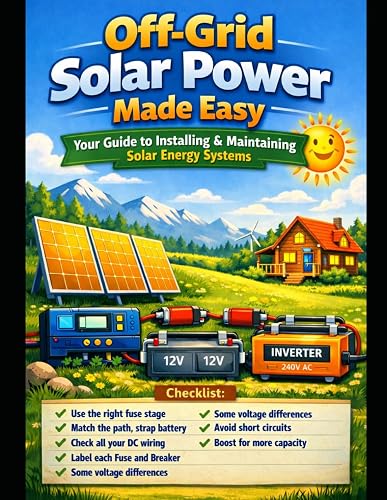 TOP CHOICEBest for a step-by-step buildOff Grid Solar Power Made Easy: Build Your Own Off-Grid Solar SystemView on Amazon
- 4
 Best for expanding laterComplete Solar Inverter Kit 4000W/6000W Inverter with 100W Panels & 50View on Amazon
- 5
 Best for larger loadsECO-WORTHY 10KW Output Off Grid Solar System Complete KitView on Amazon
Our Top Picks
Quick Comparison
| Product | Best for | Key feature |
|---|---|---|
| 480W Solar Panel Kit with 100Ah LiFePO4 Battery | Small cabins and weekend use | Complete 12V kit |
| The DIY Off Grid Solar Power Bible | Planning and self-education | Design and maintenance guide |
| Off Grid Solar Power Made Easy | First-time builders | Step-by-step build guide |
| Complete Solar Inverter Kit 4000W/6000W | Backup power and room to grow | Inverter with 50A controller |
| ECO-WORTHY 10KW Off Grid Solar System Kit | Larger cabins with heavy loads | 10KW split-phase output |
480W Solar Panel Kit with 100Ah LiFePO4 Battery and 1000W Inverter, 12V Complete Off-Grid Solar Power System
480W Solar Panel Kit with 100Ah LiFePO4 Battery and 1000W Inverter, 12V Complete Off-Grid Solar Power System: 4×120W Solar Panels + 40A MPPT Controller + Pure Sine Wave Inverter for RV Cabin Shed
Best for: Small cabins with modest daily loads and a simple, all-in-one setup.
This kit suits someone who wants a single box of components rather than sourcing each part separately. Manufacturers specify four 120W panels, a 40A MPPT controller, a 100Ah LiFePO4 battery, and a 1000W pure sine wave inverter.
Pros If you want more background, see 3 Best Solar Power Well Pump Systems for Off-Grid Use (2026).
- Components are matched to one another at a 12V system voltage.
- LiFePO4 chemistry is generally specified for longer cycle life than lead-acid.
Cons
- A 100Ah battery holds roughly 1.2 kWh, which limits runtime for heavier loads.
The DIY Off Grid Solar Power Bible: Complete Guide to Design, Install, and Maintain Solar Energy Systems
The DIY Off Grid Solar Power Bible: [10 in 1] The Most Complete and Updated Guide to Design, Install, and Maintain Solar Energy Systems for Tiny Homes, Cabins, Rvs, and Boats
Best for: Learning how to size and wire a system before buying hardware.
This book fits readers who want to understand the math behind panel wattage, battery bank size, and wire gauge. It covers tiny homes, cabins, RVs, and boats.
Pros
- Covers design, installation, and maintenance in one volume.
- Useful reference regardless of which hardware you choose.
Cons
- It is a guide, so you still need to buy components separately.
Off Grid Solar Power Made Easy: Build Your Own Off-Grid Solar System
off grid solar power made easy: Build Your Own Off-Grid Solar System (Step-by-Step for Homes & Cabins)
Best for: First-time builders who want a structured, step-by-step path.
This title suits readers who prefer a guided process over reference-style charts. It is aimed at homes and cabins alike.
Pros
- Organized as a sequence, which helps beginners avoid skipping steps.
- Focuses on practical builds rather than theory alone.
Cons
- Less depth on advanced sizing than a full design reference.
Complete Solar Inverter Kit 4000W/6000W Inverter with 100W Panels and 50A Charge Controller
Complete Solar Inverter Kit 4000W/6000W Inverter with 100W Panels & 50A Charge Controller, Off-Grid Power System for Home Backup, RV, Cabin, Outdoor Energy Use(6000W,12V-220V)
Best for: Backup power and cabins that may need more capacity later.
This kit targets people who want an inverter sized for appliances like power tools or a small refrigerator, paired with a modest panel array. The 6000W rating is the inverter’s maximum; continuous output depends on your battery bank and wiring.
Pros
- Inverter capacity leaves headroom for intermittent loads.
- Includes controller and panels in one package.
Cons
- Panel wattage is modest, so sunny-day charging may be slow in winter.
ECO-WORTHY 10KW Output Off Grid Solar System Complete Kit
ECO-WORTHY 10KW Output Off Grid Solar System Complete Kit:10KW 120V/240V Output Split Phase Inverter| 4Pcs 48V 100Ah 20.48kWh High Capacity Energy Storage| 5310 Watts Solar Panel PV
Best for: Larger cabins with heavier loads and split-phase 120V/240V needs.
This system is for owners whose cabin uses electric heat, a well pump, or a full kitchen. It is considerably larger than a simple cabin setup and may exceed what a first-timer should wire alone.
Pros
- Split-phase output supports 240V appliances.
- Battery storage is specified at roughly 20 kWh.
Cons
- Oversized for most small cabins and harder to install without experience.
Buying Guide
Estimate Your Daily Energy Use
List every device and multiply its wattage by hours of daily use to get watt-hours. A cabin with LED lights, a fan, and a phone charger often needs only a few hundred watt-hours per day.
Match Battery Size to Autonomy
Plan for two to three days of storage if your location gets cloudy stretches. Divide daily watt-hours by battery voltage, then add margin for depth of discharge.
FAQ
How much solar power does an off-grid cabin need?
The right size depends on your daily energy use, measured in watt-hours, along with how many sunny hours your location gets. Start by listing the appliances you plan to run and how long each one operates per day, then add a margin for cloudy days.
Is a lithium battery better than lead-acid for a cabin?
Lithium iron phosphate (LiFePO4) batteries generally offer a longer lifespan, deeper usable capacity, and lower maintenance than traditional lead-acid batteries. They cost more upfront, but many cabin owners find the longer service life makes them worthwhile over time.
Can I install an off-grid solar system myself?
Many people with basic electrical knowledge can handle a small kit, especially one designed for plug-and-play setup. Larger systems involving higher voltages, split-phase output, or permanent wiring may require a licensed electrician, and local codes often apply.
Do I need a charge controller and an inverter?
Yes, in most cases. A charge controller regulates the flow of power from the panels into the battery so it isn’t overcharged, while an inverter converts stored DC power from the battery into the AC power most household appliances use.
How long will the battery last during cloudy weather?
Battery autonomy, or how many days the system can run without sun, depends on total battery capacity and how much energy you draw each day. Sizing the battery to cover at least one to two days of typical use is a common approach for cabins in variable climates.
Should I add a backup generator?
A small backup generator is a useful safety net for long stretches of overcast weather or periods of high demand. It can be paired with most systems so the battery stays healthy when solar production falls short.
Conclusion
If you want a compact, low-cost starting point for a small cabin or weekend getaway, a smaller all-in-one kit with a modest battery is the simplest route. If you run more appliances or want room to grow, a larger system with higher inverter output and more storage will serve you better.
Owners who prefer to learn and build the system themselves may get the most value from a guide-style resource paired with a mid-sized kit. Those who want maximum power for a full-time off-grid home should look at the larger split-phase systems, ideally with help from a qualified installer.
Related reading
- 6 Best Off Grid Cabin Solar Power System Options for 2026
- Top 5 Solar Panel Systems for Off Grid Cabin Kits Compared (2026)
- Top 5 DIY Home Solar Power System Options for Off-Grid Homes
- Off-Grid Solar Power System Diagram: A Step-by-Step Layout for DIY Builders
- Off-Grid Solar Power System Calculator: How to Size Your Setup Step-by-Step
- Off Grid Solar System for Small Cabin: 5 Best Picks Compared (2026)
About Ethan Brooks
Ethan Brooks is part of our editorial team and reviews and edits our DIY solar power systems guides, checking product details against manufacturer specifications and owner feedback.


