By Claire Whitaker
Updated November 2026
Choosing a solar kit with inverter comes down to three things: how many watts your loads draw, how much battery storage you need between sunny hours, and whether the inverter’s output matches what you plan to run. This list compares seven kits by use case, from small RV and cabin setups to whole-house off-grid systems. Each pick is based on product listings, manufacturer specifications and common owner feedback patterns. We have not tested these kits ourselves.
Our top picks at a glance
- 1
 TOP CHOICEBest overallECO-WORTHY 10KW Output Off Grid Solar System Complete KitView on Amazon
- 2
 TOP CHOICEBest for whole-house backupWhole House System 10KW 120V/240V Split Phase Solar Inverter KitView on Amazon
- 3
 TOP CHOICEBest for RV and camper starter useECO-WORTHY 200 Watt 12V Complete Solar Panel Starter KitView on Amazon
- 4
 Best for cabins and sheds1280WH Complete Off-Grid Solar Panel Kit with 1000W Pure Sine Wave InverterView on Amazon
- 5
 Best for higher inverter outputComplete Solar Inverter Kit 4000W/6000W Inverter with 100W Panels & 50View on Amazon
- 6
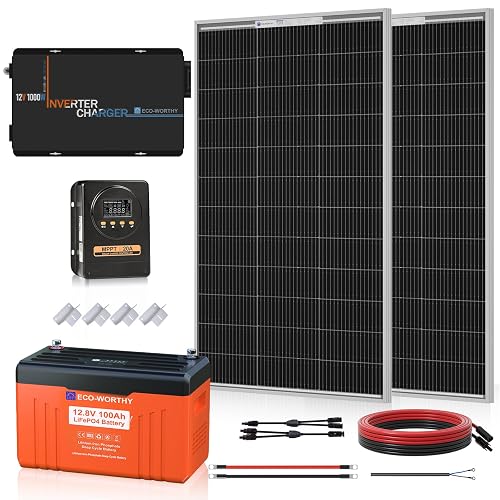 Best for Bluetooth monitoring2 PCS 100W Solar Panel,12V 100Ah Lithium Battery,Upgrade 2000W 12V InvView on Amazon
- 7
 Best for basic panel-and-controller setupsECO-WORTHY 200 Watts 12 Volt/24 Volt Solar Panel Kit with High EfficieView on Amazon
Our Top Picks
Quick Comparison
| Product | Best for | Key feature |
|---|---|---|
| ECO-WORTHY 10KW Output Off Grid Solar System Complete Kit | Large off-grid homes | 10KW split-phase inverter |
| Whole House System 10KW Solar Inverter Kit | Whole-house backup | 48V 16kWh storage |
| ECO-WORTHY 200 Watt 12V Solar Panel Starter Kit | RV and camper starter use | Includes 100Ah lithium battery |
| 1280WH Complete Off-Grid Solar Panel Kit | Cabins and sheds | 1000W pure sine wave inverter |
| Complete Solar Inverter Kit 4000W/6000W | Higher inverter output | Selectable 4000W or 6000W inverter |
| 2 PCS 100W Solar Panel with Battery and Inverter Kit | Bluetooth monitoring | 20A MPPT controller with Bluetooth |
| ECO-WORTHY 200 Watts 12V/24V Solar Panel Kit | Basic panel and controller setups | 30A PWM charge controller |
ECO-WORTHY 10KW Output Off Grid Solar System Complete Kit
ECO-WORTHY 10KW Output Off Grid Solar System Complete Kit:10KW 120V/240V Output Split Phase Inverter| 4Pcs 48V 100Ah 20.48kWh High Capacity Energy Storage| 5310 Watts Solar Panel PV
7 Best Small Solar Panel Kits with Battery and Inverter Picks for 2026 goes further into this.
Best for: Large off-grid homes that need split-phase 120V/240V power.
This kit suits homeowners planning a full off-grid installation who want high inverter capacity and expandable storage. Owners often report it is a larger undertaking than a small kit, so plan wiring and permits carefully.
Pros
- 10KW split-phase output for 120V and 240V loads
- Large 20.48kWh battery capacity
Cons
- Requires significant installation planning
Whole House System 10KW 120V/240V Split Phase Solar Inverter Kit
Whole House System:10KW 120V/240V Split Phase Solar Inverter| 48V 314Ah 16kWh High Capacity Energy Storage| 2950W Solar Panel ECO WORTHY 10000W Output Complete Off-Grid Solar Panel Kit for Home
Best for: Whole-house backup during outages.
Best suited to households that want to keep most circuits running during grid outages. Manufacturers specify a 48V 314Ah battery bank, so check that your electrical panel and load calculations match.
Pros
- 16kWh storage supports extended backup
- Split-phase output matches standard US service
Cons
- Heavy battery bank needs a dedicated mounting location
ECO-WORTHY 200 Watt 12V Complete Solar Panel Starter Kit
with Battery and Inverter: 2*100W Solar Panel + 30A Charge Controller + 100Ah Lithium Battery + 1100W Premium Solar Inverter ECO-WORTHY 200 Watt 12V Complete Solar Panel Starter Kit for RV Off Grid
Best for: RV and camper starter use.
A good fit for someone building a 12V system for lights, fans and phone charging without a large investment in infrastructure. Listings show a 1100W inverter, so keep simultaneous loads well under that figure.
Pros
- Includes panels, controller, battery and inverter
- Simple 12V layout suits mobile setups
Cons
- Limited capacity for high-draw appliances
1280WH Complete Off-Grid Solar Panel Kit with 1000W Pure Sine Wave Inverter
1280WH Complete Off-Grid Solar Panel Kit with 1000W Pure Sine Wave Inverter, 20A MPPT Controller & 100Ah 12.8V Battery, 2×120W Monocrystalline Solar Panels for RV Boat Cabin Shed Home Backup
Best for: Cabins, sheds and small backup loads.
This kit is aimed at users who want a pure sine wave inverter suitable for sensitive electronics and a moderate battery bank. Manufacturers list 1280Wh of storage, which covers modest daily loads when panels are sized correctly.
Pros
- Pure sine wave output for sensitive electronics
- Includes MPPT controller for better panel efficiency
Cons
- 1000W inverter limits large appliance use
Buying Guide
Match the inverter output to your running loads
Add up the wattage of everything you plan to run at the same time, then choose an inverter with continuous output comfortably above that total. Pay attention to surge capacity as well, since motors and compressors draw a brief spike when they start. A kit that looks powerful on paper can still trip if a single appliance pushes past its rating.
Check battery capacity and voltage compatibility
Battery capacity determines how long your system can run overnight or during cloudy days, while system voltage must match the inverter and charge controller. Smaller kits often use 12V batteries, while larger home systems typically use 48V. Mixing voltages or components not designed for each other is a common and costly mistake.
Confirm solar array size and charge controller type
The solar panel wattage should be large enough to recharge the battery within a typical day of sunlight. MPPT charge controllers generally extract more energy from panels than PWM controllers, especially when panel voltage is higher than battery voltage. Make sure the controller’s current rating can handle the panel array you choose.
Consider the waveform and intended use
Pure sine wave inverters produce clean power that suits sensitive electronics, medical devices and most household appliances. Modified sine wave units cost less but can cause problems with some equipment. Also consider whether you need split-phase 120V/240V output for a home, or simple 120V output for a cabin, RV or shed.
FAQ
Can a solar kit with inverter power my whole house?
Some larger kits are designed for whole-house backup, but this depends on your home’s total electrical demand and how many appliances you need running at once. Heating, cooling and electric cooking loads are usually the biggest factors. Calculating your daily energy use in kilowatt-hours is the best way to know whether a kit will be enough.
How long will a battery run my appliances?
Runtime is roughly the battery’s usable energy divided by the load you are drawing, and real results are lower because of inverter losses and battery depth-of-discharge limits. Running a smaller load like lights and a fridge will last far longer than running a space heater. Plan for a margin rather than relying on the best-case number.
Do I need a separate charge controller if the kit includes an inverter?
Most complete kits include a charge controller that regulates power from the panels to the battery, and this is essential for battery health. Some all-in-one units combine the inverter and charger, but the controller is still a separate function. Always confirm the kit includes one before you buy.
Are these kits suitable for RVs and boats?
Smaller 12V kits are commonly used in RVs, campers, caravans and cabins because they are compact and match vehicle electrical systems. Boat use can work, but you should consider marine conditions, mounting, and corrosion protection. Verify the kit’s weight, dimensions and ventilation needs before installing it in a mobile setting.
Conclusion
For a small RV, camper or weekend cabin with modest needs, a 12V starter kit with a smaller inverter and battery is usually the most practical and affordable choice. For a shed, workshop or off-grid cabin running more appliances, a mid-sized 12V or 24V kit with a 1000W to 2000W inverter offers a good balance of capacity and cost.
For full-home backup or true off-grid living, a high-capacity 48V system with a split-phase 120V/240V inverter and substantial battery storage is the right fit, though it requires careful sizing and professional installation. Start with your daily energy needs, then choose the kit whose inverter, battery and solar array meet that demand with some room to spare.
Related reading
- 7 Best Solar Panels and Inverter Kits for Off-Grid Homes (2026)
- 7 Best Off Grid Solar Panel Kits with Battery and Inverter for Homes (2026)
- 7 Best Off Grid Solar Inverters with Battery Kits for Homes (2026)
- 7 Best 400 Watt Solar Panel Kits with Battery and Inverter for Home and RV (2026)
- 6 Best Solar Panels with AC Inverter Kits for Home and Off-Grid Use
- 6 Best Solar Panel Kits with Battery and Inverter Options for Off-Grid Use (2026)
About Claire Whitaker
Claire Whitaker is part of our editorial team and reviews and edits our DIY solar power systems guides, checking product details against manufacturer specifications and owner feedback.