 By Ethan Brooks
Updated November 2026
Shopping for a 200w off grid solar system usually means balancing panel wattage, charge controller type, battery capacity and how much you plan to run. This list covers kits that suit RVs, small cabins, boats and light backup use. Selection criteria were product listing specifications, brand reputation and common owner feedback patterns, with a focus on what each kit includes and what it can realistically power.
Our top picks at a glance
- 1
 TOP CHOICEBest overallRenogy 200W 12V Monocrystalline Solar Panel KitView on Amazon
- 2
 TOP CHOICEBest for 24V battery banks200 Watt 12Volt/24Volt Solar Panel Starter KitView on Amazon
- 3
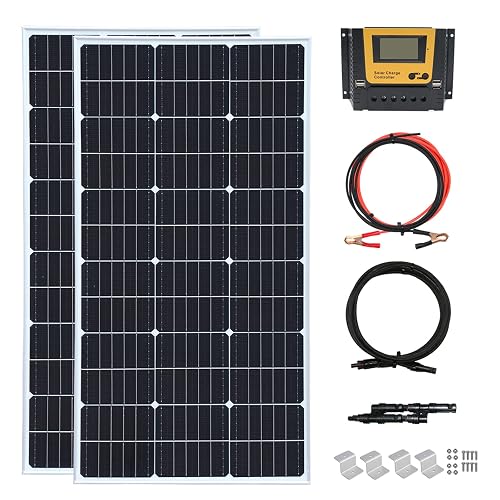 TOP CHOICEBest for boats and marine use2x 100W Monocrystalline Module KitView on Amazon
- 4
 Best for a small step up in powerSUNGOLDPOWER 3000W 24V Off Grid System Solar KitView on Amazon
- 5
 Best for a 48V home setupSUNGOLDPOWER 5000W 48V Off Grid System Complete Solar KitView on Amazon
- 6
 Best for whole-home scaleECO-WORTHY 10KW Output Off Grid Solar System Complete KitView on Amazon
Our Top Picks
| Product | Best for | Key feature |
|---|---|---|
| Renogy 200W 12V Monocrystalline Solar Panel Kit | Overall starter use | 30A PWM controller included |
| 200 Watt 12Volt/24Volt Solar Panel Starter Kit | 24V battery banks | 20A charge controller |
| 2x 100W Monocrystalline Module Kit | Boats and marine use | Two-panel modular layout |
| SUNGOLDPOWER 3000W 24V Off Grid System Solar Kit | Small cabin step-up | 3000W inverter with batteries |
| SUNGOLDPOWER 5000W 48V Off Grid System Complete Solar Kit | 48V home setup | 5000W inverter with LiFePO4 |
| ECO-WORTHY 10KW Output Off Grid Solar System Complete Kit | Whole-home scale | Split-phase 120V/240V output |
Renogy 200W 12V Monocrystalline Solar Panel Kit
200W 12V Monocrystalline solar starter kit with 2Pcs 100W panels & 30A PWM controller for RV, Boats, Camper,Off-Grid System Renogy 200W 12V Monocrystalline Solar Panel Kit + 30A PWM Charge Controller
Best for: Overall starter use
This kit suits RV and camper owners who want a simple 12V system to keep a small battery topped up.
Pros
- Pairs two 100W panels with a 30A PWM controller
- Well-known brand with widely available replacement parts
Cons
- PWM control gives less harvest than MPPT in cold or low light
200 Watt 12Volt/24Volt Solar Panel Starter Kit
2PCS 105W Monocrystalline Module 20A Charge Controller for RV, Boats, Trailer, Camper,Cabin Off-Grid System(200W Solar kit) 200 Watt 12Volt/24Volt Solar Panel Starter Kit
Best for: 24V battery banks
A good match for cabin owners running a 24V battery bank who want a compact starter array.
Pros
- Works with both 12V and 24V system voltages
- 20A controller sized for the 200W array
Cons
- Limited headroom if you later add panels
2x 100W Monocrystalline Module Kit
2x 100W Monocrystalline Module,20A Charge Controller for RV, Boats, Trailer, Camper,Off-Grid System (200W solar kit) 200 Watt 12Volt/24Volt Solar Panel Kit for RV Home Boat Camper
Best for: Boats and marine use
Fits owners of boats, trailers and small campers who need flexible panel placement on a curved or limited roof.
Pros
- Two separate panels make mounting easier on uneven surfaces
- Includes a 20A charge controller for 12V or 24V use
Cons
- Owners report that mounting hardware is sold separately
SUNGOLDPOWER 3000W 24V Off Grid System Solar Kit
SUNGOLDPOWER 3000W 24V Off Grid System Solar Kit Complete,1 * 3000W 120Vac Solar Inverter+4 * 200W Solar Panels+2pcs 24V 100Ah LifePO4 Battery,for RV,House Storage, Farm,Off Grid System
Best for: Small cabin step-up
Aimed at owners who have outgrown a 200W array and want a complete inverter and battery package for a small cabin or farm shed.
Pros
- Bundles a 3000W 120V inverter with panels and batteries
- Includes two 24V 100Ah LiFePO4 batteries
Cons
- Four 200W panels may be short for heavy daily loads
SUNGOLDPOWER 5000W 48V Off Grid System Complete Solar Kit
SUNGOLDPOWER 5000W 48V Off Grid System Complete Solar Kit,1 * 5000W 120Vac Solar Inverter UL1741+6 * 200W Mono Solar Panels +1 * 100Ah 51.2V Lifepo4 Battery UL1973, for House Storage (SGM-5K5E)
Best for: 48V home setup
Suits homeowners building a modest off-grid home system who want a 48V architecture with more headroom.
Pros
- Six 200W panels give more daily harvest than a 200W kit
- 48V LiFePO4 battery supports higher inverter loads
Cons
- A single battery means limited storage for longer cloudy spells
ECO-WORTHY 10KW Output Off Grid Solar System Complete Kit
ECO-WORTHY 10KW Output Off Grid Solar System Complete Kit:10KW 120V/240V Output Split Phase Inverter| 4Pcs 48V 100Ah 20.48kWh High Capacity Energy Storage| 5310 Watts Solar Panel PV
Best for: Whole-home scale
For owners who need split-phase 120V/240V output for a full house, well pump and major appliances.
Pros
- Split-phase output supports 240V appliances
- Four 48V batteries provide about 20 kWh of storage
Cons
- Far beyond a true 200W system, so it suits only larger budgets for planning
Buying Guide
Panel Wattage and Your Daily Energy Needs
A 200W panel array produces roughly what its rating suggests only under good sun, so the real daily output depends on your location, season and how many hours of usable sunlight you get. Add up the watt-hours your appliances use each day and compare that to what the panels can realistically produce. If your needs are modest, such as lights, a fan, a phone charger and a small fridge, a 200W kit may be enough. Heavier loads like air conditioning or power tools will need far more capacity.
Battery Type and Capacity
Battery choice affects both lifespan and how much energy you can actually use. LiFePO4 batteries generally offer longer cycle life and deeper usable discharge than lead-acid options, though they cost more upfront. Check the amp-hour rating and voltage, and make sure the battery matches the system voltage of the kit you choose.
Charge Controller Type
The charge controller regulates power from the panels into the battery. PWM controllers are simpler and less expensive but are typically best suited to smaller arrays, while MPPT controllers can harvest more energy, especially in cooler weather or when panel voltage is higher than battery voltage. Match the controller’s amp rating to your panel wattage and battery voltage so the system runs safely.
Inverter Output and Surge Capacity
If you plan to run standard household appliances, you need an inverter that converts battery DC power to 120V AC. Pay attention to both continuous wattage and surge capacity, since motors and compressors draw extra power when they start. An inverter that is too small for your loads will shut down or fail to start them.
Expandability and Installation Effort
Think about whether you may want to add panels or batteries later. Some kits are designed to grow with your needs, while others are closed systems. Also consider how much wiring and mounting work you are comfortable doing yourself, and whether the kit includes the cables, fuses and mounting hardware you will need.
FAQ
Can a 200W off grid solar system run a refrigerator?
A small, efficient refrigerator may be possible with a 200W array and a suitable battery, but results depend heavily on sunlight and the fridge’s energy use. Compression fridges cycle on and off, so their daily consumption can vary a lot. Checking the appliance’s energy rating and planning for some backup charging is a sensible approach.
What is the difference between 12V and 24V systems?
A 24V system carries the same power at lower current, which can reduce wire losses and allow thinner cables over longer runs. 12V systems are common in small RVs and boats and work well with many small appliances. Choose the voltage that matches your battery bank and the equipment you plan to use.
Do I need an MPPT or PWM charge controller?
PWM controllers are adequate for many small setups where panel voltage is close to battery voltage. MPPT controllers are generally more efficient, particularly when panels are wired for higher voltage or when conditions are cool and bright. The right choice depends on your budget and how much harvest you need from the array.
How long will a 200W kit take to charge the battery?
Charge time depends on battery size, panel output, weather and the controller in use. On a clear day with good sun, a small battery can recharge within a few hours of strong sunlight, while cloudy conditions can extend that considerably. Monitoring the battery’s state of charge helps you learn how your system behaves in your location.
Is a kit suitable for permanent installation in a cabin?
Many people use these kits in cabins, but permanent installations should follow local electrical codes and, where appropriate, involve a qualified installer. Proper grounding, overcurrent protection and correct cable sizing are important for safety. Review the manufacturer’s manuals before mounting and wiring anything.
Can I add more panels or batteries later?
Some kits support expansion, but you need to confirm that the charge controller, inverter and battery bank can handle the additional capacity. Mixing components with different voltages or chemistries can cause problems. Check the specifications before planning an upgrade.
Conclusion
If you want a simple, capable setup for an RV, boat or small cabin with modest loads, a 200W kit with a 12V or 24V battery and a suitable controller is a practical starting point. Choose the option whose voltage, controller and included components best match your current appliances and your plans for future expansion.
For larger homes, farms or heavier daily use, the bigger inverter and battery kits in this list are better suited to the job, while the smaller starter kits fit people who need only light, occasional power. Match the system to your real energy budget, and you will get the most value from whichever kit you choose.
Related reading
- Wiring Diagram for Off-Grid Solar System: A Step-by-Step Guide
- Wind Solar Hybrid Off Grid System: How to Size and Wire One
- Whole House Off-Grid Solar System: Sizing Steps and Parts for Your Home
About Ethan Brooks
Ethan Brooks is part of our editorial team and reviews and edits our DIY solar power systems guides, checking product details against manufacturer specifications and owner feedback.



