 By Ethan Brooks
Updated November 2026
Shopping for an off grid solar EV charging system means balancing panel wattage, battery capacity, inverter output and how many miles you need to add each day. The six kits below were compared on the criteria that matter most for home charging: total solar array size, storage capacity, inverter output suitable for a Level 2 charger, expandability, and the consistency of owner feedback about setup and performance. Read the specifications carefully, because a kit that powers lights and appliances may not carry a typical EV charger for long.
Our top picks at a glance
- 1
 TOP CHOICEBest overallECO-WORTHY 10KW Output Off Grid Solar System Complete KitView on Amazon
- 2
 TOP CHOICEBest for high-capacity expansionSolar Panel Kit 9.36KWH Off Grid System for HomeView on Amazon
- 3
 TOP CHOICEBest for small-scale starter setupsSUNGOLDPOWER 3000W 24V Off Grid System Solar KitView on Amazon
- 4
 Best for mid-size homes2400W 48V Off-Grid Solar Power System KitView on Amazon
- 5
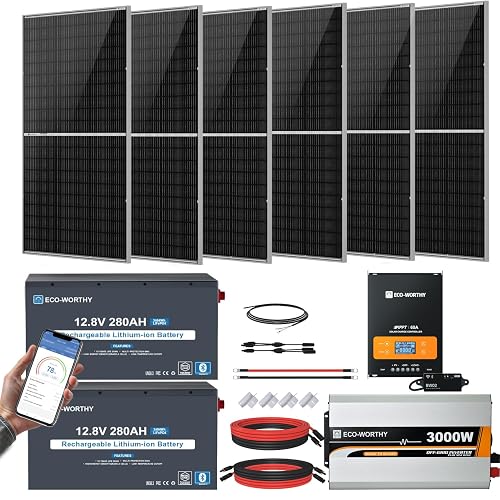 Best budget pickECO-WORTHY 1200W 24V 4.68KWH Lithium Battery Solar SystemView on Amazon
- 6
 Best for larger off-grid cabins5KWH Off-Grid Solar Power System 48V 2880WView on Amazon
Our Top Picks
Quick Comparison
| Product | Best for | Key feature |
|---|---|---|
| ECO-WORTHY 10KW Output Off Grid Solar System Complete Kit | Whole-home off-grid use with EV charging | 10kW split-phase 120V/240V inverter with 20.48kWh storage |
| Solar Panel Kit 9.36KWH Off Grid System for Home | Homes planning to expand storage over time | 2,340W panel array with 10.24kWh lithium batteries |
| SUNGOLDPOWER 3000W 24V Off Grid System Solar Kit | Smaller setups and light EV top-ups | 3000W 120Vac inverter with 24V LiFePO4 storage |
| 2400W 48V Off-Grid Solar Power System Kit | Mid-size homes with moderate daily driving | 50A MPPT charge controller and 2400W array |
| ECO-WORTHY 1200W 24V 4.68KWH Lithium Battery Solar System | Budget-conscious builders with limited roof space | 4.68kWh lithium storage with 60A MPPT controller |
| 11.5KWH Off-Grid Solar Power System 48V 2880W | Larger off-grid cabins and high-demand homes | 11.5kWh storage with 3000W inverter charger |
ECO-WORTHY 10KW Output Off Grid Solar System Complete Kit
ECO-WORTHY 10KW Output Off Grid Solar System Complete Kit:10KW 120V/240V Output Split Phase Inverter| 4Pcs 48V 100Ah 20.48kWh High Capacity Energy Storage| 5310 Watts Solar Panel PV
Best for: Whole-home off-grid use with EV charging
This kit suits homeowners who want one integrated system capable of running the house and supporting a Level 2 EV charger. The split-phase output matches standard North American residential wiring, which simplifies connecting a 240V charger.
Key specs
- 10kW output, 120V/240V split-phase inverter
- Four 48V 100Ah batteries, 20.48kWh total storage
- 5,310W solar panel array
Pros
- Split-phase output supports 240V loads directly
- Large storage capacity for overnight EV charging
- Complete kit reduces component matching work
Cons
- Heavy battery assembly requires two people
- Installation still requires careful electrical planning
Bottom line: Best suited to homeowners wanting the most capable all-in-one option for regular EV charging without grid power.
Solar Panel Kit 9.36KWH Off Grid System for Home
Solar Panel Kit:12PCS 195W Solar Panels(2340W)+2PCS 48V 100AH Cubix Lithium Battery(10.24kWh)+10KW Solar Inverter 120V/240V ECO-WORTHY 10KW Output 9.36KWH Off Grid Solar System Complete Kit for Home
Best for: Homes planning to expand storage over time
This configuration pairs twelve 195W panels with two 48V 100Ah lithium batteries and a 10kW inverter. It is a practical choice for builders who want a strong starting array and room to add batteries later.
Key specs
- 12 x 195W panels, 2,340W total array
- Two 48V 100Ah lithium batteries, 10.24kWh storage
- 10kW solar inverter, 120V/240V output
Pros
- Battery count is straightforward to expand
- Solid panel array for daytime charging
- Clear 120V/240V output for household circuits
Cons
- Storage is modest for multi-day overnight EV charging
- Panel count requires substantial roof or ground space
Bottom line: A good fit for homeowners who want to start with a balanced system and grow storage as their charging needs increase.
SUNGOLDPOWER 3000W 24V Off Grid System Solar Kit
SUNGOLDPOWER 3000W 24V Off Grid System Solar Kit Complete,1 * 3000W 120Vac Solar Inverter+4 * 200W Solar Panels+2pcs 24V 100Ah LifePO4 Battery,for RV,House Storage, Farm,Off Grid System
Best for: Smaller setups and light EV top-ups
This kit is sized for lower-demand use. A 3000W inverter and 24V battery bank can support a smaller Level 1 or low-amperage Level 2 charger, but it will not replace a full daily EV charging load.
Key specs
- 3000W 120Vac solar inverter
- Four 200W solar panels
- Two 24V 100Ah LiFePO4 batteries
Pros
- Lower-voltage battery bank is easier to handle
- Good match for RVs and small cabins
- Simpler layout for first-time builders
Cons
- Limited energy for regular full-range EV charging
- Expansion options depend on how the inverter is configured
Bottom line: Best for owners with short commutes or plug-in hybrids who want a compact, manageable starter system.
2400W 48V Off-Grid Solar Power System Kit
2400W 48V Off-Grid Solar Power System Kit – 20x 120W Monocrystalline Panels, 50A MPPT Charge Controller, 6-String PV Combiner Box for Home Energy Solutions
Best for: Mid-size homes with moderate daily driving
This kit uses twenty 120W monocrystalline panels with a 50A MPPT charge controller and a PV combiner box. It is a reasonable option for households whose EV charging is spread across the day rather than concentrated overnight.
Key specs
- 20 x 120W monocrystalline panels, 2,400W array
- 50A MPPT charge controller
- 6-string PV combiner box
Pros
- MPPT controller improves harvest in variable light
- Combiner box simplifies string wiring
- 48V architecture is standard for larger systems
Cons
- Battery storage is not included in the listing name, so verify before buying
- Requires careful string sizing to stay within controller limits
Bottom line: Suited to owners who can match storage separately and want flexibility in their panel and battery layout.
ECO-WORTHY 1200W 24V 4.68KWH Lithium Battery Solar System
6pcs 195W Solar Panels+2Pcs 12.8V 280Ah Lithium Battery+60A MPPT Charge Controller+3000W Pure Sine Wave Inverter [Ultra] ECO-WORTHY 1200W 24V 4.68KWH Lithium Battery Solar System Off Grid
Best for: Budget-conscious builders with limited roof space
This kit combines six 195W panels, two 12.8V 280Ah lithium batteries, a 60A MPPT controller and a 3000W pure sine wave inverter. It offers a balanced entry point for builders with a smaller footprint.
Key specs
- Six 195W panels
- Two 12.8V 280Ah lithium batteries, 4.68kWh storage
- 60A MPPT charge controller and 3000W pure sine wave inverter
Pros
- Pure sine wave output suits sensitive electronics
- Compact array fits smaller roofs
- Lithium storage offers good cycle life
Cons
- Storage is limited for sustained EV charging
- Likely needs supplemental generation on cloudy stretches
Bottom line: A sensible pick for owners who want to test off-grid EV charging on a modest scale before committing to a larger array.
11.5KWH Off-Grid Solar Power System 48V 2880W
11.5KWH Off-Grid Solar Power System 48V 2880W, 24x120W Solar Panels, 80A MPPT Charge Controller, 3000W LF Inverter Charger (9000W Peak), PV Combiner Box, 4x100Ah 25.6V Battery for Home Cabin
Best for: Larger off-grid cabins and high-demand homes
This is the highest-capacity option in the list, combining twenty-four 120W panels, four 100Ah 25.6V batteries and a 3000W inverter charger. It fits homes where EV charging runs alongside substantial household loads.
Key specs
- 24 x 120W panels, 2,880W array
- Four 25.6V 100Ah batteries, 11.5kWh storage
- 3000W inverter charger (9000W peak), 80A MPPT controller
Pros
- Large storage for overnight charging
- Inverter charger can accept grid or generator backup
- 80A MPPT controller handles a larger array
Cons
- Inverter output limits how fast a high-power charger can run
- Heavier installation footprint than smaller kits
Bottom line: Best for owners with larger energy needs who want substantial storage and a backup-capable inverter.
Buying Guide
Solar Array Size
Estimate your daily EV energy use first. A typical EV uses roughly 0.25 to 0.35 kWh per mile, so 40 miles a day needs about 10 to 14 kWh. Divide that by your local peak sun hours to estimate panel wattage. Five peak sun hours and 12 kWh of daily need implies roughly 2,400W of panels after losses. See Can an Off Grid Solar System Charge an EV? Sizing Math and Limits for the full calculation.
Good picks for this: Solar Panel Kit 9.36KWH Off Grid System for Home, 2400W 48V Off-Grid Solar Power System Kit
Battery Storage Capacity
Storage determines whether you can charge overnight. Check usable capacity, not just nominal capacity, and remember that lithium batteries are commonly discharged to around 80 to 90 percent depth of discharge. For planning background, see Planning an Off-Grid Solar System: 8 Steps to Size It Right.
Good picks for this: ECO-WORTHY 10KW Output Off Grid Solar System Complete Kit, 11.5KWH Off-Grid Solar Power System 48V 2880W
Inverter Output and Voltage
Most home EV chargers run on 240V. Confirm the inverter provides split-phase or 240V output, and check its continuous rating against the charger’s amperage. A 3000W inverter cannot run a 7.2kW Level 2 charger at full power, so you may need to reduce the charging rate.
Good picks for this: ECO-WORTHY 10KW Output Off Grid Solar System Complete Kit, 11.5KWH Off-Grid Solar Power System 48V 2880W
Charge Controller Type
MPPT controllers generally harvest more energy than PWM controllers, especially when panel voltage is well above battery voltage. Confirm the controller amperage can handle your array’s short-circuit current. For wiring context, see Solar Cell Off Grid System: Step-by-Step Sizing and Wiring for Beginners.
Good picks for this: 2400W 48V Off-Grid Solar Power System Kit, ECO-WORTHY 1200W 24V 4.68KWH Lithium Battery Solar System
Expandability
If you may add batteries or panels later, check whether the battery bank is parallel-compatible and whether the inverter can handle a larger array. Systems with a clear modular layout make future upgrades simpler. Compare design approaches in Solar Grid Tie System vs Off Grid: Which Should You Choose?.
Good picks for this: Solar Panel Kit 9.36KWH Off Grid System for Home, SUNGOLDPOWER 3000W 24V Off Grid System Solar Kit
Durability and Installation Environment
Check panel frame ratings, cable UV resistance and battery enclosure specifications. Outdoor battery installations should be kept within the manufacturer’s temperature range and protected from direct weather. Lithium batteries generally should not be charged below freezing unless the manufacturer states otherwise.
Good picks for this: SUNGOLDPOWER 3000W 24V Off Grid System Solar Kit, ECO-WORTHY 1200W 24V 4.68KWH Lithium Battery Solar System
Safety, Wiring and Permits
Off-grid systems involve high DC currents and, with 240V output, potentially lethal AC voltages. Local codes may require permits, grounding details and disconnects. Consult a licensed electrician or a qualified solar installer before connecting an EV charger to any battery-backed system.
Good picks for this: 11.5KWH Off-Grid Solar Power System 48V 2880W, ECO-WORTHY 10KW Output Off Grid Solar System Complete Kit
FAQ
Can an off grid solar EV charging system charge a car every night?
Yes, if storage and solar production are sized for your daily driving. A typical 40-mile daily commute may need roughly 10 to 14 kWh per day. Storage must cover overnight charging, and the array must refill the batteries the next day.
What size inverter do I need for a Level 2 EV charger?
A Level 2 charger often draws 16A to 32A at 240V, roughly 3.8kW to 7.7kW. Your inverter’s continuous output should exceed the charger’s draw, or you should set the charger to a lower amperage.
Is a 120V outlet enough to charge an EV off grid?
It can add range slowly, usually a few miles per hour depending on the vehicle and circuit. It is generally too slow for daily full charging but can help with light top-ups.
How many solar panels do I need for daily EV charging?
It depends on your daily kWh need and local peak sun hours. Divide your daily energy need by peak sun hours, then add losses of roughly 20 to 25 percent for wiring, inverter and battery efficiency.
Do I need a backup generator with an off grid solar EV charging system?
Many owners add a generator for cloudy weeks. Systems with inverter-chargers that accept generator input can make this easier. Confirm the inverter’s generator compatibility before purchase.
Does lithium battery storage work better than lead-acid for EV charging?
Lithium batteries typically offer higher usable capacity, longer cycle life and lighter weight. Lead-acid batteries cost less upfront but usually need more capacity and maintenance for the same usable energy.
Conclusion
For most homes, the ECO-WORTHY 10KW Output Off Grid Solar System Complete Kit offers the most complete split-phase setup for regular EV charging. Owners who plan to expand storage later may prefer the Solar Panel Kit 9.36KWH configuration. Smaller homes, RVs and plug-in hybrid owners may find the SUNGOLDPOWER 3000W or the 1200W ECO-WORTHY kit more manageable. Larger cabins with heavy household loads should look closely at the 11.5KWH 48V system. Whatever you choose, verify inverter output against your charger and consult a licensed electrician before installation.
Sources
- Federal guidance on residential solar energy, system components and planning considerations (energy.gov)
- Research on solar resource data, PV performance and off-grid energy modeling (nrel.gov)
- Electrical and fire safety standards relevant to residential battery and inverter installations (nfpa.org)
About Ethan Brooks
Ethan Brooks is part of our editorial team and reviews and edits our DIY solar power systems guides, checking product details against manufacturer specifications and owner feedback.



